Exam practice

IELTS Task 1 process diagram: model and practice

Write an IELTS Task 1 process diagram report on paper recycling, with a seven-stage sequence, overview planning, verb choices and a complete model.

In short

For an IELTS process diagram, give the overall route, then describe the stages in order. Use the present simple for a process shown in general, with the passive when the material receives an action: The paper is sorted. Report the steps shown; keep causes, temperatures and times tied to the diagram.

Yellow the idea to rememberBlue English to learnRed watch out

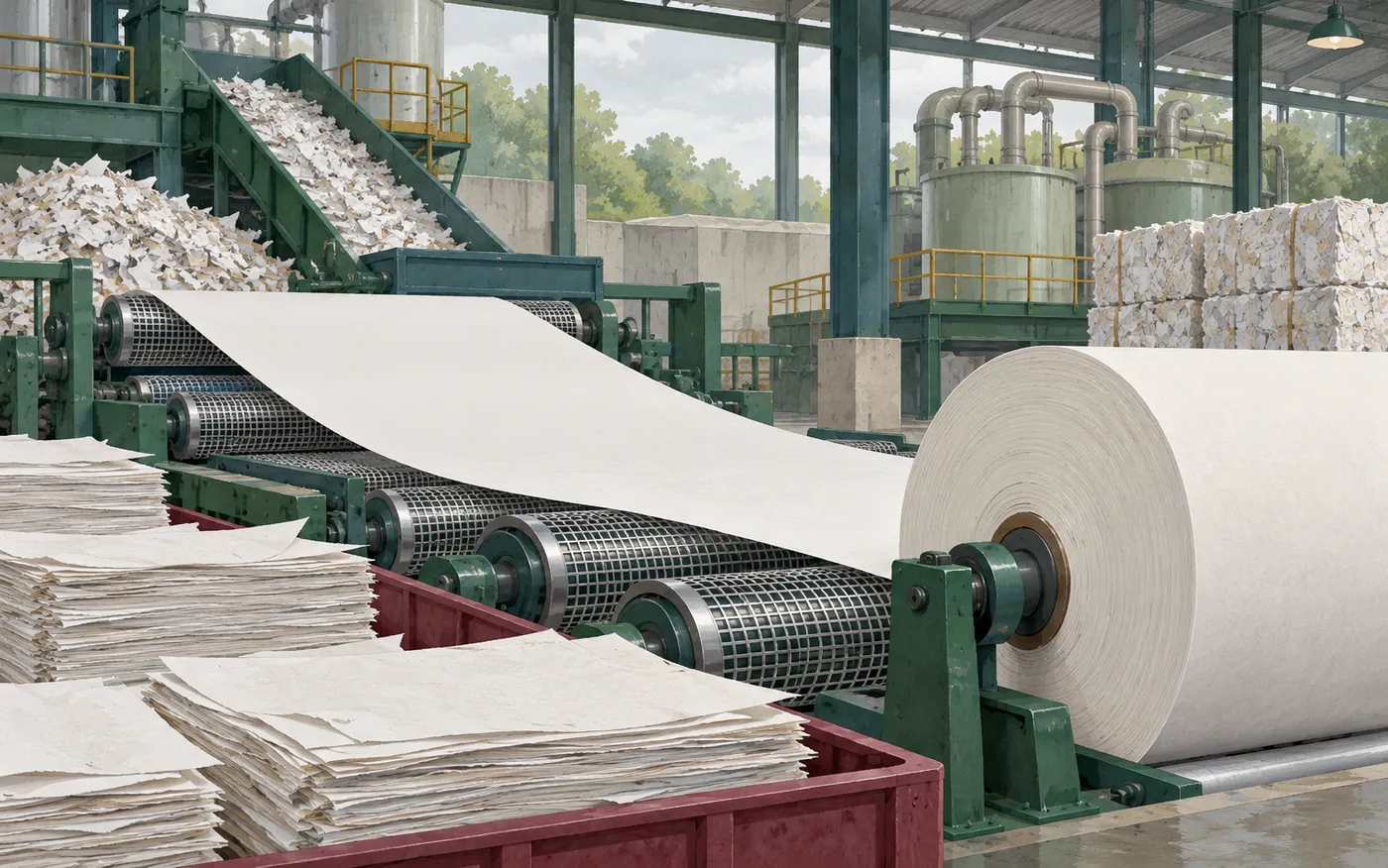
Used office paper moves across a mesh belt towards a finished paper roll.
Used paper is sorted, pressed and dried before it becomes a roll; the paper is sorted. Illustration: Atelier

What does the process diagram show?

Follow the seven stages below from used office paper to finished rolls. The numbered stages show one route from start to finish. Stages 1-4 prepare the material; stages 5-7 form the new paper and send it on. Use this sequence as the source for your report.

How is used office paper made into new paper rolls?

  1. 1. Collection
    Used paper is collected from offices and taken by lorry to a recycling centre.The centre receives the used paper.
  2. 2. Sorting
    The paper is sorted by hand, and unsuitable material is removed.Only suitable paper continues to the next stage.
  3. 3. Pulping
    The sorted paper is mixed with water in a tank to form pulp.The paper becomes a wet mixture.
  4. 4. Screening
    The pulp passes through a screen that catches remaining solid fragments.The screen removes small pieces that should not be in the paper.
  5. 5. Forming
    The cleaned pulp is spread onto a moving mesh belt. Water drains through the mesh, leaving a wet sheet.A sheet begins to form as water leaves the pulp.
  6. 6. Pressing and drying
    The wet sheet passes between rollers and then over heated cylinders to remove the remaining moisture.The sheet is pressed and dried.
  7. 7. Rolling and dispatch
    The dry paper is wound into large rolls. A lorry takes them to a paper-products factory.The finished rolls leave the recycling centre.

Which materials and equipment appear in the process?

How would you describe this process in at least 150 words?

IELTS Academic - Writing Task 1 - process practiceNot an official exam paper

Spend about 20 minutes on this task. The process above shows how a recycling centre turns used office paper into new paper rolls. Describe the main stages and their order in a report of at least 150 words.

(at least 150 words)

Your answer

Nothing you write is saved or sent. Copy it before you leave.

Read a model answer

The process sequence illustrates how a recycling centre converts used office paper into new rolls of paper.

Overall, there are seven main stages, beginning with the collection of used paper and ending with the delivery of finished rolls to a paper-products factory. The material changes from loose paper into a wet mixture before it is formed into a continuous sheet and dried.

First, used paper is collected from offices and transported by lorry to the recycling centre. On arrival, it is sorted by hand so that unsuitable material can be removed. The remaining paper is then mixed with water in a tank to produce pulp. Next, this mixture passes through a screen, which catches any solid fragments left in it.

The cleaned pulp is subsequently spread onto a moving mesh belt. Water drains through the mesh, leaving a wet sheet on the belt. In the sixth stage, this sheet passes between rollers and then over heated cylinders, which remove the remaining moisture. Finally, the dry paper is wound into large rolls. These are loaded onto a lorry and delivered to a factory that makes paper products.

Review your draft

Before you finish

A self-review aid, not an exam mark. Ticks are not saved.

What makes the overview useful?

The model overview gives the number of main stages and the two ends of the process. It also follows the material as it changes: used paper, wet mixture, sheet, dry rolls. That gives the reader a map before the detailed description. The overview is separate from the step-by-step detail.

When should you use the active or passive?

Choose the verb to fit what the subject does
Subject and actionUseful sentenceWhy it fits
Paper receives an actionThe paper is sorted by hand.The focus is on the material being sorted.
Pulp moves through equipmentThe mixture passes through a screen.The material is the subject of the movement.
Equipment does a jobThe screen catches solid fragments.The screen performs the action.
One stage follows anotherAfter being screened, the pulp is spread onto the belt.The pulp receives both actions.
  • The paper is mix with water.The paper is mixed with water.

    Use is + past participle for the present simple passive. The participle is mixed.

  • After sorting the paper, it is mixed with water.After being sorted, the paper is mixed with water.

    The paper receives the action. After being sorted keeps that clear; after sorting suggests the subject does the sorting.

  • The sheet is dried at 120 degrees for an hour.The sheet passes over heated cylinders to remove the remaining moisture.

    The sequence gives the equipment and purpose. It gives no temperature or drying time, so describe the information shown.

Question 1No account needed
Which overview matches the whole process?

Choose one answer.

Answer and explanation

Paper goes through several changes, from collection to delivery as new rolls.. The route begins with collection and ends with dispatch. The stages follow one another.

Question 2No account needed
Which detail belongs in the report?

Choose one answer.

Answer and explanation

The wet sheet passes between rollers before passing over heated cylinders.. Stage 6 gives the order of rollers and heated cylinders. Energy use and chemical removal are not shown.

Question 3No account needed
Choose the correct passive sentence.

Choose one answer.

Answer and explanation

The pulp is spread onto a moving belt.. The past participle of spread is spread. Use is spread when the pulp receives the action.

Question 4No account needed
Which transition correctly links screening and forming?

Choose one answer.

Answer and explanation

Once the pulp has passed through the screen, it is spread onto the belt.. Screening is stage 4 and forming is stage 5. Once clearly links these consecutive steps.

Built from