Cheat sheet

Present continuous for the future: I'm meeting her at six

Use present continuous for the future with agreed arrangements. Read a diary, compare going to and practise questions in a five-question quiz.

In short

Use am, is or are + -ing for a future arrangement: I'm meeting her at six. You have made the plan, often with another person or a booking. Keep am, is or are: say We're meeting tomorrow, not We meeting tomorrow.

Yellow the idea to rememberBlue English to learnRed watch out

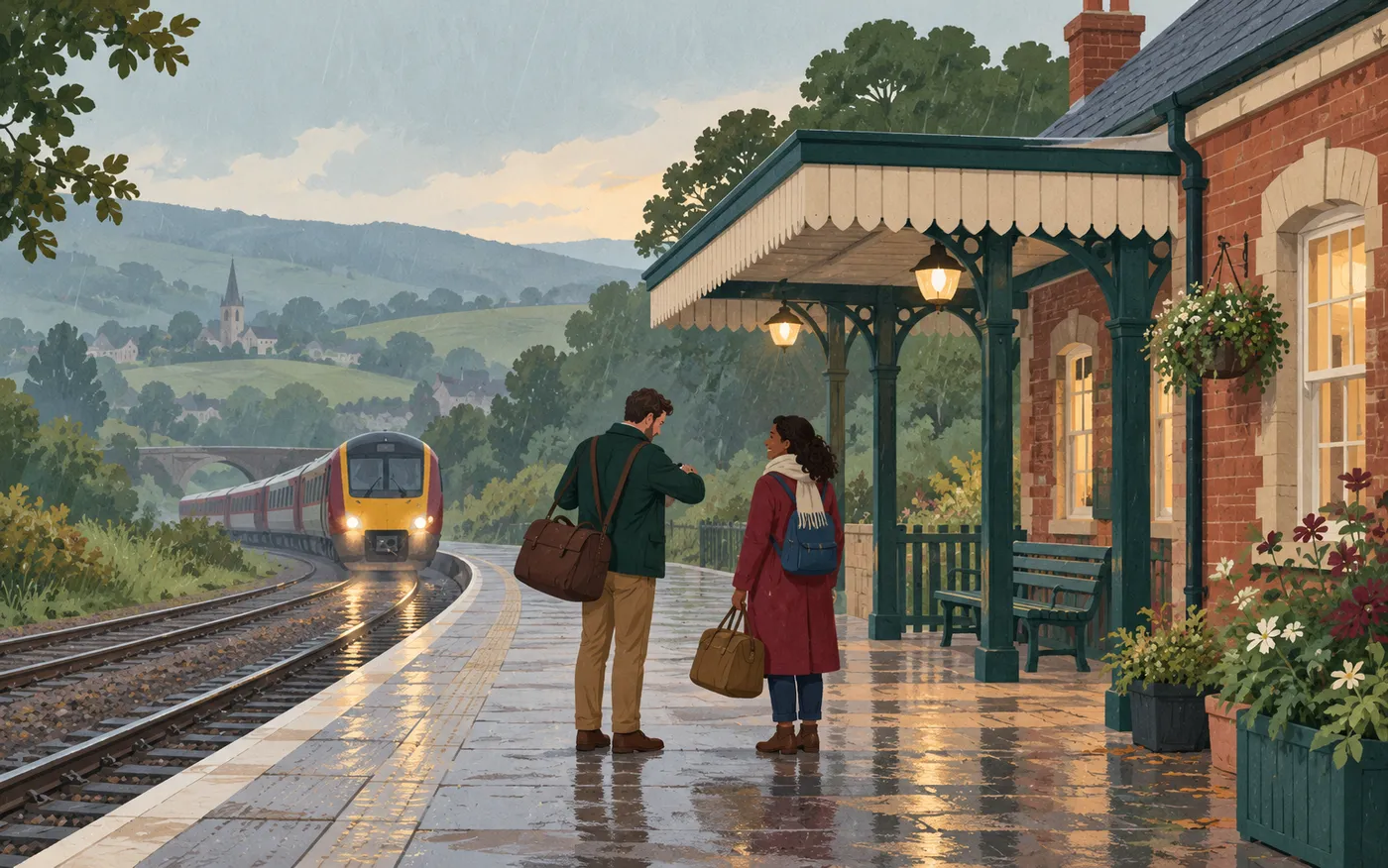
Two friends meet beside a sheltered British railway platform as a train arrives.
We’re meeting tomorrow describes an agreed arrangement. Illustration: Atelier

How do you use the present continuous for the future?

Future arrangements: eight useful rules

1 · Has someone agreed to the plan?

Use this form when you have made an arrangement. You often know who you will meet, where you will go or when it will happen. A booking can also show that the plan is ready.

We are meeting the guide at two on Friday.The guide has confirmed the visit.

2 · Which form of be do you need?

Use I am, he/she/it is and you/we/they are. Then add the -ing form. I'm, she's and we're are common in conversation.

I'm meeting Jo at six.Jo and I have agreed to meet.

She is having lunch with Kim tomorrow.She and Kim have agreed to have lunch.

3 · How do you make the -ing form?

Usually add -ing: meet - meeting, visit - visiting. Drop the final e in have - having and leave - leaving.

We're leaving at eight tomorrow morning.That is our agreed departure time.

4 · How do people know you mean the future?

Add a future time, such as tonight, tomorrow or on Saturday. You can leave it out when the other person already knows when.

I'm seeing the dentist tomorrow.I have an appointment.

What are you doing on Friday? - I'm meeting Jo.The question gives the future time.

5 · How do you make it negative?

Put not after am, is or are. Use I'm not, isn't or aren't in conversation.

We aren't meeting at the station after all.That arrangement has changed.

6 · How do you ask about an arrangement?

Put am, is or are before the person. For a short answer, use be: Yes, I am. / No, I'm not.

Are you meeting Jo at six?Is that your plan with Jo?

Where are you staying next weekend?Which place have you arranged to stay at?

7 · How is it different from going to?

Going to often tells us what someone has decided to do. The present continuous often tells us what is arranged. Both can describe the same plan; the focus changes.

I'm going to visit my sister this summer.That is my intention. We may still need to choose a date.

I'm visiting my sister on Saturday.We have agreed on Saturday.

8 · Is it a personal arrangement or a timetable?

Use the present simple for a timetable. Use the present continuous to say what you have arranged to do.

The train leaves at nine.That is the time on the timetable.

We are catching the nine o'clock train.That is our travel plan.

What can you say from a diary?

It is Wednesday evening. Nisha and Ben have checked these plans. The visit is booked, and Ben has agreed to meet Nisha outside the station.

Nisha's Friday diary
TimeAgreed planWhat Nisha says
1.15 pmCollect Ben outside the station.I'm picking Ben up outside the station at quarter past one.
2 pmVisit the studio with the guide.We're meeting the guide at two.
4 pmHave tea with Eva.I'm having tea with Eva at four.

Can you use going to for an arranged plan too?

Yes. We're going to meet the guide at two can also describe the booked visit. The present continuous puts the arrangement first; going to puts the intention first. A future time alone is not enough to show that a plan is agreed.

Checking Friday's visit
  1. Ben

    Are we still meeting at the station on Friday?

    Ben checks their arrangement.

  2. Nisha

    Yes. I'm picking you up at quarter past one.

    Nisha confirms the pick-up.

  3. Ben

    I'm going to bring sandwiches for lunch.

    Ben tells Nisha what he has decided to do.

  4. Nisha

    Good idea. Your bag looks heavy. I'll carry it.

    Nisha offers to help now.

Which mistakes are easy to fix?

  • I meeting Jo at six.I'm meeting Jo at six.

    The form needs am, is or are. Use I'm with I.

  • She is meet us tomorrow.She is meeting us tomorrow.

    Use the -ing form after is: is meeting.

  • Do you meeting Jo tomorrow?Are you meeting Jo tomorrow?

    Move are before you to make the question. Do not add do.

  • We aren't meet at the station.We aren't meeting at the station.

    Keep the -ing form in negative sentences too.

For a weather prediction, use It's going to rain tomorrow or It will rain tomorrow. A weather prediction is not an arrangement.

Question 1No account needed
Jo has agreed to meet you at six tomorrow. Choose the complete sentence.

Choose one answer.

Answer and explanation

I'm meeting Jo at six tomorrow.. Use am + meeting. The agreed time makes this a future arrangement.

Question 2No account needed
Nisha's Friday diary says the guide visit is booked for 2 pm. What does she say?

Choose one answer.

Answer and explanation

We're meeting the guide at two.. The confirmed visit is an arrangement. We're meeting has the correct form.

Question 3No account needed
Choose the correct question about Friday.

Choose one answer.

Answer and explanation

Are you picking Ben up?. Put are before you and keep the -ing form: Are you picking ...?

Question 4No account needed
You have decided to visit your sister, but you have not spoken to her or chosen a date. Which sentence clearly expresses that intention?

Choose one answer.

Answer and explanation

I'm going to visit my sister this summer.. Going to expresses your decision. The context says that the details are still open.

Question 5No account needed
Can both sentences describe an agreed plan: We're meeting Jo tomorrow and We're going to meet Jo tomorrow?

Choose one answer.

Answer and explanation

Yes. They can describe the same plan, with a different focus.. Both forms can describe a plan. The present continuous highlights the arrangement; going to highlights the intention.

Built from