Cheat sheet

Must, might and can't: modal deduction with a quiz

Use must, might and can't for deductions about now, with certainty clues, verb patterns, clear examples, common mistakes and a short practice quiz.

In short

Use must when the clues make you almost sure something is true, might when it is possible, and can't when you are almost sure it is impossible. Choose the modal to match the clues. The negative of must for a guess is usually can't, not mustn't.

Yellow the idea to rememberBlue English to learnRed watch out

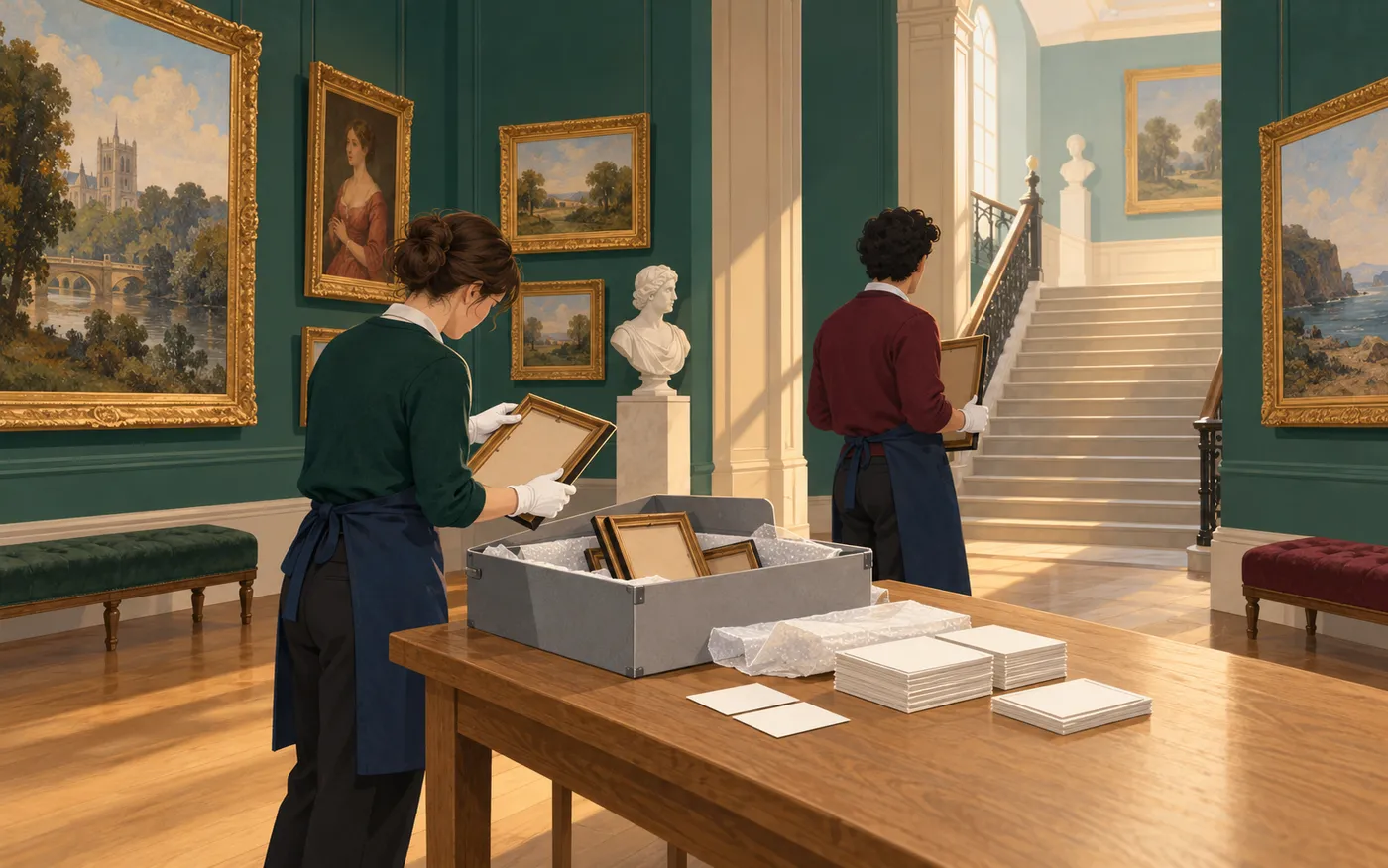
Museum staff prepare an exhibition with a box of blank cards and look toward the stairs.
Museum staff use clues to decide what must be, might be or can't be true. Illustration: Atelier

How do you make a guess about the present?

1 · When do you use must?

Use must + base verb for a strong guess. You have a good reason to believe it.

This must be our box. The list on the lid matches ours.The matching list is a strong clue.

2 · When do you use might?

Use might + base verb when something is possible but you are not sure.

The spare labels might be in the cupboard. I haven't checked.The cupboard is one possible place.

3 · When do you use can't?

Use can't + base verb when a clue makes you almost sure something is impossible.

That can't be the label box. It's full of cups.The contents show that it is a different box.

4 · Does the verb change after a modal?

Keep the base form after must, might and can't. Leave out to. Use the same form with every person.

She must know which box we need. She packed them all.Her job gives us a reason for this guess.

They might need more labels.More labels are a possibility.

5 · How do you guess about an action happening now?

Use modal + be + -ing. This describes an action in progress.

I can hear the printer. Jo must be printing the labels.The sound gives us a clue about Jo's activity.

Sam might be checking the display upstairs.That is one possible explanation for where Sam is.

6 · What is the difference between might not and can't?

Might not leaves a possibility open. Can't gives a strong negative guess.

Jo might not be in the office.Perhaps Jo is elsewhere; we are not sure.

Jo can't be in the office. She's here in the cafe with me.We have a clear reason to rule out the office.

7 · Can you also use may and could for a guess?

Yes. May, might and could can all describe a possible explanation. The choice does not give an exact percentage.

The missing list could be in my bag.My bag is another possible place.

The photographer may be upstairs.Perhaps the photographer is upstairs.

How do you use these guesses in a conversation?

Getting an exhibition ready
  1. Mina

    We need the labels for the photographs. Is this the right box?

    Mina asks which box to use.

  2. Joel

    It must be. The list on the lid has all six titles.

    Joel gives a strong guess and a reason.

  3. Mina

    Where's the photographer?

    Mina asks about someone who is absent.

  4. Joel

    She might be upstairs. The lights are on, but I haven't seen her.

    The lights are a clue, but Joel is still unsure.

  5. Mina

    She can't be in the hall. I've just checked, and it's empty.

    Mina rules out one place.

  6. Joel

    Let's look upstairs, then.

    They check the possible explanation.

A deduction is a guess based on a clue. In the scene, the matching titles support must be. The lights only suggest might be. You can give your reason in a second sentence or use because.

  • She must to know the answer.She must know the answer.

    Use the base verb know after must. Leave out to.

  • He might works upstairs.He might work upstairs.

    The modal stays the same, and the verb has no -s, even after he.

  • It mustn't be Jo. Jo is in Leeds today.It can't be Jo. Jo is in Leeds today.

    For a strong negative guess, choose can't. Mustn't usually tells someone that an action is forbidden.

  • She might working upstairs.She might be working upstairs.

    An action happening now needs be before the -ing form.

Question 1No account needed
You hear your colleague speaking through the office door. Choose the strong positive guess.She ___ in the office.

Choose one answer.

Answer and explanation

must be. You recognise her voice inside. That is a strong clue, so must be fits.

Question 2No account needed
You are downstairs with Jo. Choose the strong negative guess.She ___ upstairs.

Choose one answer.

Answer and explanation

can't be. Jo is downstairs with you. Can't be rules out the upstairs explanation.

Question 3No account needed
You have not checked your bag or your desk. Choose a possible explanation.The list ___ in my bag.

Choose one answer.

Answer and explanation

might be. Your bag is one possible place. You lack a strong clue, so might be fits.

Question 4No account needed
Choose the correct form for an action happening now.He might ___ the labels at the moment.

Choose one answer.

Answer and explanation

be printing. Use might + be + -ing for a possible activity in progress: might be printing.

Question 5No account needed
What does this mean: 'The labels might not be ready'?

Choose one answer.

Answer and explanation

It is possible that they are unfinished.. Might not expresses a negative possibility. The speaker is still unsure.

Built from