A, an or the? English articles explained
A, an or the? Choose English articles for everyday things, jobs, meals and places. Compare general and specific meanings, then try ten questions.
In short
Articles are the small words a, an and the before a noun. Use a/an for one thing when the listener does not know which one; use the when you both know which thing or things you mean. Use no article for plural things and things you cannot count when you mean them in general: Dogs need water. Choose a or an by sound, not spelling.
Yellow the idea to rememberBlue English to learnRed watch out
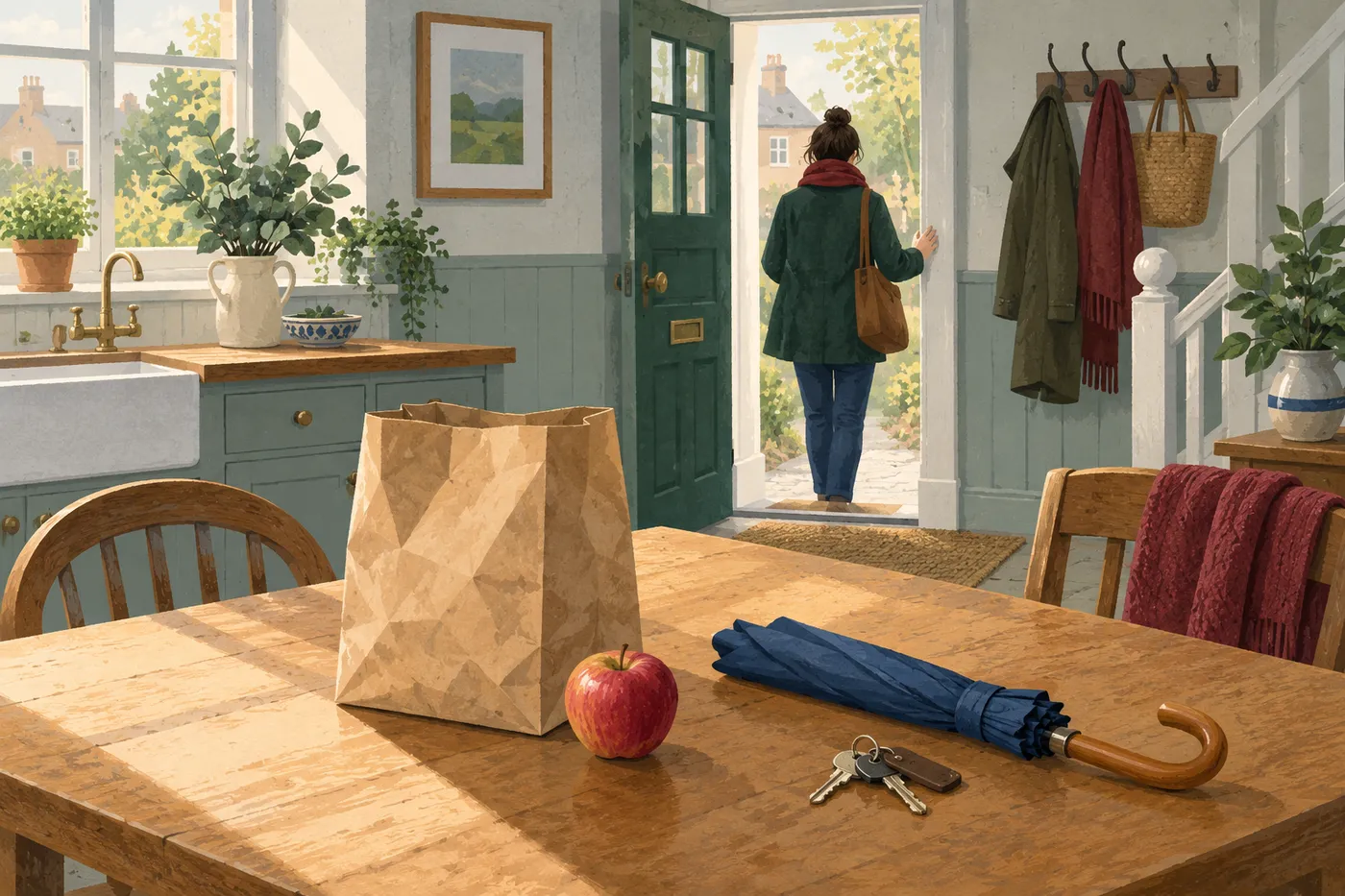
How do you choose a, an, the or no article?
Ask whether you mean one thing, a known thing or things in general. A noun is a word for a person, place, thing or idea: teacher, town, bag, time. With a countable noun, you can say one bag, two bags.
| Question | Choose | Example |
|---|---|---|
| One countable thing, but which one is not clear? | a / an | I need a bag. |
| Can the listener tell which thing or things? | the | The bag by the door is mine. |
| Plural things in general? | no article | Bags are useful. |
| Something you cannot count, in general? | no article | Water is important. |
There's a wallet on the chair. The wallet is brown.
First we introduce a wallet. Then we talk about that same wallet.
A singular countable noun usually needs a word before it: a bag, the bag, my bag, this bag. Say I need a bag, rather than I need bag. My and this already do that job, so say my bag, not the my bag.
When do you use a or an?
Use a or an before one countable person or thing when the listener cannot yet tell which one. You can also use them when any one thing will do. If you ask for a pen, any suitable pen is fine.
| Situation | Example | Meaning |
|---|---|---|
| Introduce something | I bought a bag. | This is new information. |
| Ask for any one | Have you got a pen? | Any pen is fine. |
| Say what something is | It's an umbrella. | This is the kind of thing it is. |
| Add a describing word | We need a quiet room. | One room that is quiet. |
I'd like an apple, please.
You want one apple. You have not chosen a particular one.
Use a/an with a singular noun. For more than one, use a plural: an apple, two apples, some apples. For an amount such as water, use some water or count the container: a bottle of water.
What is the difference between a and an?
Use a before a consonant sound and an before a vowel sound. Listen to the first sound of the next word. The letters a, e, i, o and u are vowel letters, but the sound can be different.
| Use a | Use an | Why? |
|---|---|---|
| a bag | an apple | The words begin with different sounds. |
| a university | an umbrella | University begins with a 'y' sound. |
| a hotel | an hour | The h in hour is silent. |
| a useful bag | an old bag | The describing word comes next. |
We waited for an hour outside a university.
Hour starts with a vowel sound. University starts with a 'y' sound.
Do the same with a job or a describing word: an engineer, a good engineer, an excellent engineer. Look at the word immediately after the article, not only the noun at the end.
When do you use the?
Use the when the listener can tell which person, place or thing you mean. You may have mentioned it before. You may both see it. Or the words after the noun may tell the listener which one.
| Reason | Example |
|---|---|
| You mentioned it before. | I bought a bag. The bag is blue. |
| You both see the same thing. | Please close the door. |
| The words explain which one. | The bag under your chair is mine. |
| There is one in our everyday world. | The sun is shining. |
| You name a position or order. | This is the first page. |
| You choose the best or biggest one. | This is the best seat in the room. |
I bought a bag and a coat. The bag was cheaper.
The coat is a new thing, so it still needs a. The bag is the one already mentioned.
The means 'you know which one', not 'the second sentence'. You can use it the first time you speak: Where's the kitchen? In someone's home, the situation tells you which kitchen.
Could you pass me the keys on the table?
The words on the table tell you which keys.
The works with one thing, several things and an amount: the bag, the bags, the water in this bottle. You do not change the article for a plural noun.
When do you use no article?
Use no article with plural nouns and nouns such as water when you talk about them in general. 'No article' means there is no a, an or the. It is also called the zero article.
| General | Particular | What changes? |
|---|---|---|
| Rooms need light. | The rooms upstairs need cleaning. | We know which rooms. |
| I like apples. | The apples in this bag are sweet. | We mean these apples. |
| Water is important. | The water in my glass is cold. | We mean this water. |
| Information is useful. | The information in this email is useful. | We mean this information. |
Music helps me relax. I like the music in this cafe.
The first sentence means music generally. The second means what is playing here.
For an easy general sentence, choose a plural: Cats sleep a lot. You can also say A cat needs a safe place to sleep: one cat stands for cats in general. Start with the plural pattern when you are unsure.
Some English nouns name an amount, not separate things: rice, money, advice, information. Say some advice or a piece of advice. Do not put a/an before information or advice.
Do you use a or an with jobs?
Use a or an when you say that someone has a job, with a singular job noun. In answer to What do you do?, say I'm a teacher, I'm a nurse or I'm an engineer.
| One person | More than one |
|---|---|
| She's a teacher. | They're teachers. |
| He's an engineer. | They're engineers. |
| I'm a nurse. | We're nurses. |
My sister is an engineer. She's the engineer who fixed our lift.
First we name her job. Then we say which engineer she is.
A job title can also take the when you mean a known person: The receptionist gave me a form. The job itself does not decide the article; what the listener knows still matters.
Do you use an article with breakfast, lunch and dinner?
Use no article with breakfast, lunch and dinner when you mean the usual meal. Say have breakfast, after lunch and before dinner. A particular meal can take a or the.
| Meaning | Example |
|---|---|
| The usual meal | I have breakfast at seven. |
| Describe one meal | We had a lovely dinner. |
| A meal you both know | The dinner you cooked was delicious. |
| Food in general | I like rice. |
| A particular amount of food | The rice in this bowl is cold. |
We had lunch at one. It was a quick lunch.
The first part names the meal. The second describes that meal.
The describing word can change the pattern: breakfast, but a big breakfast; dinner, but an early dinner. Choose a/an from the next sound as usual.
Do you use the with places?
Most country and town names have no article, but some names and place expressions use the. Learn common names as whole phrases. For example, say France and London, but the UK.
| No article | With the |
|---|---|
| France, Japan, Wales | the UK, the United States, the Netherlands |
| London, Cardiff | the Thames, the Atlantic Ocean |
| Lake Windermere | the Alps |
| go home, at home, at work | go to the station, at the bus stop |
She lives in London, near the Thames.
The city has no article. The river name uses the.
Some place expressions change with the reason for being there. In British English, at school means being there as a pupil; in hospital can mean being there as a patient. Use the for a particular building or place.
| Usual activity or role | A particular place |
|---|---|
| Mia is at school. | I'll meet you outside the school. |
| Ben is in hospital as a patient. | The hospital is near the station. |
| Leila is at university. | The university has a new library. |
My brother is in hospital. I'm going to the hospital to visit him.
He is a patient. I mean the hospital where he is staying.
American English usually uses in the hospital for a patient. These phrases vary by place word: learn at school, at work, at home and at the station separately.
What article mistakes should you check?
Check whether the noun is one thing, a known thing or something general.
- She's engineer.She's an engineer.
A singular job noun needs a/an here. Engineer starts with a vowel sound.
- We waited for a hour.We waited for an hour.
The h in hour is silent. Choose an before its vowel sound.
- I need an advice.I need some advice.
Advice is uncountable in English. You can also ask for a piece of advice.
- I live in the London.I live in London.
Use the city name London with no article.
- Where is the my bag?Where is my bag?
My already tells us whose bag it is. Use my bag on its own.
Can you choose the right article?
Choose one answer. 'No article' means that you leave the gap empty.