Graded story

First day at the café: an A2 short story with a quiz

Read an A2 English short story about Lea's first shift in a Liverpool café, with a mixed-up order, eight work words, polite requests and questions.

In short

Lea's first morning at a Liverpool café starts badly, but a simple question helps her. Ask Could you say that again, please? when you need to hear something again. Check an order before you take it to the table.

Yellow the idea to rememberBlue English to learnRed watch out

A café worker checks an order with a customer at a table.
Lea asks, Could you say that again, please? Illustration: Atelier

Read to find out: what changes after Lea asks for help?

First day at the café

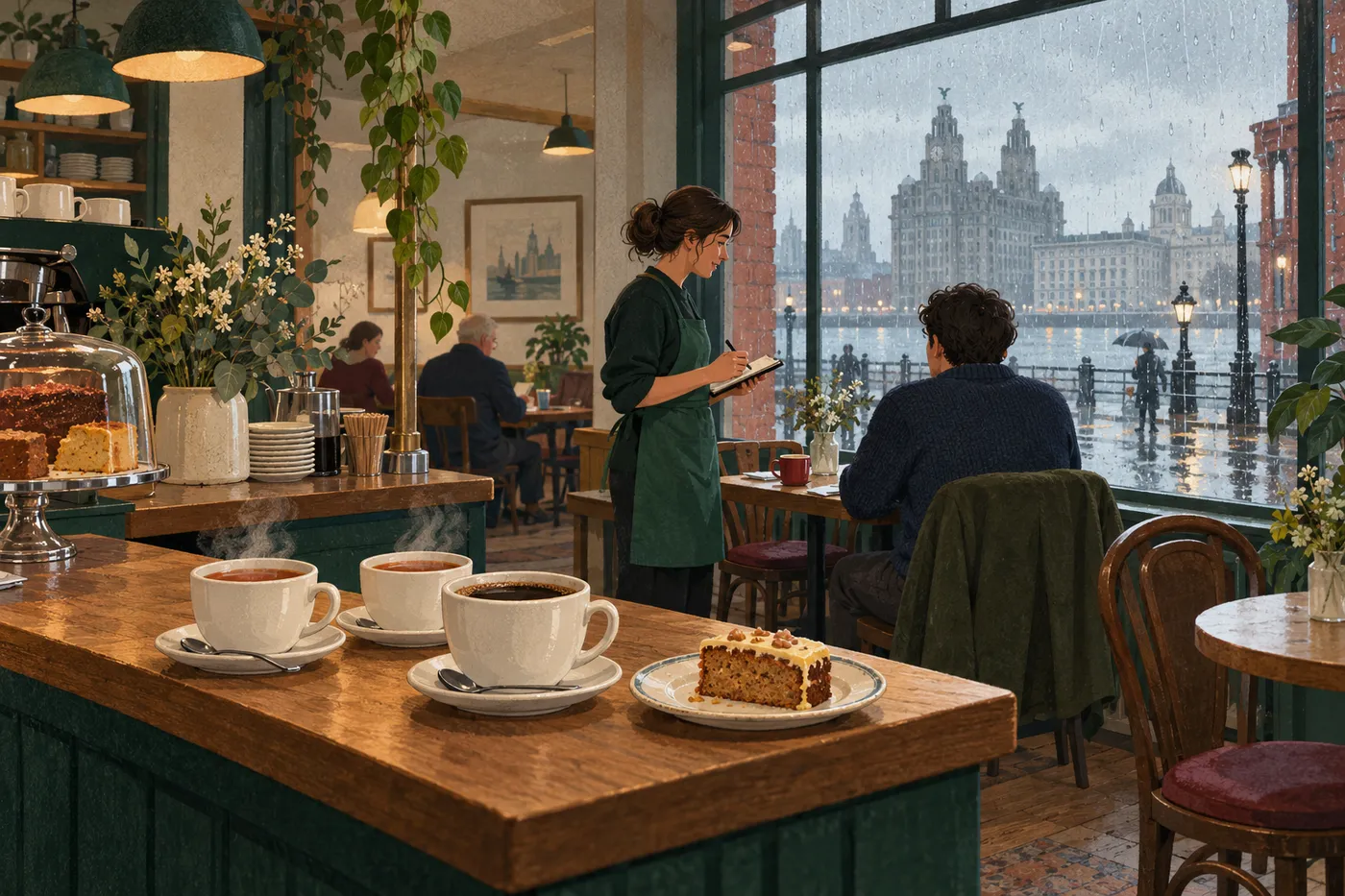
At seven on Monday morning, Lea tied on her new apron1. It was her first shift2 at a small café in Liverpool. Outside, rain was running down the windows. Inside, the coffee machine was making a terrible noise.

"Just watch me for the first few orders," said Mo, the manager. But then the phone rang. Mo went into the kitchen, and a woman came to the counter3.

"Two teas for table four, please. With milk. And one coffee for my friend at table six." Lea heard the numbers, but she was nervous. She wrote very quickly in her notebook4.

Five minutes later, she carried two coffees to table four. The woman looked at the cups. "We asked for tea." Lea's face felt hot. She turned round too quickly and dropped a teaspoon5. It rang like a little bell on the floor.

"I think everyone heard that," Lea said when Mo came back. "Only everyone in Liverpool," he said, smiling. Then he picked up the spoon. "You can ask people to repeat things, you know."

Lea went back to the woman. "I'm sorry. Could you say your order again, please?" This time she wrote slowly. "Two teas with milk for this table, and one coffee for table six?" The woman nodded6.

Lea took the right drinks to both tables. "Anything else?" she asked. "A piece of cake," said the woman. Lea checked which cake she wanted.

By eleven, Lea was still busy, but she felt calmer7. As the woman left, she smiled at Lea. "See you tomorrow." Lea put her notebook in her apron pocket8. Tomorrow already sounded better.

What does Lea use at work?

Things from Lea's morning

What can you say when you need to check an order?

Try Lea's part, then change the order
  1. Customer

    I'd like two teas, please.

    The customer asks for two cups of tea.

  2. You

    Could you say that again, please?

    Ask the customer to repeat the order.

  3. Customer

    Two teas, both with milk.

    Each cup needs milk.

  4. You

    Two teas with milk. Anything else?

    Check the order and ask if the customer wants more.

Two teas means two cups of tea. Anything else? asks if the customer wants another thing. When Lea checks the order, she can hear if she has made a mistake.

Did you follow the order and the mistake?

Question 1No account needed
What did the woman order for table four?

Choose one answer.

Answer and explanation

Two teas with milk. The woman wanted two teas with milk for table four and one coffee for table six.

Question 2No account needed
Why did Lea take the wrong drinks to table four?

Choose one answer.

Answer and explanation

She was nervous and mixed up the order.. Lea heard the numbers but was nervous. She wrote quickly and then brought two coffees.

Question 3No account needed
What does Mo's joke about everyone in Liverpool do?

Choose one answer.

Answer and explanation

It helps Lea feel less worried.. Mo smiles and makes a small joke. He then helps Lea and suggests asking people to repeat things.

Question 4No account needed
Which sentence shows that the customer plans to return?

Choose one answer.

Answer and explanation

See you tomorrow.. See you tomorrow shows that the woman expects to visit again the next day.

How can you tell a friend about Lea's first day?

Write a message of 40-60 words from Lea to a friend. Say where you worked, what went wrong and who helped. Finish with how you feel about tomorrow.

I took the wrong drinks to a table, but Mo helped me.

Two finished actions in Lea's morning.

Use took, the past form of take, and helped, the past form of help.

Built from