مقال تاريخي للمستوى C2 — بريطانيا والولايات المتحدة
How the working week acquired an ending
What counts as the beginning of the weekend?
To give the weekend a birthday is to mistake a gradual settlement for a single act of creation. A reduction in working hours, a regular afternoon off and two consecutive days free from employment are related achievements, but they are not interchangeable. A history that treats them as equivalent will produce an admirably tidy chronology at the cost of explaining very little. The difficulty lies partly in attribution1: a conspicuous announcement leaves a clearer documentary trail than a custom slowly established in workshops.
Why did workers take Monday off?
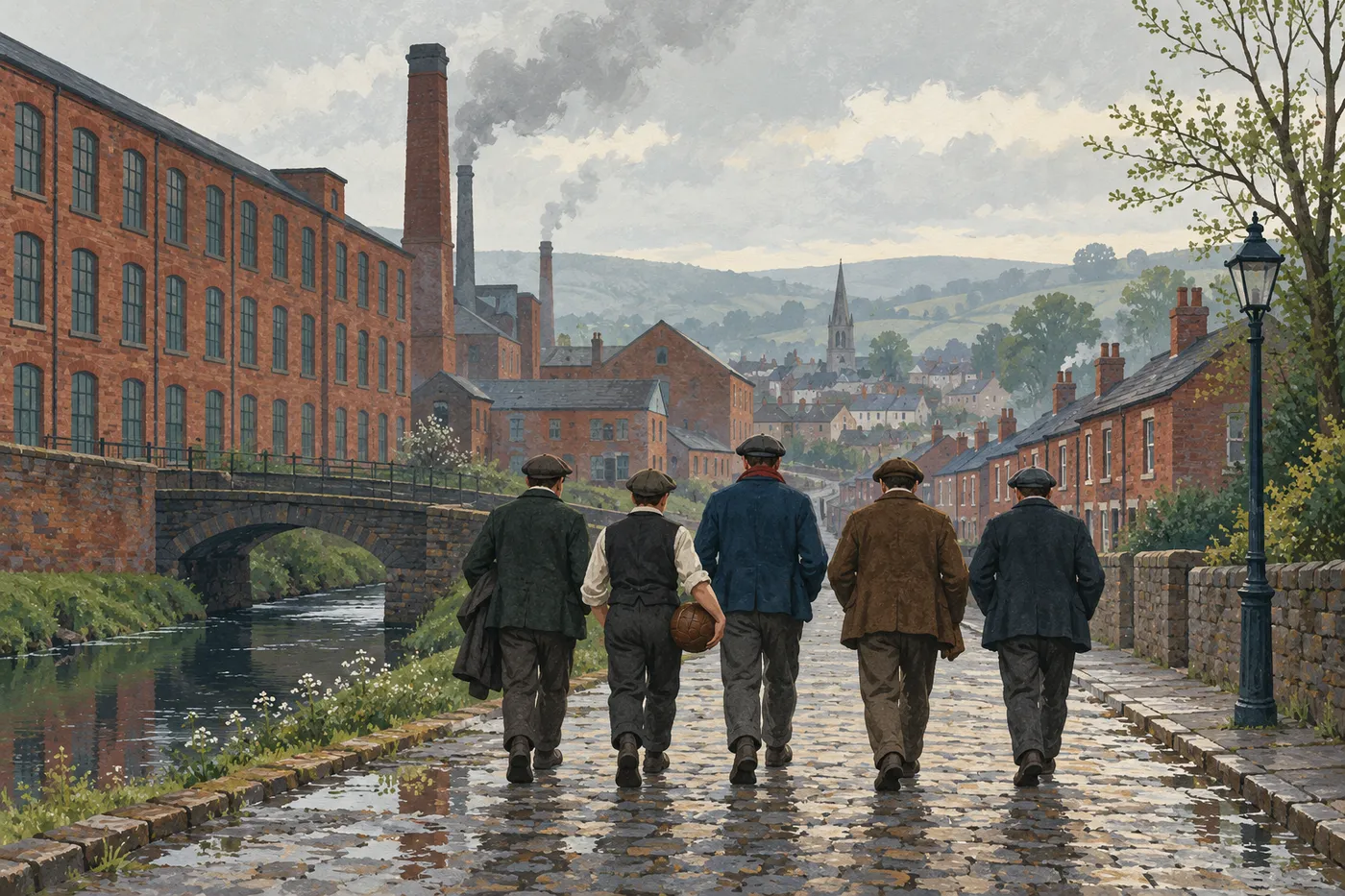
In historian Brad Beaven's account, the nineteenth-century British working week was disrupted by the unofficial observance known as Saint Monday. Workers extended their leisure beyond Sunday; employers faced uncertain attendance. Unions sought regular hours and a recognised Saturday half-holiday, while religious and philanthropic reformers promoted rational recreation2, hoping to steer leisure towards sober pursuits. These groups could support the same adjustment without sharing an account of what leisure was for. The apparent agreement was a convergence3 of interests, not evidence of a common philosophy.
What can a parliamentary debate tell us?
The record becomes sharper, though no less contested4, in Parliament. In the Lords debate of 15 July 1850, supporters of the Factories Bill presented a Saturday finish at two o'clock as securing a half-holiday. The discussion concerned regulated factory labour, particularly that of women and young persons. To turn it into a proclamation of universal leisure would erase precisely the limits that make the evidence useful.
Here the historian must distinguish a stated intention from its implementation5. Hansard records what speakers argued for and expected; a speech alone cannot establish how every workplace subsequently operated. Nor is a shorter Saturday the same as a full Saturday off. The distinction can seem pedantic6 until its omission transforms a particular reform into a national entitlement.
How did leisure become a business?
As Beaven explains, commercial recreation reinforced the emerging pattern: football helped establish Saturday afternoon as leisure time, and cheaper transport opened up excursions. The significance is larger than a choice of entertainment. A predictable interval can be sold in advance; an irregular absence cannot be scheduled so conveniently. On this reading, the timetable that disciplined labour also made leisure commercially legible. That is an interpretation of the connection, rather than a motive that can be assigned to every traveller.
Did Henry Ford create the five-day week?
Across the Atlantic, Ford's 1926 announcement gave the five-day, forty-hour week exceptional prominence7. The Library of Congress traces earlier preparation and experiments, as well as contemporary disagreement over who stood to gain. Its account therefore complicates the familiar story of a solitary industrial benefactor. The scale and visibility of a decision can help a practice spread without proving that the decision originated it. To credit Ford with publicity and influence is one proposition; to credit him with the weekend itself is a much more sweeping8 one.
Whose time does the weekend describe?
These episodes suggest a distinction between the quantity of free time and its synchronisation9. Two people may each have two days off yet have no day available together. The social value of a shared pause therefore exceeds its arithmetic: it permits a match, a visit or a meeting to be arranged. Equally, describing a day as leisure says little about the cooking, cleaning or care performed within it.
The weekend is best understood, then, as a settlement10 over the distribution and coordination of time. Its history resists a single hero because its benefits, purposes and boundaries were never a single question. Asking who created it is less revealing than asking which change is being described, whose hours were affected and what evidence survives.
بكلمات أبسط
The weekend developed in stages. Shorter hours, a Saturday afternoon off and two full days off are different changes. Big announcements are easier to trace than gradual changes in custom.
Some workers took Monday off unofficially. Unions, employers and reformers had different reasons for supporting a regular Saturday break. Agreement on a change did not mean agreement on its purpose.
In 1850, the Lords discussed a Saturday finish at two o'clock for particular factory workers. That discussion did not cover every worker.
A parliamentary speech shows what a speaker wanted or expected. It cannot by itself show how a plan worked everywhere. Half a Saturday off is also different from a full day off.
Football and cheaper trips helped support regular leisure time. The writer argues that regular schedules also made leisure easier to sell. This is an interpretation, rather than a statement about every traveller's motives.
Ford's 1926 announcement attracted attention, but the Library of Congress shows a longer and more complicated development. Influence and being first are different things.
The writer argues that people benefit from having time off together. A day away from paid work can still contain other work.
The weekend concerns both how much time people have and when they have it. A useful history asks whose lives changed and what the evidence shows.