地図と、その下にある空間
The cartographer's daughter
My father taught me that every line should answer a question. Where does the road turn? How steep is the hill? At eleven, I found this comforting. The world might be untidy, but his maps suggested that someone had understood it.
Beyond the railway lay a narrow lane, with six houses and a yard where washing snapped above the puddles. My school friend Annie lived there. We walked to her door by counting the broken paving stones1. On my father's new map, the lane ended at the railway. Beyond it was a rectangle marked for redevelopment2.
'But Annie lives there,' I said. He set down his ruler3. 'The map shows the approved plan.' I thought approved meant correct in every possible way. He returned to his work, and I watched him rub out a faint pencil line. That is the moment I remember. Whether he looked tired, or whether I have since supplied the tiredness, I cannot say.
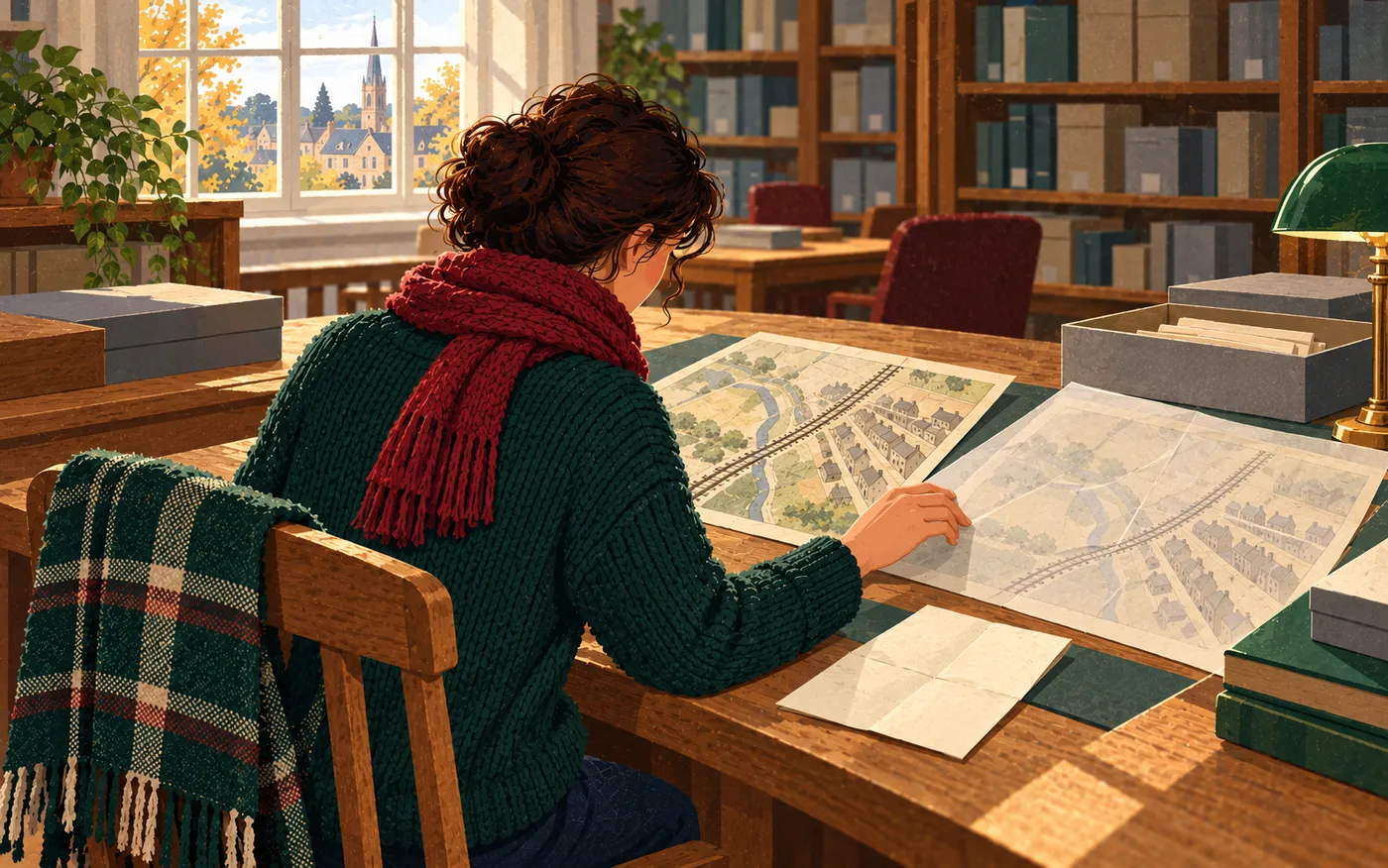
Twenty-four years later, after his death, I was asked to lend some of his work to an exhibition. In his study I found a drawer labelled 'Earlier versions'. Beneath a sheet of tracing paper4 carrying the approved plan was the first map of the railway area. There was Annie's lane, carefully measured. Beside it, in my father's small writing, stood a note: 'Access retained pending agreement.'
I carried the map to the town archive. The assistant brought out a file of letters about the building work. One was addressed to my father. Annie's mother had written it. She thanked him for explaining the plans, then asked why a street could disappear on paper while people still needed to walk home along it. The letter had been folded twice. His reply was not in the file.
Only when I unfolded the letter did I notice the date. It was the day before our conversation in his study. For a moment I felt I had caught him: he had known exactly what my question meant. Then I remembered that knowing a question and being free to answer it were different things. This was the explanation I wanted. Wanting it made me suspicious.
The exhibition curator5 suggested showing the finished map. Its clean lines would reproduce well. I asked for the earlier version to be placed beside it, with the letter between them. 'What should the caption6 say?' she asked. I began, 'My father tried to preserve...' Then I stopped. The note recorded a condition. It could not tell me what he had tried to do.
We settled on dates, street names and a brief account of the changes. At the bottom I added a question: 'Which routes remain when a place is redrawn?' Before leaving, I laid the tracing paper over the older map. Through the finished rectangle, the lane was still faintly7 visible. I had learnt, at last, to leave both versions in view8.
やさしい言葉で
As a child, the daughter trusted her father's maps. She believed they made the world clear.
Her friend Annie lived in a lane beyond the railway. The new map showed a planned building area in place of part of the lane.
Her father said the map showed an approved plan. As an adult, she questions how accurately she remembers his reaction.
After his death, she finds an older map under a tracing of the approved plan. The older map includes the lane and a note about keeping access.
At the archive, she finds a letter from Annie's mother asking her father why the street has disappeared from the plan.
The letter was written before the daughter's childhood question. The daughter wants to believe her father was unable to help, but she notices her own wish to defend him.
She asks to display both maps and the letter. She stops herself from writing that her father tried to save the lane, because the note leaves his intentions uncertain.
She writes a caption with facts and a question. Through the tracing, she can still see the old lane. She accepts a display that lets visitors consider both versions.