畑の縁を歩く
What the hedgerow knows
From the lane, the hedge appears to have been drawn in a single impatient stroke. It divides one field from another, obeys the road for fifty yards, then wanders towards a gate. In winter its twigs make a filigree1 against the sky. At speed, through a car window, it is scarcely a thing at all: a dark line between destinations. On foot, the line acquires depth.
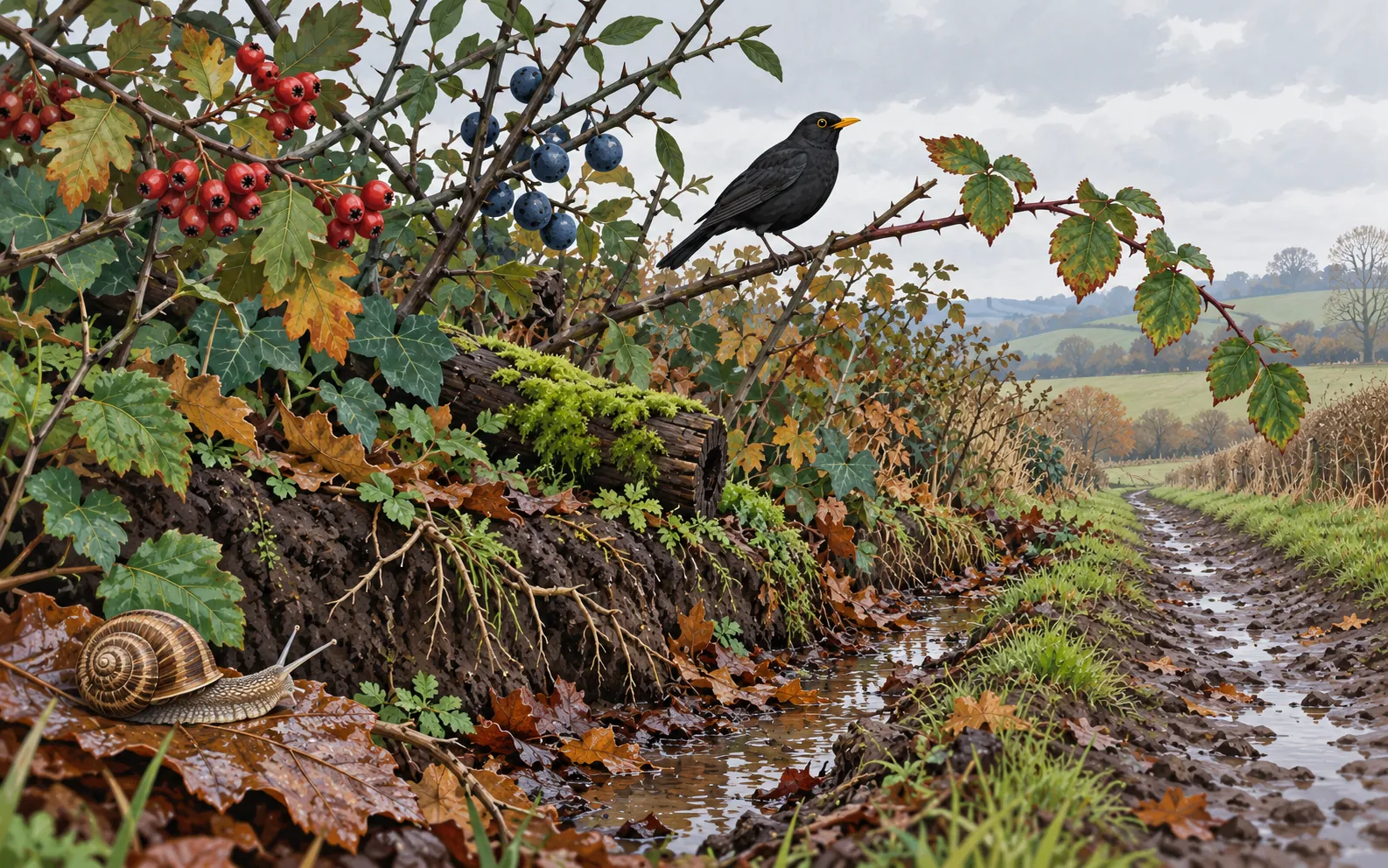
I used to like this stretch best just after it had been cut. Tidy, I called it. The word offered the small satisfaction of a cleared desk: everything visible, nothing apparently left to do. This morning, fallen leaves have gathered in the ditch, and a bramble has reached across the path to catch my sleeve. Beneath the bramble lies a snail, its shell glazed with rain. I have to step sideways. The hedge has interrupted my progress by the simple means of being there.
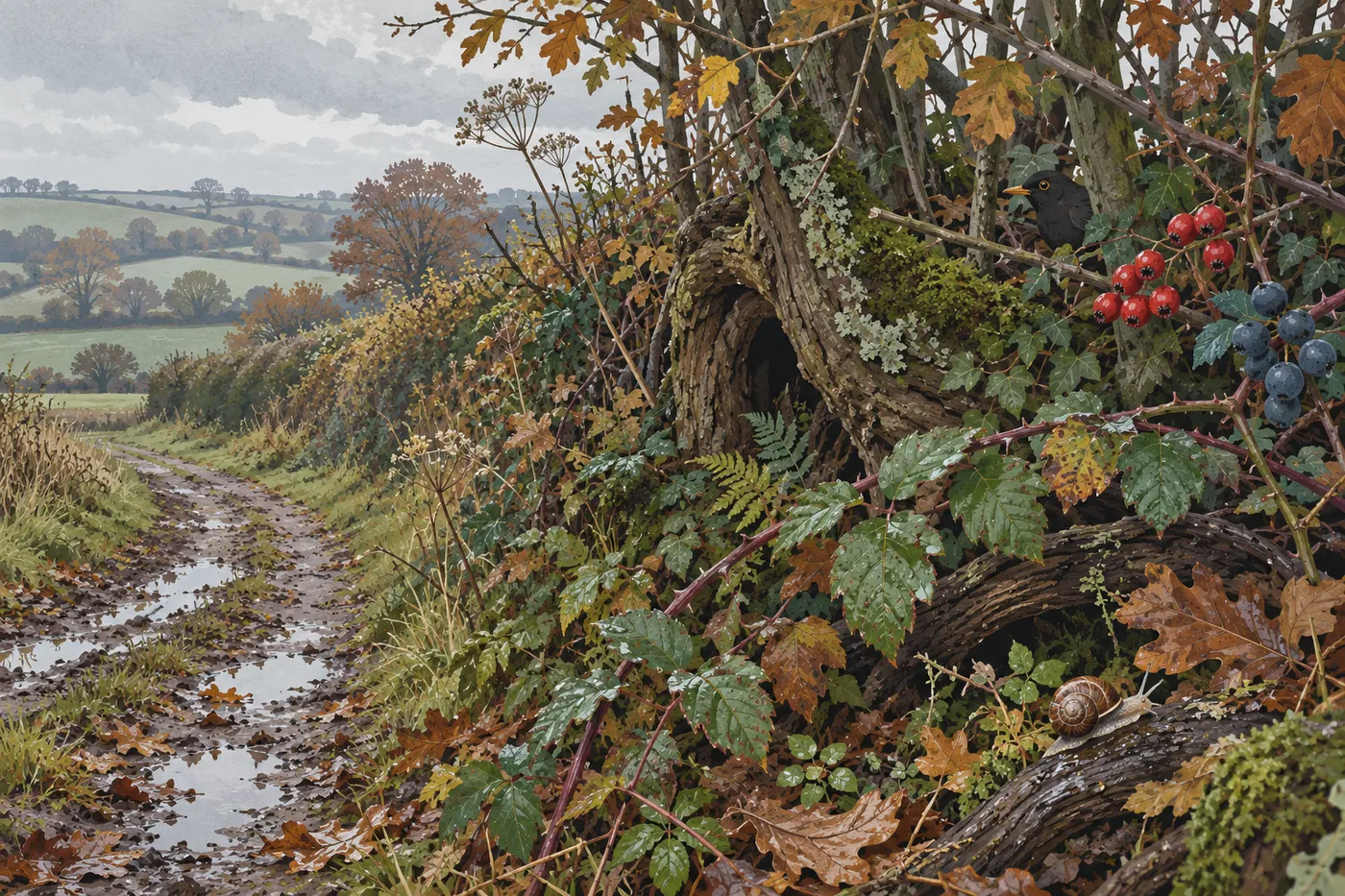
Look closely and its apparent solidity breaks into interstices2: a tunnel between stems, a pocket of dry leaves, a gap beneath a root. A blackbird drops through one of these openings so neatly that the branches seem to close behind it. Higher up, a few haws3 remain, small red points in the grey. Farther along are blackthorn stems bearing the last dusty-blue sloes4. The hedge offers different things to different visitors. To me, a snagged cuff; to the bird, cover and fruit.
Along its base runs an old bank. Here the soil is held in a mesh of roots; there, a boot has exposed a pale stone. Pieces of older wood remain among the new stems, dark and hollow, their surfaces written over by moss. A field boundary becomes a palimpsest5: one season's growth laid across another's, each alteration leaving something visible. Even the plastic thread caught in a fork belongs to this record. It is too easy to call the place timeless when my own century is hanging from it.
The wind rises. One loose leaf turns, stops, turns again. Beyond the hedge, a tractor crosses the field with a steadiness that makes these small movements seem provisional6. Yet the machine will leave; the leaf will eventually fall; next spring another will occupy a slightly different patch of air. Nothing here holds still long enough to resemble the line on a map. The boundary remains, but everything making it is busy changing.
There is comfort in calling such a place wild, though the word can hide the work that shaped it. Someone planted, cut, repaired or spared these stems. Someone decided how wide the path should be. I walk the convenient strip and admire the tangle beside it, complicit7 in the division I am tempted to praise from a distance. The hedge bears the marks of human choices as readily as it bears thorns. Looking carefully means allowing both into the picture.
On the way back I pass the snail again. It has crossed the distance between two wet leaves: an unregarded8 journey made immense by the scale of its traveller. I think of my cleared desk, the brisk pleasure of an empty surface. Tidy. This time the word sounds less like praise than an instruction to remove whatever happens to be in the way.
The hedge keeps no ledger9 that I can read, and its apparent reticence10 is partly my failure to notice. Still, I leave with the sense of having been corrected. I had wanted a neat edge. I found a place with an inside.
やさしい言葉で
From a distance, a hedge looks like a simple line. Walking beside it reveals its shape and depth.
The narrator once admired the hedge when it was neatly cut. Now a bramble and a snail make them stop and look.
There are many small spaces inside the hedge. Birds use them for shelter, and different shrubs provide fruit. The narrator and the bird experience the same place differently.
Old and new growth exist together. Even a piece of plastic records a human presence. The place contains traces of different times.
Small natural movements seem uncertain beside a steady tractor. Yet both the machine and the leaves will move on. The boundary lasts while its living parts keep changing.
People have helped create this landscape. The narrator benefits from a clear path while admiring the plants beside it. They recognise their own part in shaping the place.
Seeing the snail again makes the narrator reconsider the word tidy. A tidy surface may involve removing things that matter to someone else.
The hedge holds traces of change rather than written records. By looking more closely, the narrator has moved from seeing a simple edge to seeing a complex living place.