Reading

B2 English reading about sleep: science and quiz

Try B2 English reading about sleep with stages, memory and the body clock, eight glosses, passive forms, cause-and-effect links and reading questions.

Why do we need sleep?

Sleep supports memory, clear thinking and physical health; the sleeping brain is still active. This B2 text uses passive forms such as is recorded to put the process first, and because or as a result to connect causes and effects. Sleep is more than a simple pause in brain activity.

Yellow the idea to rememberBlue English to learnRed watch out

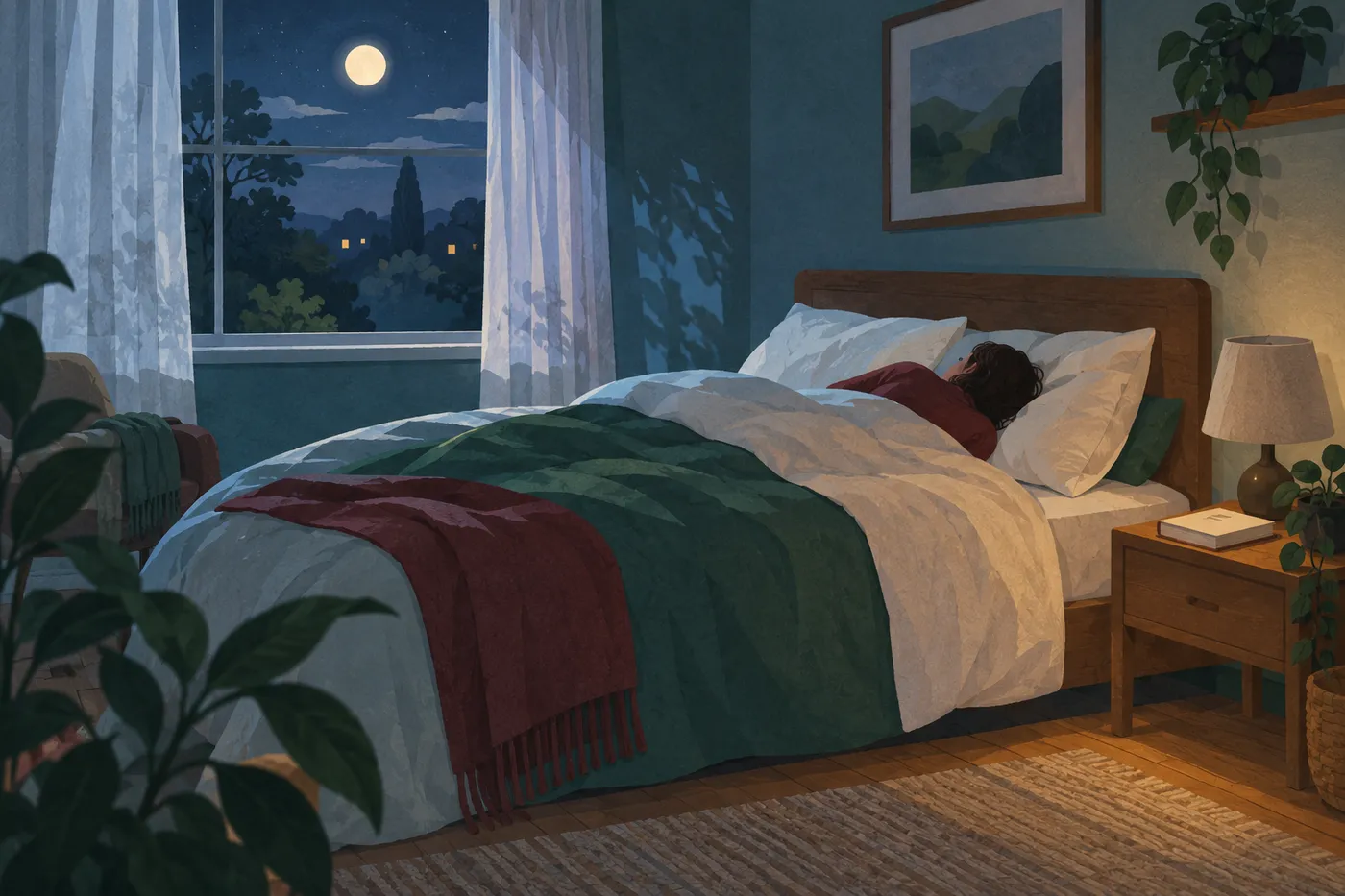
A person sleeps beneath a quilt in a quiet bedroom at night.
A quiet bedroom hides the active work that happens while we sleep. Illustration: Atelier

Why we need sleep

What happens while we sleep?

At the end of a long day, closing your eyes can feel like switching off a machine. Yet inside your head, activity continues. Sleep helps us learn and form long-term memories1. It also supports physical health. The quiet bedroom hides a changing pattern of work.

Sleep is divided into non-REM sleep and REM sleep. REM stands for rapid eye movement2. During non-REM sleep, we pass through stages that include deep sleep. During REM sleep, the brain is highly active and the eyes move quickly beneath closed lids. These different phases are repeated in cycles3 through the night.

How do scientists study sleep?

Brain activity is recorded using sensors4. These measurements help researchers identify the stages. Instead of asking only whether someone slept, scientists can ask how their sleep was organised. Two people may spend the same number of hours in bed but have different patterns of sleep.

What controls when we feel sleepy?

Our need for sleep builds while we are awake. At the same time, the body follows a roughly 24-hour rhythm5, often called the body clock. Light signals received through the eyes help keep this clock in line with day and night.

Bright light late in the evening can affect that timing. As a result, we may feel alert6 when we expect to feel sleepy. This helps explain why the time on a clock and the feeling in our bodies do not always agree.

How does sleep affect the next day?

Sleep supports learning, while too little good-quality sleep can make it harder to concentrate7. Because attention is reduced, tasks that normally feel simple may take more effort. Reading the same sentence again and again can be a familiar sign of that difficulty.

Think of sleep as part of learning, rather than time taken away from it. A page of notes records what you studied; the next day's recall8 shows what you can bring back to mind. The hours between the two are far from empty.

In simpler words

Sleep may look like a time when the brain stops, but the brain is active. Sleep helps learning, memory and physical health.

We move through different types and stages of sleep during the night. REM sleep includes quick eye movements and high brain activity.

Researchers use measuring devices to identify sleep stages. The number of hours in bed tells only part of the story.

The longer we stay awake, the more we need sleep. Our bodies also follow a daily pattern. Light helps keep this pattern connected to day and night.

Bright evening light can change when we feel ready to sleep. We may still feel awake at bedtime.

Too little good sleep can make it hard to pay attention. Ordinary tasks can then feel harder.

Sleep is part of the learning process. What happens overnight matters as well as what we write in our notes.

Why does the text say 'Brain activity is recorded'?

Researchers record brain activity.The sentence starts with the people doing the work.

Focus: Who does the action?

Researchers record brain activity using sensors.
The researchers do the recording.

Brain activity is recorded using sensors.The sentence starts with what is measured.

Focus: What happens to brain activity?

subject + am / is / are + past participle

Brain activity is recorded using sensors.
The recording is the main point.

Keep the same time and meaning when changing the voice
ActivePassive
Sensors record brain activity.Brain activity is recorded by sensors.
Researchers recorded eye movements last night.Eye movements were recorded last night.
Researchers can measure sleep patterns.Sleep patterns can be measured.

How do you connect a cause to its effect?

Three ways to show the link
PatternExample
because + causeTasks may take more effort because attention is reduced.
cause + so + effectAttention is reduced, so tasks may take more effort.
cause. As a result, + effectAttention is reduced. As a result, tasks may take more effort.

Because introduces the reason; so introduces the result. The order changes, but the link stays the same. Avoid because ... so for the same link: choose one of the two patterns above.

Which objects help you talk about sleep research?

Sleep and measurement

Can you follow the science and the language?

Question 1No account needed
Which statement matches the text?

Choose one answer.

Answer and explanation

Different sleep phases repeat through the night.. The text describes non-REM and REM sleep. The phases occur in repeated cycles rather than as one unchanging state.

Question 2No account needed
Why are sensors useful to sleep researchers?

Choose one answer.

Answer and explanation

They provide measurements that help identify sleep stages.. Sensors record activity. Researchers use the measurements to identify stages and compare sleep patterns.

Question 3No account needed
In 'Attention is reduced, so tasks may take more effort', what follows 'so'?

Choose one answer.

Answer and explanation

The possible effect.. So introduces the result: tasks may take more effort. Reduced attention is the cause given before it.

Question 4No account needed
Which sentence is the correct passive of 'Researchers can measure sleep patterns'?

Choose one answer.

Answer and explanation

Sleep patterns can be measured.. Use can + be + past participle. The past participle of measure is measured.

Built from