Lectura

Lectura de inglés de B2 sobre el sueño: ciencia y cuestionario

Practica la lectura de inglés de B2 sobre el sueño: fases, memoria y reloj biológico, ocho notas de vocabulario, formas pasivas, relaciones de causa y efecto y preguntas de lectura.

¿Por qué necesitamos dormir?

Dormir favorece la memoria, la claridad de pensamiento y la salud física; el cerebro sigue activo mientras duerme. Este texto de B2 usa formas pasivas como is recorded para poner el proceso en primer plano, y because o as a result para conectar causas y efectos. El sueño es más que una simple pausa en la actividad cerebral.

Amarillo la idea para recordarAzul inglés para aprenderRojo cuidado con esto

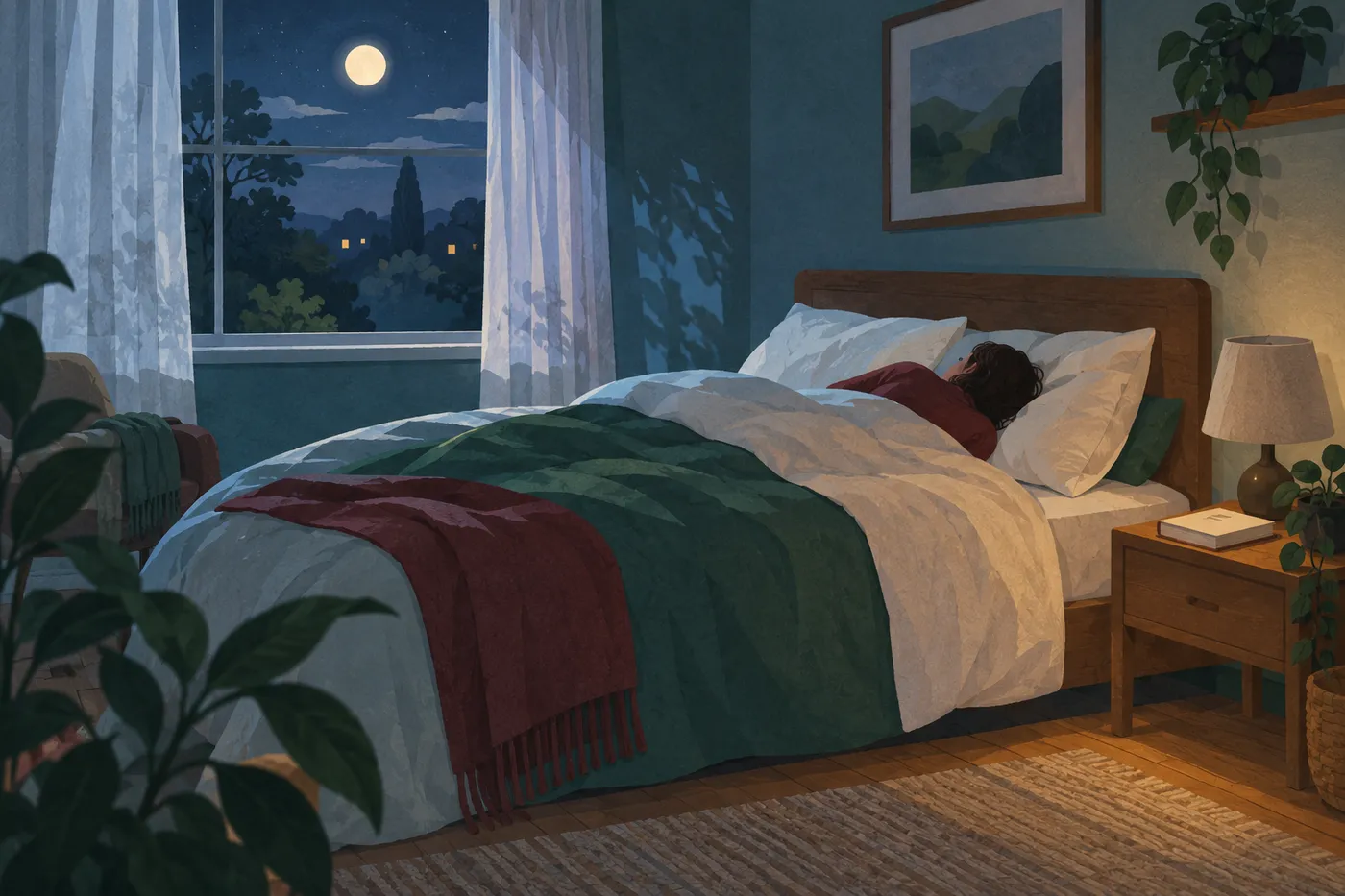
Una persona duerme bajo un edredón en un dormitorio tranquilo por la noche.
Un dormitorio tranquilo oculta el trabajo activo que ocurre mientras dormimos (while we sleep). Ilustración: Atelier

Why we need sleep

What happens while we sleep?

At the end of a long day, closing your eyes can feel like switching off a machine. Yet inside your head, activity continues. Sleep helps us learn and form long-term memories1. It also supports physical health. The quiet bedroom hides a changing pattern of work.

Sleep is divided into non-REM sleep and REM sleep. REM stands for rapid eye movement2. During non-REM sleep, we pass through stages that include deep sleep. During REM sleep, the brain is highly active and the eyes move quickly beneath closed lids. These different phases are repeated in cycles3 through the night.

How do scientists study sleep?

Brain activity is recorded using sensors4. These measurements help researchers identify the stages. Instead of asking only whether someone slept, scientists can ask how their sleep was organised. Two people may spend the same number of hours in bed but have different patterns of sleep.

What controls when we feel sleepy?

Our need for sleep builds while we are awake. At the same time, the body follows a roughly 24-hour rhythm5, often called the body clock. Light signals received through the eyes help keep this clock in line with day and night.

Bright light late in the evening can affect that timing. As a result, we may feel alert6 when we expect to feel sleepy. This helps explain why the time on a clock and the feeling in our bodies do not always agree.

How does sleep affect the next day?

Sleep supports learning, while too little good-quality sleep can make it harder to concentrate7. Because attention is reduced, tasks that normally feel simple may take more effort. Reading the same sentence again and again can be a familiar sign of that difficulty.

Think of sleep as part of learning, rather than time taken away from it. A page of notes records what you studied; the next day's recall8 shows what you can bring back to mind. The hours between the two are far from empty.

Con palabras más sencillas

Sleep may look like a time when the brain stops, but the brain is active. Sleep helps learning, memory and physical health.

We move through different types and stages of sleep during the night. REM sleep includes quick eye movements and high brain activity.

Researchers use measuring devices to identify sleep stages. The number of hours in bed tells only part of the story.

The longer we stay awake, the more we need sleep. Our bodies also follow a daily pattern. Light helps keep this pattern connected to day and night.

Bright evening light can change when we feel ready to sleep. We may still feel awake at bedtime.

Too little good sleep can make it hard to pay attention. Ordinary tasks can then feel harder.

Sleep is part of the learning process. What happens overnight matters as well as what we write in our notes.

¿Por qué dice el texto «Brain activity is recorded»?

Researchers record brain activity.La frase empieza por las personas que hacen el trabajo.

Objetivo: ¿Quién realiza la acción?

Researchers record brain activity using sensors.
Los investigadores realizan el registro.

Brain activity is recorded using sensors.La frase empieza por lo que se mide.

Objetivo: ¿Qué le ocurre a la actividad cerebral?

sujeto + am / is / are + participio pasado

Brain activity is recorded using sensors.
El registro es el punto principal.

Mantén el mismo tiempo y significado al cambiar la voz
ActivaPasiva
Sensors record brain activity.Brain activity is recorded by sensors.
Researchers recorded eye movements last night.Eye movements were recorded last night.
Researchers can measure sleep patterns.Sleep patterns can be measured.

¿Cómo conectas una causa con su efecto?

Tres formas de mostrar el vínculo
EstructuraEjemplo
because + causaTasks may take more effort because attention is reduced.
causa + so + efectoAttention is reduced, so tasks may take more effort.
causa. As a result, + efectoAttention is reduced. As a result, tasks may take more effort.

Because introduce la razón; so introduce el resultado. El orden cambia, pero el vínculo se mantiene. Evita because ... so para un mismo vínculo: elige una de las dos estructuras anteriores.

¿Qué objetos te ayudan a hablar de la investigación del sueño?

Sueño y medición

¿Puedes seguir la ciencia y el lenguaje?

Pregunta 1No necesitas una cuenta
¿Qué afirmación coincide con el texto?

Elige una respuesta.

Respuesta y explicación

Different sleep phases repeat through the night.. El texto describe el sueño no REM y el sueño REM. Las fases se producen en ciclos repetidos, en lugar de en un único estado sin cambios.

Pregunta 2No necesitas una cuenta
¿Por qué son útiles los sensores para quienes investigan el sueño?

Elige una respuesta.

Respuesta y explicación

They provide measurements that help identify sleep stages.. Los sensores registran actividad. Los investigadores usan las mediciones para identificar fases y comparar patrones de sueño.

Pregunta 3No necesitas una cuenta
En «Attention is reduced, so tasks may take more effort», ¿qué sigue a «so»?

Elige una respuesta.

Respuesta y explicación

The possible effect.. So introduce el resultado: las tareas pueden requerir más esfuerzo. La menor atención es la causa que aparece antes.

Pregunta 4No necesitas una cuenta
¿Qué frase es la pasiva correcta de «Researchers can measure sleep patterns»?

Elige una respuesta.

Respuesta y explicación

Sleep patterns can be measured.. Usa can + be + past participle, con participio pasado. El participio pasado de measure es measured.

Elaborado a partir de