In, on or at? Prepositions of time and place
In, on or at for time and place: choose the right word for days, times, rooms and streets, then compare by, until, during, next to and opposite.
In short
Prepositions are small words that tell us when or where: at ten, on Friday, in the room. For time, use at with clock times, on with days and dates, and in with months and years. For place, in often means inside, on means on a surface, and at gives a place to meet or do something. Use by for a latest time, until for when something stops, during with an event, next to for beside, and opposite for facing across a space.
Yellow the idea to rememberBlue English to learnRed watch out
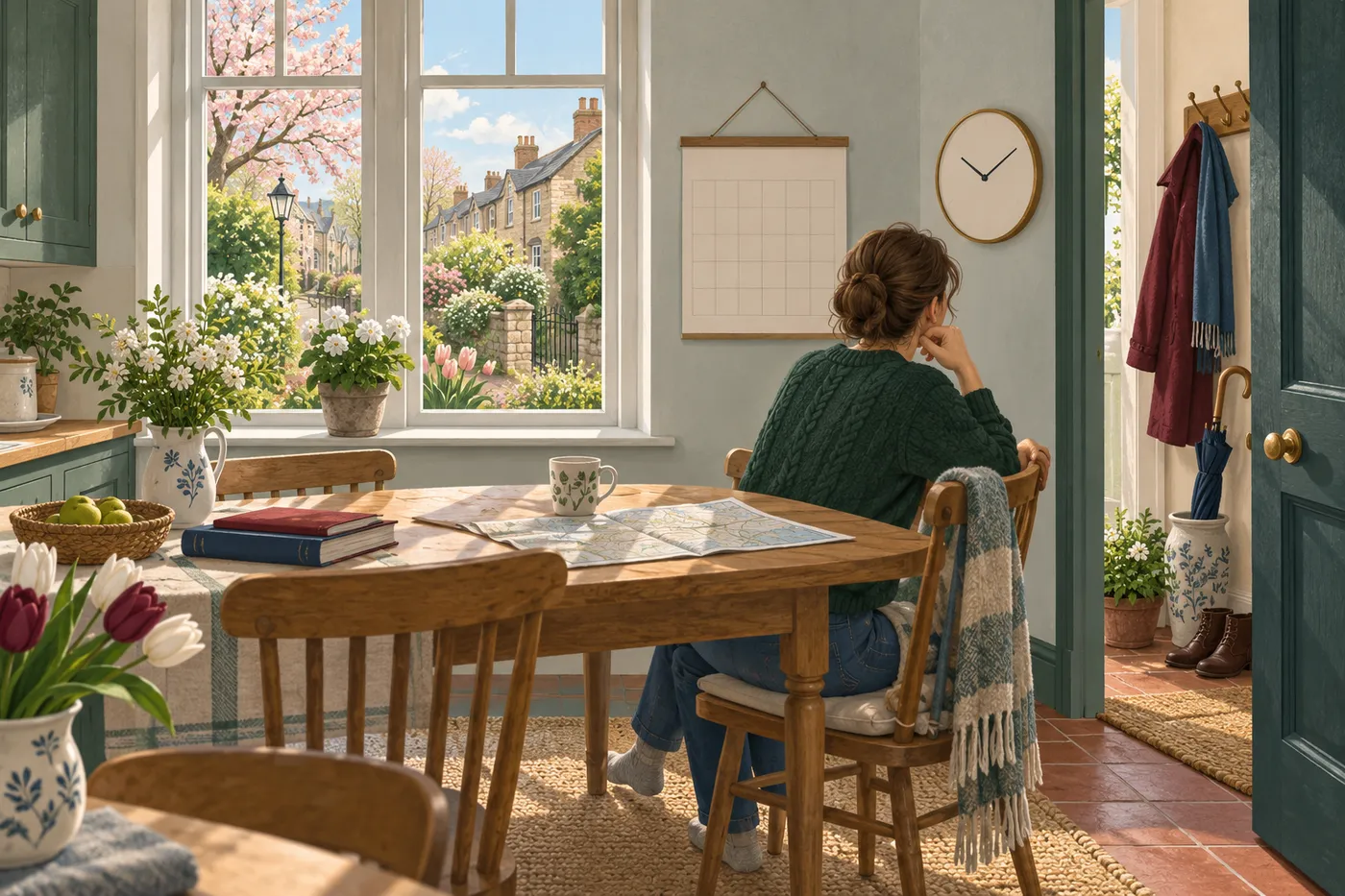
When do you use in, on and at for time?
Use in for months, years and seasons, on for days and dates, and at for clock times. Think of a visit: you choose the month, then the day, then the time. You can use all three in one message, but each goes with a different time word.
| Use | Time words | Example |
|---|---|---|
| in | months, years, seasons | in May; in 2027; in winter |
| on | days and dates | on Friday; on 12 May; on my birthday |
| at | clock times and some fixed phrases | at ten; at 10.30; at noon |
River Room opens at ten on Friday.
Ten is the clock time. Friday is the day.
These are the Friday opening details in module 4.
My birthday is in May. This year, my party is on 12 May.
The first sentence gives the month. The second gives the date.
Write days and months with capital letters: Monday, Friday, May. A date can be written as 12 May. When speaking, say the twelfth of May. The small word stays the same: on the twelfth of May.
Do you say in the morning or on Monday morning?
Say in the morning, but on Monday morning when you name the day. The same change works with afternoon and evening. Learn at night and the British phrase at the weekend together.
| General time | A named day or special time |
|---|---|
| in the morning | on Monday morning |
| in the afternoon | on Friday afternoon |
| in the evening | on Saturday evening |
| at night | on the night of 12 May |
| at the weekend | on Sunday |
I work in the morning, but I'm free on Saturday morning.
The first phrase gives a part of the day. The second gives a day as well.
Use at Christmas for the holiday period and on Christmas Day for that one day. In American English, you will often hear on the weekend; British English usually has at the weekend.
Do you need a preposition before next Monday?
Leave out in, on and at before time phrases starting with next, last, this or every. Also leave them out before today, tomorrow and yesterday. Say next Monday, not on next Monday.
| With a preposition | With no preposition |
|---|---|
| on Monday | next Monday |
| in the evening | this evening |
| on Friday | last Friday |
| at ten | tomorrow at ten |
See you next Tuesday at six.
There is no preposition before next Tuesday. The clock time still needs at.
The same message can have both kinds of phrase: I'm busy this morning. Can we meet in the afternoon? Check each phrase on its own. This already tells us which morning.
When do you use in, on and at for place?
Use in for inside a space, on for a surface, and at for a location or meeting point. At can tell someone where to find you. In gives the extra detail that you are inside.
| Word | Use | Example |
|---|---|---|
| in | inside; a town or country | in the box; in Leeds; in England |
| on | touching a surface | on the desk; on the wall |
| at | a meeting point or activity | at the entrance; at work; at school |
Rina's wallet is on the desk. The keys are in the bag.
The wallet rests on the top. The keys are inside the bag.
I'm at the station. I'm in the waiting room.
The station is the general location. The waiting room tells you exactly where to look.
Learn at home, at work and at school as whole phrases. They have no the in these everyday uses. Compare I'm at school with I'm in the school office: the second phrase names a room inside the building.
What is the difference between next to and opposite?
Use next to for beside something and opposite for across a space from it. A door can be next to a desk. Two shops can be opposite each other, with a road between them. Both phrases answer Where is it?
| Phrase | Meaning | Example |
|---|---|---|
| next to | beside | The bookshop is next to the bank. |
| opposite | facing across a space | The cafe is opposite the bank. |
| by | near or beside | Wait by the blue door. |
The Oak room is next to the desk.
The room is beside the desk, so it is easy to find.
Module 8 uses this detail when people choose a room.
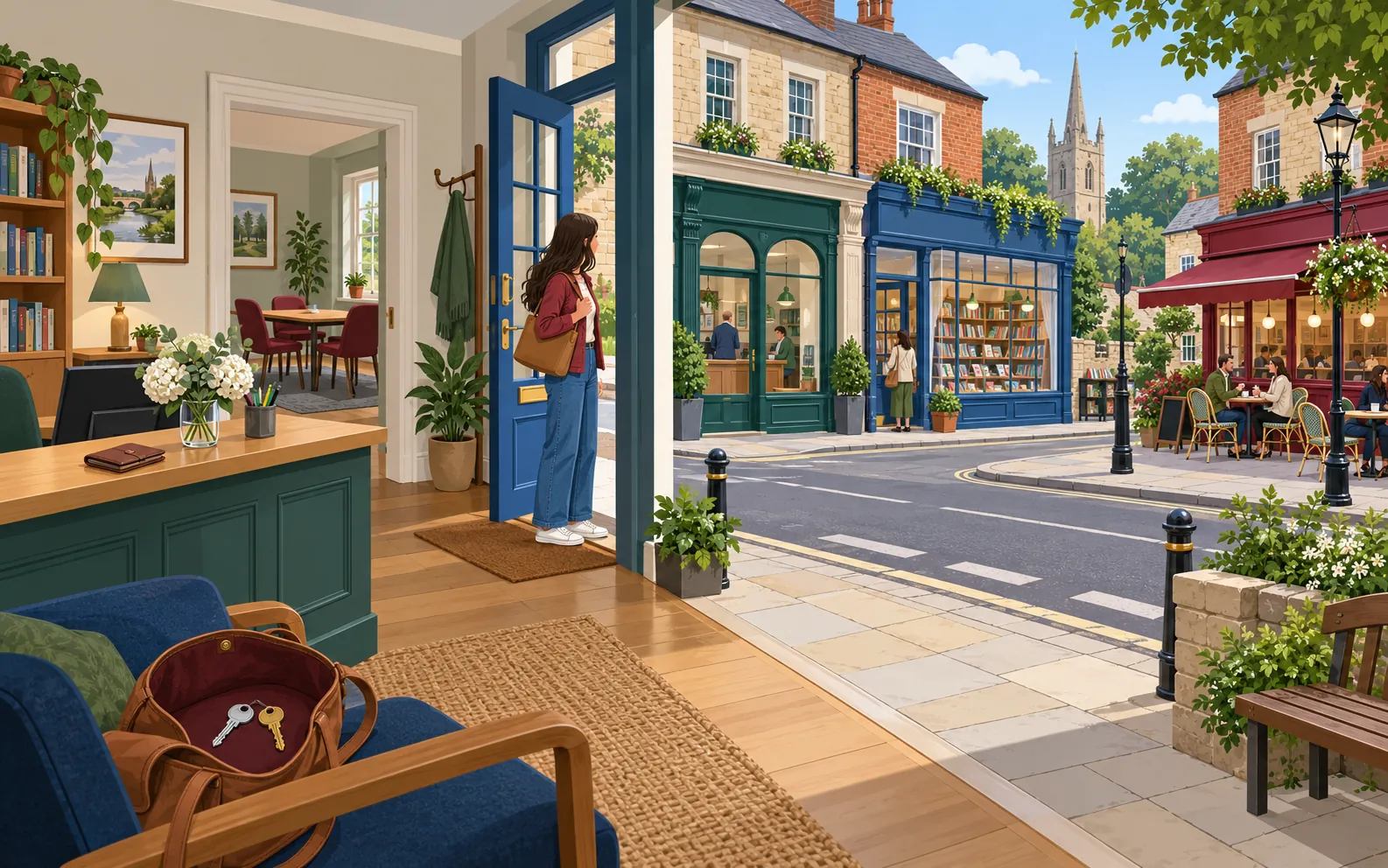
Where is everything near the community room?
Find:
Which prepositions do you use for travel and addresses?
Say in a car or in a taxi, but on a bus or on a train when you are a passenger. For a full address with a number, use at. For a town or country, use in.
| Question | Answer |
|---|---|
| Where are you? | I'm on the bus. |
| Where is Jo? | She's in a taxi. |
| How do you travel? | By bus, or on foot. |
| Where is the class? | At 18 Green Road, in Leeds. |
I usually come by bus. Today I'm in a taxi.
By bus tells you how I usually travel. In a taxi tells you where I am now.
With a street name alone, British English often uses in: The class is in Green Road. Add the number, and use at 18 Green Road.
Use no article in by bus, by train and by car. Keep the article when you say where you are: on the bus, in the car. We say on foot for walking. These are useful phrases to learn together.
What is the difference between by and until?
Use by for the latest time to finish or arrive, and until for the time when an activity stops. By five means at five or earlier; until five means the activity continues up to five.
| Phrase | What happens? |
|---|---|
| Please arrive by ten. | Come at ten or earlier. |
| Please wait until ten. | Keep waiting; stop at ten. |
| Send the form by Friday. | Friday is the last day to send it. |
| The office is open until five. | It stays open, then closes at five. |
I need to leave by twelve, so I can only stay until half past eleven.
Twelve is my latest leaving time. My visit ends at half past eleven.
You can also give both ends of a period: The room is open from ten until five. From ten to five is another way to say this. Until and till have the same meaning here; until works well in messages and notices.
When do you use during?
Use during before an event or period, such as the lesson, the film or the night. It tells us when something happens. Use for with a length of time, such as two hours.
| Use | Example |
|---|---|
| during + event | My phone rang during the lesson. |
| for + length of time | We waited for twenty minutes. |
| while + person and action | My phone rang while I was cooking. |
Please keep your phone in your bag during the session.
Keep it there while the session is happening.
We talked for ten minutes during the break.
Ten minutes tells you how long. The break tells you when.
Which preposition mistakes should you check?
Check the word after the preposition: a day, a time, a place or an event. Some phrases need a different small word; some need none.
- The class starts in Monday.The class starts on Monday.
Use on with a day, including Monday morning.
- I'll see you at next week.I'll see you next week.
Next week is a complete time phrase. Leave out at.
- The keys are on my pocket.The keys are in my pocket.
The keys are inside the pocket, so use in.
- Please finish until Friday.Please finish by Friday.
A latest finishing time needs by. Use until for an activity that continues.
- We waited during two hours.We waited for two hours.
Two hours tells you how long. Use for with a length of time.
How can you check your time and place phrases?
Ask When? or Where? first, then look at the kind of word that follows. Use this list to check a message about a visit.
Can you choose the right prepositions?
Choose one answer each time. Think about the whole phrase, especially whether it gives a clock time, a day, a place or a time limit.