Updated
Gap-fill
Prepositions of movement in English: into, onto and through
Learn prepositions of movement in English with routes and clear examples. Compare into, onto, across and through, then practise a short journey.
- A2
- 6 gaps
- Hints in brackets
- Learn this in the A2 notebook →
In short
Prepositions of movement in English describe where something goes and the path it takes. Into means to the inside, onto means to a surface, and through means via an enclosed space; in and on usually describe position rather than the whole movement.
Yellow the idea to rememberBlue English to learnRed watch out
What is the difference between into and in?
She walked into the room describes a change from outside to inside. She walked in the room places the walking inside the room. Likewise, The cat jumped onto the table tells us its destination, while The cat is on the table tells us its position. Some movement verbs can naturally take in or on, such as Come in and Put it on the table. Learn the full expression rather than changing every in to into.
| Preposition | Example | Path |
|---|---|---|
| to | Walk to the café. | towards a destination, usually reaching it |
| towards | Walk towards the café. | in its direction; arrival is not certain |
| into | Go into the building. | from outside to inside |
| out of | Come out of the building. | from inside to outside |
| onto | Step onto the platform. | to a surface |
| off | Step off the platform. | away from a surface |
| across | Walk across the road. | from one side to the other |
| through | Walk through the tunnel. | via an enclosed space |
| along | Walk along the river. | following its length |
| past | Walk past the shop. | go beyond it |
| over | Climb over the wall. | cross above it |
| under | Walk under the bridge. | pass below it |
Should you say across or through?
Choose across when you think of an area as a surface with two sides: across the square, across the road. Choose through for a route within something: through the tunnel, through the forest, through the crowd. A park can take either, depending on the picture: across the park focuses on crossing it, while through the park focuses on the route inside it.
Can you follow a route to the café?
From the garden entrance
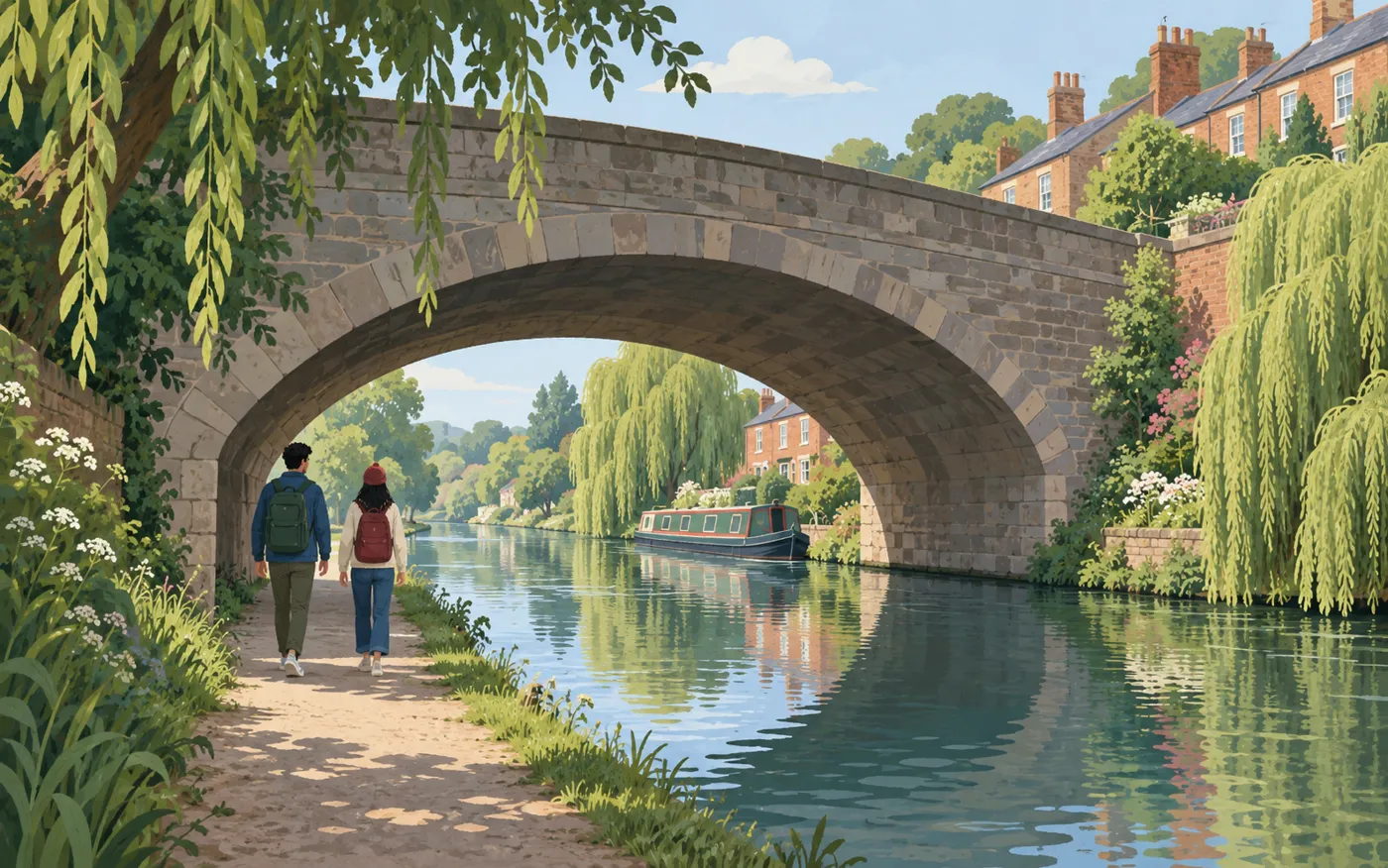
Start at the garden entrance. Walk (following the length of) the path beside the river. Go (below) the small bridge, then continue past the ticket office.
Turn right and walk (inside an enclosed passage) the short tunnel. At the far end, go (from one side to the other) the square. Watch for bicycles before you cross.
Go (from outside to inside) the café and order at the counter. When you finish, come (from inside to outside) the café and turn left to return to the entrance.
- We arrived to the café.We arrived at the café.
Arrive uses at for a place such as a café; the verb does not take destination to.