C1 思考性随笔|公平、沉默与小小的例外
On queueing
At the bus stop, a queue exists mainly in people's memories. There is no rope, no numbered ticket, sometimes not even a straight line. Yet when the bus arrives, we are expected to remember who came before us. A few strangers have made a tacit agreement1 without the inconvenience of a meeting.
I used to admire this as a neat expression of fair play2. Arrival time seemed an admirably modest qualification for getting on a bus. You needed neither an impressive job title nor a convincing speech. You simply needed to have been there first. The queue made status briefly irrelevant, or at least gave us the pleasure of thinking that it did.
Then someone would arrive at the front and ask whether this was the right stop. The question was reasonable. Remaining at the front afterwards was a little ambitious. Behind the newcomer, newspapers would be lowered by half an inch. A cough would acquire unexpected importance. Everyone appeared reluctant to make a scene3, while several people quietly prepared one.
'There's a queue,' someone would eventually say. As information, this was not especially useful: six waiting people were already visible. As a rebuke4, however, it was wonderfully economical. The speaker could defend the order while appearing merely to describe it.
This is the sort of episode that invites a sweeping claim5 about British character. We are said to love queues, dislike confrontation and express fury through comments about the weather. It is an entertaining portrait, but a portrait has edges. At another stop, someone may object directly. Elsewhere, the group may invite a tired passenger to go first. The same people can behave differently when the circumstances change.
A queue also asks us to decide which exceptions count. A parent collecting a dropped toy may return to their place; a friend arriving late creates a more awkward question. First come, first served6 sounds complete until life supplies a detail that the rule has overlooked. Equality of waiting time is not always equality of need.
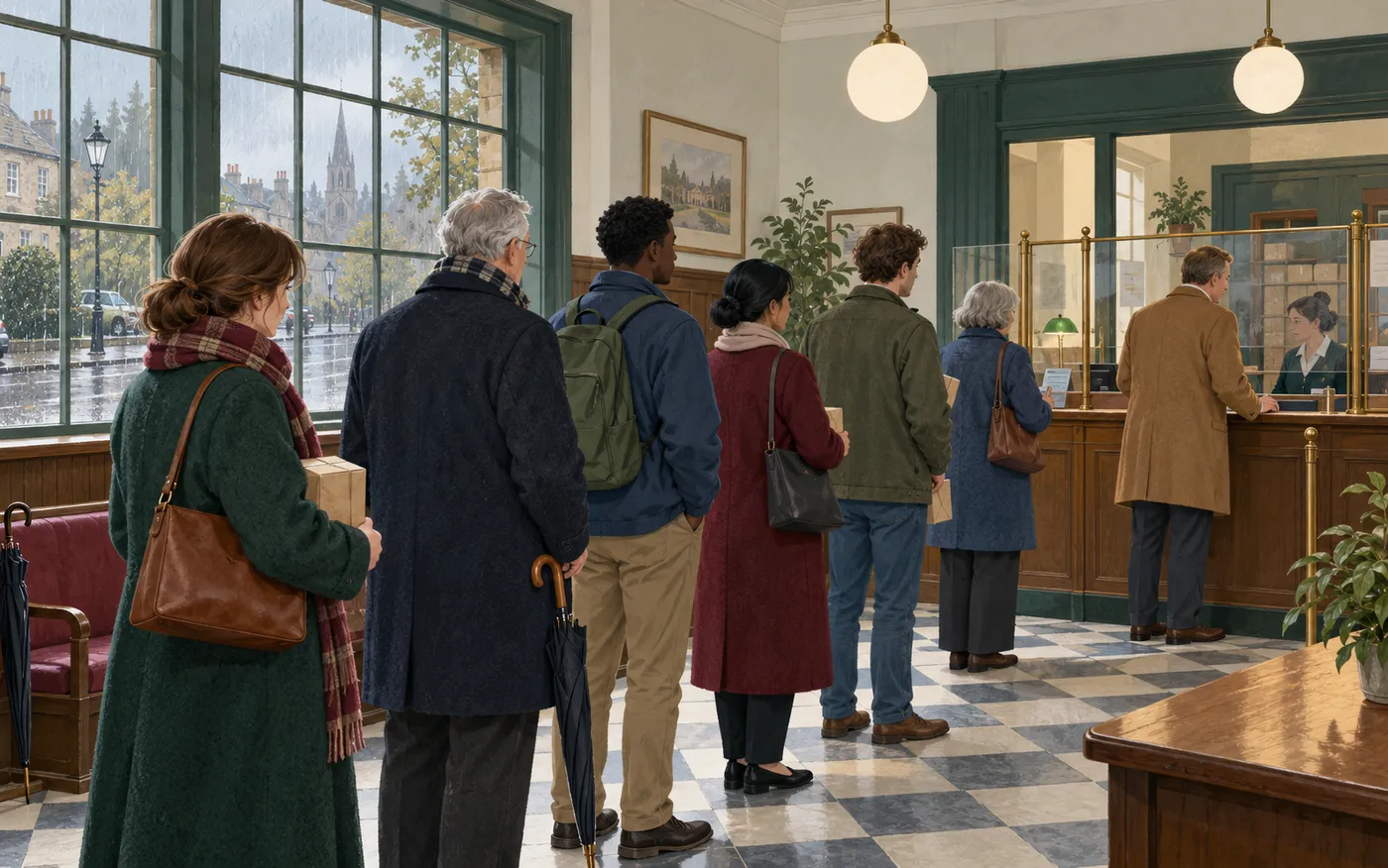
In a supermarket recently, I watched a line of customers beside a closed till while the open one stood empty. We had achieved a model of efficiency7: perfect order, no movement. Once the mistake became clear, the line dissolved into laughter. Our loyalty had been directed towards the shape of a queue rather than its purpose.
The virtue of queueing, then, lies less in national temperament than in mutual restraint8. We accept a short delay so that others can expect fair treatment. That is an achievement worth protecting, provided the rule remains open to explanation. The best queue may be the one in which a person can ask for an exception without being treated as a threat to civilisation9.
换个简单的说法
People at a bus stop often remember who arrived first, even when there is no clear line.
The narrator once thought this was a simple way to treat people equally.
A newcomer asks a question and then stays at the front. Other people are annoyed but hesitate to say so.
When someone says there is a queue, they are also telling the newcomer to respect it.
The narrator questions the idea that everyone in Britain behaves in the same way.
A rule based on arrival time can be difficult to apply when someone needs extra help.
Customers wait at a closed till. The group laughs when it realises the mistake.
The narrator values fair treatment but also wants people to explain and allow reasonable exceptions.