قصة للمستوى C2: السجلّات والذاكرة وعبور لم يُحسم
The last ferry
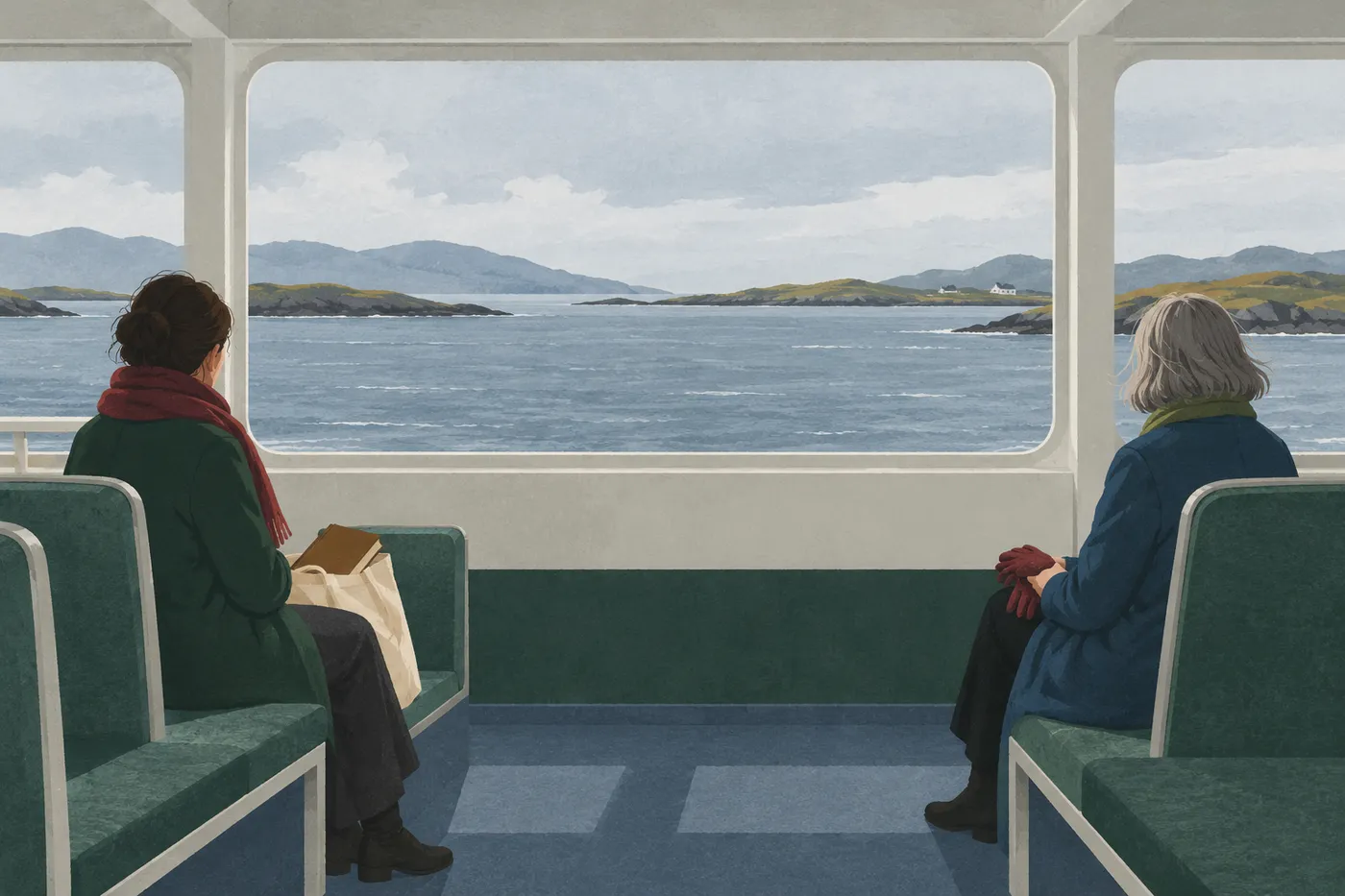
I took the last ferry across the Hebridean sound with my father's logbook in a supermarket bag. The archive had offered me an acid-free box; I had declined it, as though careful packaging might make the contents more significant than they were. He had been dead six weeks. Already I could describe the book as an administrative matter1.
Beyond the saloon window lay a strip of pewter water. On the opposite seat, a woman worked a loose thread back into the cuff of her glove. Her suitcase was yellow, the colour almost entirely scuffed away at the corners. I had seen a suitcase like it before. That was hardly remarkable. People kept things.
'Salt gets into the binding,' she said. I looked down. One corner of the book had emerged from the bag. 'You ought to wrap it.'
I tucked it away. The book covered my father's last summer as skipper. During that summer, a woman and her small daughter had disappeared. Their names had been entered on the passenger list for an evening crossing and subsequently struck through2. The newspaper said they were presumed drowned3. My father said very little. At seventeen, working in the company office for the holidays, I had understood silence as a form of authority.
The stranger stopped worrying at her glove. 'Did he keep the first version?'
'Of what?'
'The account.'
I had typed the company statement. Two passengers did not travel. In the logbook, in my father's cramped handwriting, the words were different: two passengers failed to arrive. The distinction had seemed immaterial4 when he dictated the statement. It had become useful when questions were asked.
'I wrote what I was given,' I said.
She smiled, politely enough to let me hear how little that answered. Outside, the island lights began to resolve themselves into5 separate windows. I remembered a landing place on the eastern shore: a disused jetty, a yellow suitcase, a red glove raised once. I had told myself, for thirty years, that this memory belonged to another crossing.
'Your father gave us a choice,' the woman said.
The engine note dropped. Somewhere below us a chain dragged across steel. I wanted her to explain the choice before I had to ask about it. There had been a man waiting on the main quay that evening. I remembered him too, although his presence had never found its way into6 anything I typed.
'The little girl had red gloves,' I said.
'One red glove. I dropped the other.'
I thought of the relief a simple accusation would have offered: my father guilty, myself merely young. Instead, she had brought a suitcase and a correction. I could still ask where they had gone, who had helped them afterwards, why nobody had written. Each question would begin by admitting that I had known they reached a shore.
The woman stood as the ferry nosed towards7 the quay. 'My mother said you would have kept the book.'
'I thought it might clear his name8.'
'Whose name?'
I lifted the bag onto my knees. I remembered my father's note beneath the two names: see office copy. The copy bore my initials.
'She would like hers back,' the woman said.
Below us, the ramp met the quay with a judder9. I opened the bag properly, then opened the book. For the first time since his death, I read her mother's name aloud. I could no longer bring myself to10 treat it as a line of paperwork.