Histoire adaptée au niveau

Nouvelle en anglais C2 : le dernier ferry, avec questions

Lisez une nouvelle en anglais C2 à bord d’un ferry des Hébrides : journal de bord contesté, passagère inattendue, définitions et questions sur les déductions et les détails.

L’essentiel

Lisez cette énigme C2 en comparant les formulations de la narratrice aux détails dont elle se souvient. Distinguez did not travel, « n’ont pas voyagé », et failed to arrive, « ne sont pas arrivées à destination ». L’explication d’une narratrice peut omettre ce que révèlent ses propres souvenirs.

Jaune l’idée à retenirBleu l’anglais à retenirRouge point de vigilance

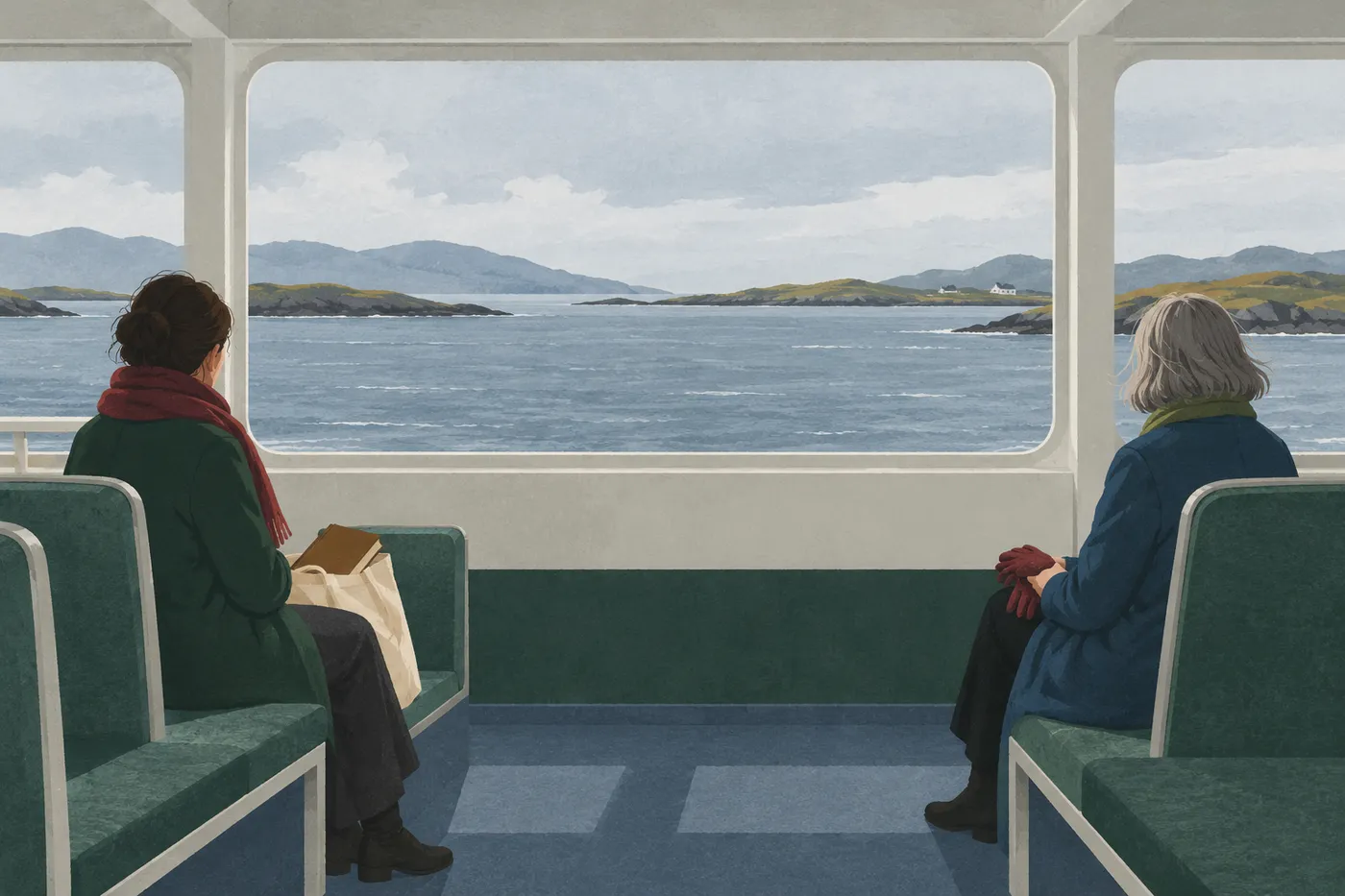
Deux femmes sont assises face à face dans la cabine d’un ferry, avec un livre et un gant rouge.
Le livre et le gant portent deux versions de ce qui s’est passé sur the last ferry, « le dernier ferry ». Illustration : Atelier

Nouvelle C2 – documents, mémoire et traversée inachevée

The last ferry

I took the last ferry across the Hebridean sound with my father's logbook in a supermarket bag. The archive had offered me an acid-free box; I had declined it, as though careful packaging might make the contents more significant than they were. He had been dead six weeks. Already I could describe the book as an administrative matter1.

Beyond the saloon window lay a strip of pewter water. On the opposite seat, a woman worked a loose thread back into the cuff of her glove. Her suitcase was yellow, the colour almost entirely scuffed away at the corners. I had seen a suitcase like it before. That was hardly remarkable. People kept things.

'Salt gets into the binding,' she said. I looked down. One corner of the book had emerged from the bag. 'You ought to wrap it.'

I tucked it away. The book covered my father's last summer as skipper. During that summer, a woman and her small daughter had disappeared. Their names had been entered on the passenger list for an evening crossing and subsequently struck through2. The newspaper said they were presumed drowned3. My father said very little. At seventeen, working in the company office for the holidays, I had understood silence as a form of authority.

The stranger stopped worrying at her glove. 'Did he keep the first version?'

'Of what?'

'The account.'

I had typed the company statement. Two passengers did not travel. In the logbook, in my father's cramped handwriting, the words were different: two passengers failed to arrive. The distinction had seemed immaterial4 when he dictated the statement. It had become useful when questions were asked.

'I wrote what I was given,' I said.

She smiled, politely enough to let me hear how little that answered. Outside, the island lights began to resolve themselves into5 separate windows. I remembered a landing place on the eastern shore: a disused jetty, a yellow suitcase, a red glove raised once. I had told myself, for thirty years, that this memory belonged to another crossing.

'Your father gave us a choice,' the woman said.

The engine note dropped. Somewhere below us a chain dragged across steel. I wanted her to explain the choice before I had to ask about it. There had been a man waiting on the main quay that evening. I remembered him too, although his presence had never found its way into6 anything I typed.

'The little girl had red gloves,' I said.

'One red glove. I dropped the other.'

I thought of the relief a simple accusation would have offered: my father guilty, myself merely young. Instead, she had brought a suitcase and a correction. I could still ask where they had gone, who had helped them afterwards, why nobody had written. Each question would begin by admitting that I had known they reached a shore.

The woman stood as the ferry nosed towards7 the quay. 'My mother said you would have kept the book.'

'I thought it might clear his name8.'

'Whose name?'

I lifted the bag onto my knees. I remembered my father's note beneath the two names: see office copy. The copy bore my initials.

'She would like hers back,' the woman said.

Below us, the ramp met the quay with a judder9. I opened the bag properly, then opened the book. For the first time since his death, I read her mother's name aloud. I could no longer bring myself to10 treat it as a line of paperwork.

Quels objets vous aident à suivre l’énigme ?

Des objets à remarquer à la deuxième lecture

Comment de petits changements de formulation créent-ils le doute ?

Trois formulations à comparer
FormulationCe que font les mots
Two passengers did not travel.Indique que ces passagères n’ont jamais commencé le voyage.
Two passengers failed to arrive.Indique qu’elles n’ont pas atteint la destination attendue, sans préciser leur itinéraire.
'Whose name?'Renvoie la question de la responsabilité à la narratrice.

Au début, la narratrice qualifie le livre d’administrative matter, « affaire administrative ». À la fin, elle lit à voix haute le nom de la mère de la femme. L’évolution de son langage montre ce qu’elle accepte désormais d’affronter.

Quelles interprétations pouvez-vous étayer avec le récit ?

Question 1Aucun compte nécessaire
Quelle est la différence la plus claire entre le communiqué et le journal de bord ?

Choisissez une seule réponse.

Réponse et explication

The statement denies travel; the logbook records a failure to arrive.. Did not travel exclut le voyage lui-même. Failed to arrive laisse ouverte la possibilité d’un voyage terminé ailleurs.

Question 2Aucun compte nécessaire
Quel détail étaye le plus fortement le lien entre l’inconnue et l’enfant disparue ?

Choisissez une seule réponse.

Réponse et explication

She corrects two red gloves to one and recalls dropping the other.. La correction ajoute un détail précis au souvenir de la narratrice et relie l’inconnue à l’enfant.

Question 3Aucun compte nécessaire
Que suggère le souvenir de la jetée ?

Choisissez une seule réponse.

Réponse et explication

She has long had reason to think the passengers reached land.. Elle se rappelle la valise et un gant levé près d’une jetée, puis reconnaît qu’elle savait qu’elles avaient atteint une rive.

Question 4Aucun compte nécessaire
Quel est l’effet de « Beyond the saloon window lay a strip of pewter water » ?

Choisissez une seule réponse.

Réponse et explication

It makes the landscape appear before the subject is fully named.. Le lieu vient en premier et le verbe précède le sujet. La vue apparaît ainsi avant que la bande d’eau soit nommée.

Question 5Aucun compte nécessaire
Quel point reste sans réponse à la fin ?

Choisissez une seule réponse.

Réponse et explication

What choice the father offered and what happened after the landing. L’inconnue évoque un choix sans en expliquer les conditions ni raconter entièrement leur vie après le débarquement.

Comment poursuivre la scène sans tout expliquer ?

Écrivez entre 80 et 120 mots en commençant juste après la lecture du nom à voix haute. Laissez un objet ou un geste porter une partie du sens. Distinguez clairement le récit de la femme et les pensées de la narratrice.

Relisez votre suite

Un outil pour vous relire, sans note. Les cases cochées ne sont pas enregistrées.

Établi à partir de