Mis à jour le
Texte à trous
Les prépositions de mouvement en anglais : into, onto et through
Apprenez les prépositions de mouvement en anglais avec des itinéraires et des exemples clairs. Comparez into, onto, across et through, puis décrivez un court trajet.
- A2
- Trous : 6
- Indices entre parenthèses
- Étudiez ce point dans le cahier A2 →
L’essentiel
Les prépositions de mouvement en anglais décrivent la destination et le chemin suivi. Into indique un déplacement vers l’intérieur, onto, vers une surface, et through, à travers un espace fermé ; in et on décrivent généralement la position plutôt que le mouvement entier.
Jaune l’idée à retenirBleu l’anglais à retenirRouge point de vigilance
Quelle est la différence entre into et in ?
She walked into the room décrit le passage de l’extérieur à l’intérieur. She walked in the room situe la marche à l’intérieur de la pièce. De même, The cat jumped onto the table indique sa destination, tandis que The cat is on the table indique sa position. Certains verbes de mouvement se construisent naturellement avec in ou on, comme Come in et Put it on the table. Apprenez l’expression entière plutôt que de remplacer chaque in par into.
| Préposition | Exemple | Trajet |
|---|---|---|
| to | Walk to the café. | vers une destination, généralement atteinte |
| towards | Walk towards the café. | dans sa direction ; l’arrivée n’est pas certaine |
| into | Go into the building. | de l’extérieur vers l’intérieur |
| out of | Come out of the building. | de l’intérieur vers l’extérieur |
| onto | Step onto the platform. | vers une surface |
| off | Step off the platform. | en quittant une surface |
| across | Walk across the road. | d’un côté à l’autre |
| through | Walk through the tunnel. | à travers un espace fermé |
| along | Walk along the river. | en suivant sa longueur |
| past | Walk past the shop. | aller au-delà |
| over | Climb over the wall. | franchir par-dessus |
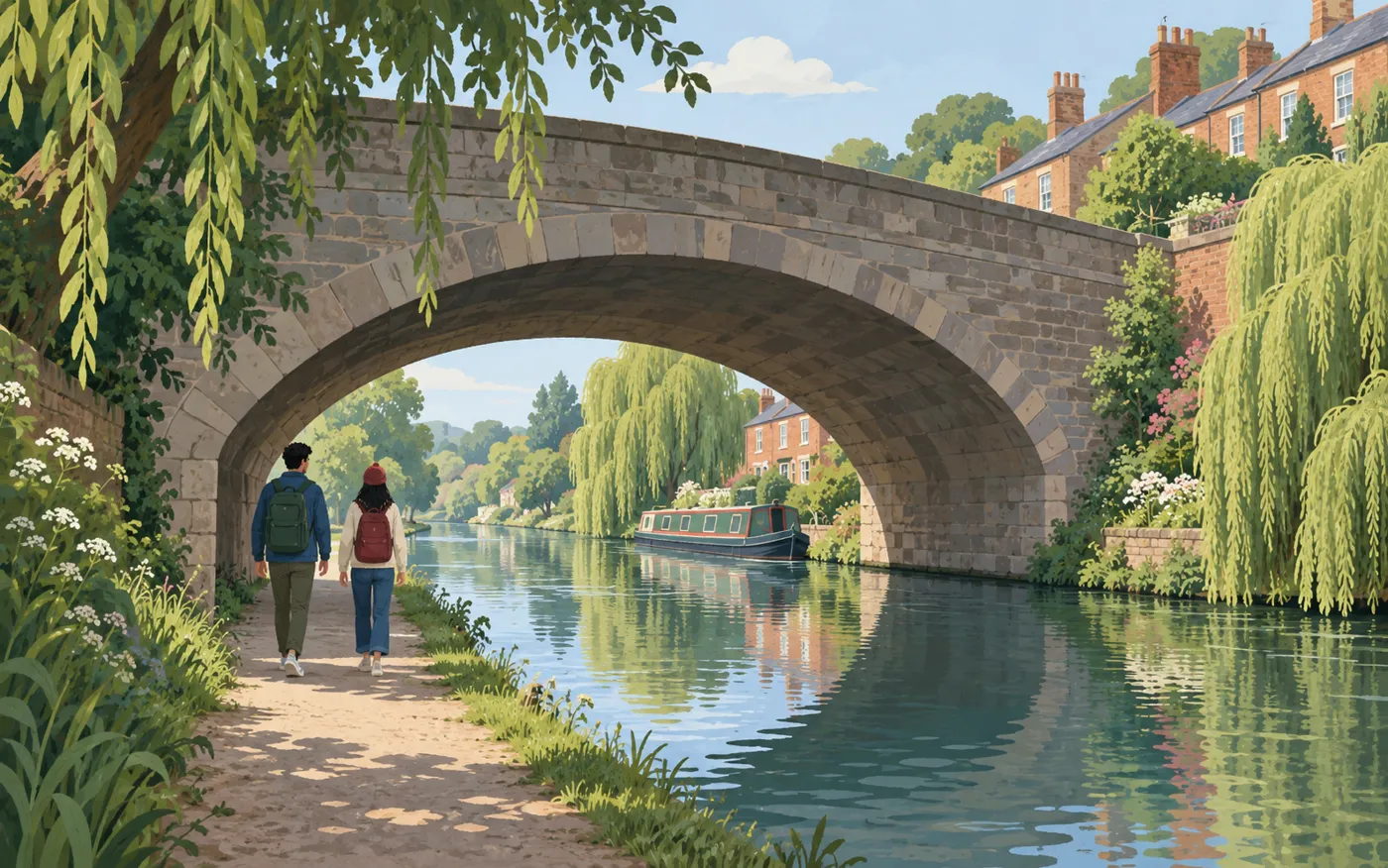
| under | Walk under the bridge. | passer en dessous |
Faut-il dire across ou through ?
Choisissez across lorsque vous envisagez un lieu comme une surface à deux côtés : across the square, across the road. Choisissez through pour un trajet à l’intérieur de quelque chose : through the tunnel, through the forest, through the crowd. Pour un parc, les deux sont possibles selon la représentation : across the park met l’accent sur la traversée, tandis que through the park met l’accent sur le trajet à l’intérieur.
Saurez-vous suivre un itinéraire jusqu’au café ?
From the garden entrance
Start at the garden entrance. Walk (en suivant la longueur de) the path beside the river. Go (en dessous) the small bridge, then continue past the ticket office.
Turn right and walk (à l’intérieur d’un passage fermé) the short tunnel. At the far end, go (d’un côté à l’autre) the square. Watch for bicycles before you cross.
Go (de l’extérieur vers l’intérieur) the café and order at the counter. When you finish, come (de l’intérieur vers l’extérieur) the café and turn left to return to the entrance.
- We arrived to the café.We arrived at the café.
Arrive se construit avec at pour un lieu comme un café ; ce verbe ne prend pas to pour indiquer la destination.