Graded story

C2 English short story: the proofreader and a quiz

Read a C2 English short story about a proofreader who changes one word, with an unreliable narrator, irony, understatement and close-reading questions.

In short

An unreliable narrator tells a story in a way that gives you reasons to doubt their account. In this C2 story, compare the proofreader's explanations with the changes they actually make. A confident voice is not proof that its account is true.

Yellow the idea to rememberBlue English to learnRed watch out

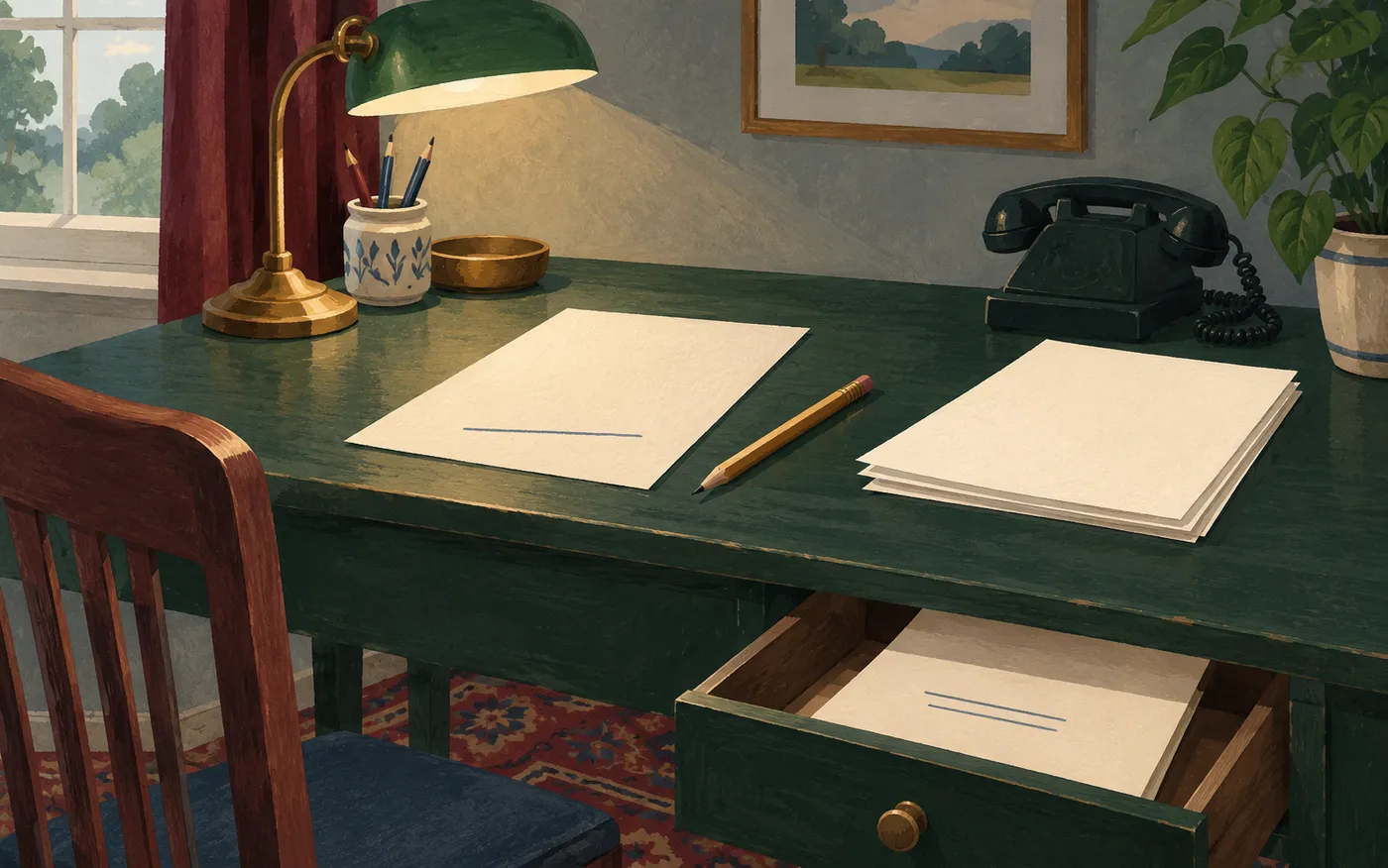
A sharpened pencil and underlined blank manuscript pages sit on a quiet desk.
One missing not changes the meaning of the sentence. Illustration: Atelier

C2 short story - read once for events, then again for excuses

The proofreader

I have always considered accuracy a form of kindness. Authors bring us their sprawling lives; we supply the commas. If, occasionally, a life requires something more substantial than punctuation, it would be pedantic1 to insist on the distinction.

Mrs Vale's memoir arrived on a Thursday, six weeks after her funeral. Her son had asked for a light proofread. 'Keep her voice,' he wrote. I remember thinking how sensible that was. A voice, unlike a fact, can survive a little attention.

On my desk lay the chapter about the theatre. The roof had collapsed three weeks after the safety committee voted to reopen it. There had been an inquiry, then another; the minutes were examined, the blame distributed, the building replaced by a car park. Mrs Vale had chaired the committee. I had taken the minutes. Neither occupation, I should point out, involves holding up a roof.

The sentence was halfway down page seventy-three: 'I did not warn the committee.' Beneath 'not' she had drawn two lines. This was characteristic. She distrusted her readers to the extent of underlining what they might otherwise prefer to miss.

On a copy of the page, I marked the word for deletion. The sentence settled into its new shape with disconcerting2 ease. The underlining, now redundant3, had to go too. My pencil was sharp; the work took less than a minute.

It would be easy to misconstrue4 this. I was not improving her conduct. I was protecting the book from a contradiction. The committee minutes clearly stated 'Warning received', and those minutes had stood unchallenged5 for thirty years. One tired woman's recollection could hardly outweigh6 the official record.

Her son rang on Monday. He was pleased with the clean pages, though he thought one word might be missing. I asked which word. There was a pause in which I could hear him turning a page.

'She was very particular about that sentence,' he said.

'She was particular about everything.'

This was true, and therefore useful.

He asked for the original. I said I would look. In the bottom drawer, beneath the invoices, it lay exactly where I had put it, the two lines under 'not' still visible. I closed the drawer quietly. The telephone, by then, was silent.

When the book appeared, a reviewer praised its candour7. Two surviving committee members sent notes of thanks. I answered both, using the same phrase: it had been a privilege to set the record straight8.

I have kept the pencil. People imagine that such work demands a heavy hand9, but the opposite is true. The trick is to leave almost nothing for anyone to take exception to10. One word, for instance. Or the absence of one.

In simpler words

The narrator says that checking writing is a kind act. They suggest that changing facts can be part of that work.

Mrs Vale has died. Her son sends her memoir and asks for small corrections that preserve her voice.

Her memoir describes a theatre roof collapse. She chaired the safety committee, and the narrator wrote its minutes.

She wrote that she did not warn the committee. She underlined the word 'not' twice.

The narrator deletes 'not' and the underlining. This reverses the sentence's meaning.

The narrator argues that the memoir should agree with the official minutes, which say a warning was received.

Her son suspects a missing word. The narrator asks him to name it.

The son says his mother cared about that sentence.

The narrator agrees that she cared about details.

The narrator uses a true statement to avoid discussing the deletion.

The son asks for the original. The narrator knows where it is but says they will look for it.

The published book is praised for honesty. Former committee members thank the narrator.

The narrator keeps the pencil and describes a small deletion as skilful work.

Which objects matter in the story?

Four objects to follow as you reread

How can you recognise the narrator's self-justification?

Compare an explanation with an action
What the narrator saysWhat the story showsWhat to question
Accuracy is 'a form of kindness'.The narrator removes a word that reverses a statement.Whose interests does this kindness serve?
The underlining has become 'redundant'.It had emphasised the exact word the narrator deleted.Why describe deliberate emphasis as unnecessary?
The minutes stood 'unchallenged'.The narrator wrote those minutes.Does lack of criticism establish accuracy?
'I said I would look.'The narrator already knows where the original is.Why make finding it sound uncertain?

The narrator calls deleting a crucial word a little attention. This understatement makes a large change sound small. The reviewer's praise for candour is ironic for the reader: we have seen a key admission disappear. A reading becomes stronger when several clues support it.

Why does the story say 'On my desk lay the chapter'?

On my desk lay the chapter about the theatre.

The chapter about the theatre lay on my desk.

The place comes first, and the subject comes after lay. This order brings the desk and its contents into view before the account of the collapse.

Which interpretations does the text support?

Question 1No account needed
What does deleting 'not' do to Mrs Vale's sentence?

Choose one answer.

Answer and explanation

It reverses her statement about giving a warning.. I did not warn denies giving a warning; I did warn states that a warning was given.

Question 2No account needed
Why is the narrator's role in taking the minutes significant?

Choose one answer.

Answer and explanation

It gives them a personal interest in protecting the official account.. They appeal to minutes they wrote themselves. The memoir's admission threatens the account recorded in those minutes.

Question 3No account needed
Why is 'This was true, and therefore useful' revealing?

Choose one answer.

Answer and explanation

It shows the narrator uses a true detail to avoid a harder question.. Calling Mrs Vale particular avoids explaining why her carefully emphasised word has disappeared.

Question 4No account needed
Why is the reviewer's praise for candour ironic for the reader?

Choose one answer.

Answer and explanation

The published account hides an admission the reader has seen.. The reader knows about the deletion, while the review praises the resulting book for honesty.

Question 5No account needed
Which conclusion goes beyond the evidence in the story?

Choose one answer.

Answer and explanation

The narrator personally caused the roof to collapse.. The story shows deliberate editing and a reason for self-protection. It never establishes who caused the physical collapse.

How can you support your own reading of the ending?

Write 100-130 words on the last two sentences. Explain the literal meaning of the absence of one, then connect it to the missing not. Quote two short clues from earlier in the story and explain how they affect your judgement of the narrator.

Built from