قصة قصيرة للمستوى C2 – اقرأ مرة للأحداث، ثم مرة للأعذار
The proofreader
I have always considered accuracy a form of kindness. Authors bring us their sprawling lives; we supply the commas. If, occasionally, a life requires something more substantial than punctuation, it would be pedantic1 to insist on the distinction.
Mrs Vale's memoir arrived on a Thursday, six weeks after her funeral. Her son had asked for a light proofread. 'Keep her voice,' he wrote. I remember thinking how sensible that was. A voice, unlike a fact, can survive a little attention.
On my desk lay the chapter about the theatre. The roof had collapsed three weeks after the safety committee voted to reopen it. There had been an inquiry, then another; the minutes were examined, the blame distributed, the building replaced by a car park. Mrs Vale had chaired the committee. I had taken the minutes. Neither occupation, I should point out, involves holding up a roof.
The sentence was halfway down page seventy-three: 'I did not warn the committee.' Beneath 'not' she had drawn two lines. This was characteristic. She distrusted her readers to the extent of underlining what they might otherwise prefer to miss.
On a copy of the page, I marked the word for deletion. The sentence settled into its new shape with disconcerting2 ease. The underlining, now redundant3, had to go too. My pencil was sharp; the work took less than a minute.
It would be easy to misconstrue4 this. I was not improving her conduct. I was protecting the book from a contradiction. The committee minutes clearly stated 'Warning received', and those minutes had stood unchallenged5 for thirty years. One tired woman's recollection could hardly outweigh6 the official record.
Her son rang on Monday. He was pleased with the clean pages, though he thought one word might be missing. I asked which word. There was a pause in which I could hear him turning a page.
'She was very particular about that sentence,' he said.
'She was particular about everything.'
This was true, and therefore useful.
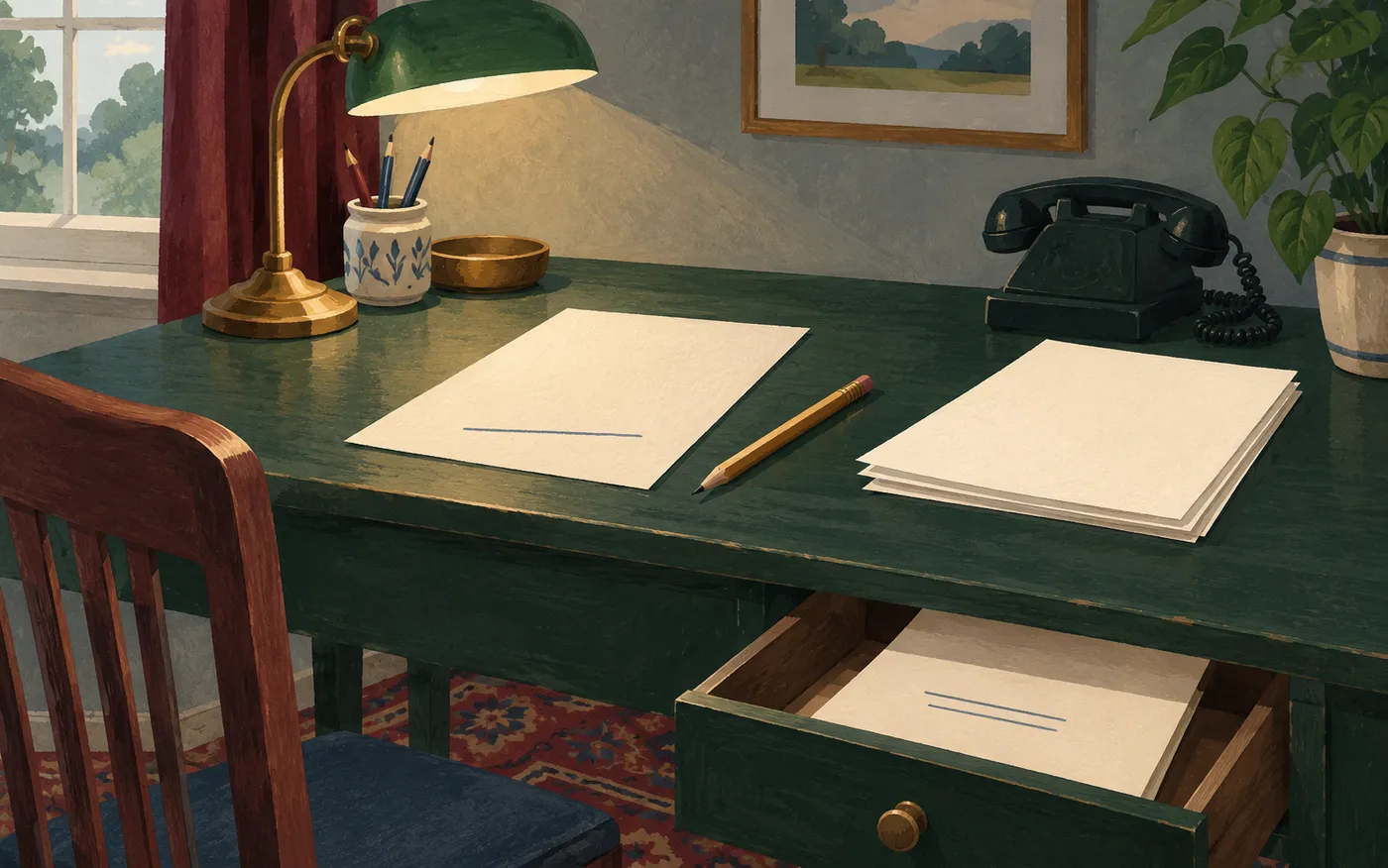
He asked for the original. I said I would look. In the bottom drawer, beneath the invoices, it lay exactly where I had put it, the two lines under 'not' still visible. I closed the drawer quietly. The telephone, by then, was silent.
When the book appeared, a reviewer praised its candour7. Two surviving committee members sent notes of thanks. I answered both, using the same phrase: it had been a privilege to set the record straight8.
I have kept the pencil. People imagine that such work demands a heavy hand9, but the opposite is true. The trick is to leave almost nothing for anyone to take exception to10. One word, for instance. Or the absence of one.
بكلمات أبسط
The narrator says that checking writing is a kind act. They suggest that changing facts can be part of that work.
Mrs Vale has died. Her son sends her memoir and asks for small corrections that preserve her voice.
Her memoir describes a theatre roof collapse. She chaired the safety committee, and the narrator wrote its minutes.
She wrote that she did not warn the committee. She underlined the word 'not' twice.
The narrator deletes 'not' and the underlining. This reverses the sentence's meaning.
The narrator argues that the memoir should agree with the official minutes, which say a warning was received.
Her son suspects a missing word. The narrator asks him to name it.
The son says his mother cared about that sentence.
The narrator agrees that she cared about details.
The narrator uses a true statement to avoid discussing the deletion.
The son asks for the original. The narrator knows where it is but says they will look for it.
The published book is praised for honesty. Former committee members thank the narrator.
The narrator keeps the pencil and describes a small deletion as skilful work.