Relato adaptado al nivel

Relato en inglés de nivel C2: el corrector y un cuestionario

Lee un relato en inglés de nivel C2 sobre un corrector que cambia una palabra, con narrador no fiable, ironía, atenuación y preguntas de lectura atenta.

En pocas palabras

Un narrador no fiable, o unreliable narrator, cuenta una historia de una manera que da motivos para dudar de su versión. En este relato de nivel C2, compara las explicaciones del corrector con los cambios que hace en realidad. Una voz segura no demuestra que su versión sea verdadera.

Amarillo la idea para recordarAzul inglés para aprenderRojo cuidado con esto

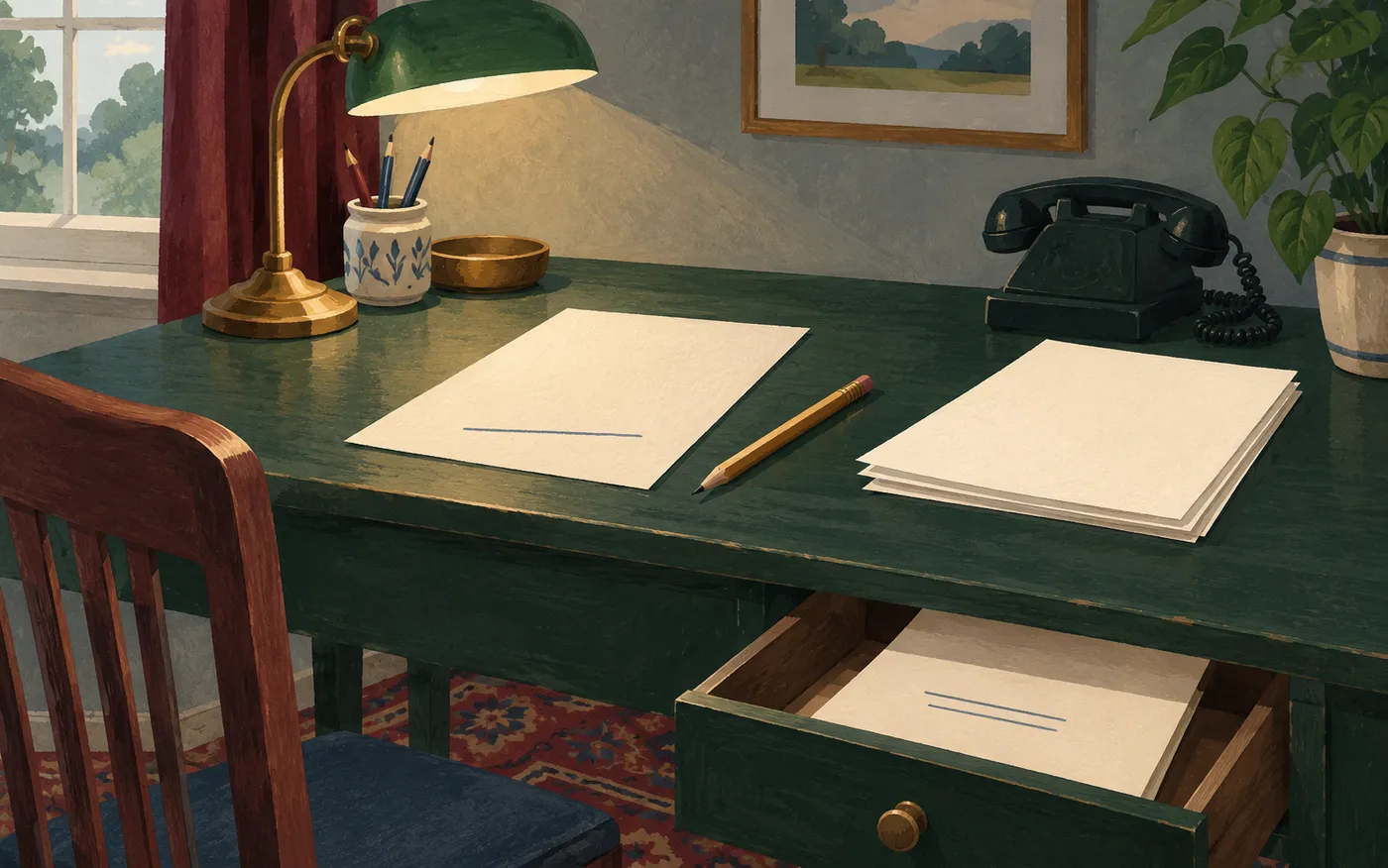
Un lápiz afilado y unas páginas de manuscrito en blanco con subrayados reposan en un escritorio tranquilo.
La ausencia de un solo not cambia el significado de la oración. Ilustración: Atelier

Relato C2: lee primero para seguir los hechos y después para detectar las excusas

The proofreader

I have always considered accuracy a form of kindness. Authors bring us their sprawling lives; we supply the commas. If, occasionally, a life requires something more substantial than punctuation, it would be pedantic1 to insist on the distinction.

Mrs Vale's memoir arrived on a Thursday, six weeks after her funeral. Her son had asked for a light proofread. 'Keep her voice,' he wrote. I remember thinking how sensible that was. A voice, unlike a fact, can survive a little attention.

On my desk lay the chapter about the theatre. The roof had collapsed three weeks after the safety committee voted to reopen it. There had been an inquiry, then another; the minutes were examined, the blame distributed, the building replaced by a car park. Mrs Vale had chaired the committee. I had taken the minutes. Neither occupation, I should point out, involves holding up a roof.

The sentence was halfway down page seventy-three: 'I did not warn the committee.' Beneath 'not' she had drawn two lines. This was characteristic. She distrusted her readers to the extent of underlining what they might otherwise prefer to miss.

On a copy of the page, I marked the word for deletion. The sentence settled into its new shape with disconcerting2 ease. The underlining, now redundant3, had to go too. My pencil was sharp; the work took less than a minute.

It would be easy to misconstrue4 this. I was not improving her conduct. I was protecting the book from a contradiction. The committee minutes clearly stated 'Warning received', and those minutes had stood unchallenged5 for thirty years. One tired woman's recollection could hardly outweigh6 the official record.

Her son rang on Monday. He was pleased with the clean pages, though he thought one word might be missing. I asked which word. There was a pause in which I could hear him turning a page.

'She was very particular about that sentence,' he said.

'She was particular about everything.'

This was true, and therefore useful.

He asked for the original. I said I would look. In the bottom drawer, beneath the invoices, it lay exactly where I had put it, the two lines under 'not' still visible. I closed the drawer quietly. The telephone, by then, was silent.

When the book appeared, a reviewer praised its candour7. Two surviving committee members sent notes of thanks. I answered both, using the same phrase: it had been a privilege to set the record straight8.

I have kept the pencil. People imagine that such work demands a heavy hand9, but the opposite is true. The trick is to leave almost nothing for anyone to take exception to10. One word, for instance. Or the absence of one.

Con palabras más sencillas

The narrator says that checking writing is a kind act. They suggest that changing facts can be part of that work.

Mrs Vale has died. Her son sends her memoir and asks for small corrections that preserve her voice.

Her memoir describes a theatre roof collapse. She chaired the safety committee, and the narrator wrote its minutes.

She wrote that she did not warn the committee. She underlined the word 'not' twice.

The narrator deletes 'not' and the underlining. This reverses the sentence's meaning.

The narrator argues that the memoir should agree with the official minutes, which say a warning was received.

Her son suspects a missing word. The narrator asks him to name it.

The son says his mother cared about that sentence.

The narrator agrees that she cared about details.

The narrator uses a true statement to avoid discussing the deletion.

The son asks for the original. The narrator knows where it is but says they will look for it.

The published book is praised for honesty. Former committee members thank the narrator.

The narrator keeps the pencil and describes a small deletion as skilful work.

¿Qué objetos son importantes en el relato?

Cuatro objetos que seguir al releer

¿Cómo puedes reconocer las justificaciones del narrador?

Compara una explicación con una acción
Lo que dice el narradorLo que muestra el relatoQué conviene cuestionar
Accuracy is 'a form of kindness'.El narrador elimina una palabra y con ello invierte el sentido de una afirmación.¿A qué intereses sirve esta amabilidad?
The underlining has become 'redundant'.Había destacado precisamente la palabra que el narrador eliminó.¿Por qué describir como innecesario un énfasis deliberado?
The minutes stood 'unchallenged'.El narrador redactó esas actas.¿La ausencia de críticas demuestra que sean exactas?
'I said I would look.'El narrador ya sabe dónde está el original.¿Por qué presenta como incierto el hecho de encontrarlo?

El narrador llama a little attention a la eliminación de una palabra decisiva. Esta atenuación presenta un gran cambio como algo pequeño. El elogio de la reseña a la candour resulta irónico para quien lee: hemos visto desaparecer una admisión clave. Una interpretación gana fuerza cuando la respaldan varias pistas.

¿Por qué dice el relato On my desk lay the chapter?

On my desk lay the chapter about the theatre.

El capítulo sobre el teatro estaba encima de mi escritorio.

El lugar aparece primero y el sujeto va después de lay. Este orden sitúa ante nuestros ojos el escritorio y su contenido antes de contar el derrumbe.

¿Qué interpretaciones respalda el texto?

Pregunta 1No necesitas una cuenta
¿Qué efecto tiene eliminar not de la oración de Mrs Vale?

Elige una respuesta.

Respuesta y explicación

It reverses her statement about giving a warning.. I did not warn niega que se diera una advertencia; I did warn afirma que sí se dio.

Pregunta 2No necesitas una cuenta
¿Por qué es importante que el narrador redactara las actas?

Elige una respuesta.

Respuesta y explicación

It gives them a personal interest in protecting the official account.. Recurre a unas actas de su propia autoría. La admisión de las memorias pone en peligro la versión recogida en esas actas.

Pregunta 3No necesitas una cuenta
¿Por qué resulta revelador This was true, and therefore useful?

Elige una respuesta.

Respuesta y explicación

It shows the narrator uses a true detail to avoid a harder question.. Decir que Mrs Vale era meticulosa evita explicar por qué ha desaparecido la palabra que ella había destacado con tanto cuidado.

Pregunta 4No necesitas una cuenta
¿Por qué resulta irónico para quien lee que la reseña elogie la candour?

Elige una respuesta.

Respuesta y explicación

The published account hides an admission the reader has seen.. Quien lee conoce la eliminación, mientras que la reseña elogia la sinceridad del libro resultante.

Pregunta 5No necesitas una cuenta
¿Qué conclusión va más allá de las pruebas del relato?

Elige una respuesta.

Respuesta y explicación

The narrator personally caused the roof to collapse.. El relato muestra una modificación deliberada y un motivo para protegerse. En ningún momento establece quién causó el derrumbe físico.

¿Cómo puedes respaldar tu interpretación del final?

Escribe entre 100 y 130 palabras sobre las dos últimas oraciones. Explica el significado literal de the absence of one y relaciónalo después con el not que falta. Cita dos pistas breves de una parte anterior del relato y explica cómo influyen en tu valoración del narrador.

Elaborado a partir de