Histoire adaptée au niveau

Petite histoire en anglais C2 : la correction d’épreuves, avec quiz

Lisez une petite histoire en anglais C2 où une personne chargée de corriger des épreuves change un mot, avec une voix narrative non fiable, de l’ironie, de la minimisation et des questions de lecture attentive.

L’essentiel

Une voix narrative dite unreliable narrator raconte d’une manière qui donne des raisons de douter de son récit. Dans cette histoire C2, comparez les explications de la personne qui corrige les épreuves avec les changements qu’elle effectue réellement. Un ton assuré ne prouve pas qu’un récit est vrai.

Jaune l’idée à retenirBleu l’anglais à retenirRouge point de vigilance

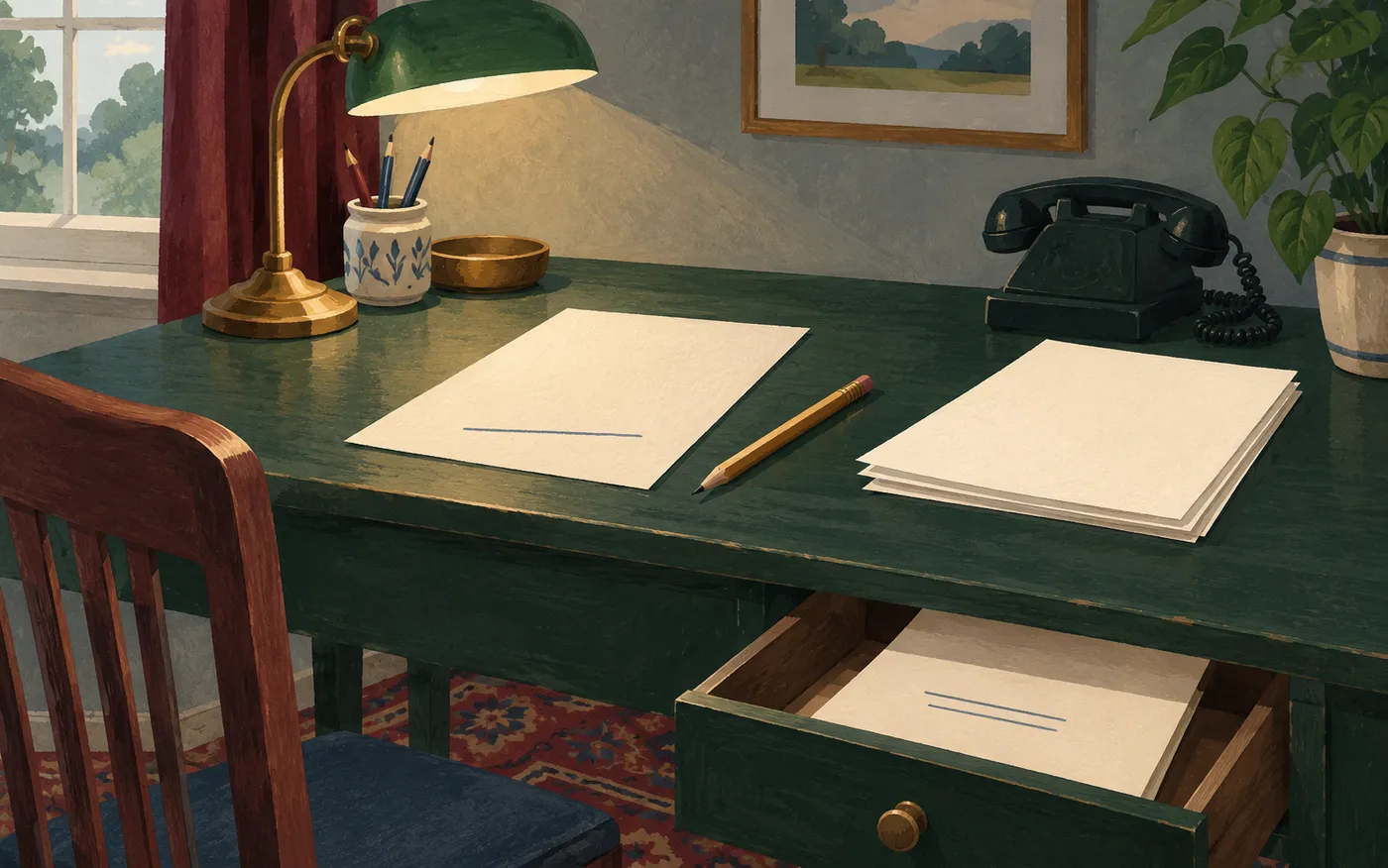
Un crayon taillé et des pages de manuscrit vierges soulignées reposent sur un bureau tranquille.
L’absence du seul mot not change le sens de la phrase. Illustration : Atelier

Petite histoire C2 : une première lecture pour les événements, une seconde pour les excuses

The proofreader

I have always considered accuracy a form of kindness. Authors bring us their sprawling lives; we supply the commas. If, occasionally, a life requires something more substantial than punctuation, it would be pedantic1 to insist on the distinction.

Mrs Vale's memoir arrived on a Thursday, six weeks after her funeral. Her son had asked for a light proofread. 'Keep her voice,' he wrote. I remember thinking how sensible that was. A voice, unlike a fact, can survive a little attention.

On my desk lay the chapter about the theatre. The roof had collapsed three weeks after the safety committee voted to reopen it. There had been an inquiry, then another; the minutes were examined, the blame distributed, the building replaced by a car park. Mrs Vale had chaired the committee. I had taken the minutes. Neither occupation, I should point out, involves holding up a roof.

The sentence was halfway down page seventy-three: 'I did not warn the committee.' Beneath 'not' she had drawn two lines. This was characteristic. She distrusted her readers to the extent of underlining what they might otherwise prefer to miss.

On a copy of the page, I marked the word for deletion. The sentence settled into its new shape with disconcerting2 ease. The underlining, now redundant3, had to go too. My pencil was sharp; the work took less than a minute.

It would be easy to misconstrue4 this. I was not improving her conduct. I was protecting the book from a contradiction. The committee minutes clearly stated 'Warning received', and those minutes had stood unchallenged5 for thirty years. One tired woman's recollection could hardly outweigh6 the official record.

Her son rang on Monday. He was pleased with the clean pages, though he thought one word might be missing. I asked which word. There was a pause in which I could hear him turning a page.

'She was very particular about that sentence,' he said.

'She was particular about everything.'

This was true, and therefore useful.

He asked for the original. I said I would look. In the bottom drawer, beneath the invoices, it lay exactly where I had put it, the two lines under 'not' still visible. I closed the drawer quietly. The telephone, by then, was silent.

When the book appeared, a reviewer praised its candour7. Two surviving committee members sent notes of thanks. I answered both, using the same phrase: it had been a privilege to set the record straight8.

I have kept the pencil. People imagine that such work demands a heavy hand9, but the opposite is true. The trick is to leave almost nothing for anyone to take exception to10. One word, for instance. Or the absence of one.

En termes plus simples

The narrator says that checking writing is a kind act. They suggest that changing facts can be part of that work.

Mrs Vale has died. Her son sends her memoir and asks for small corrections that preserve her voice.

Her memoir describes a theatre roof collapse. She chaired the safety committee, and the narrator wrote its minutes.

She wrote that she did not warn the committee. She underlined the word 'not' twice.

The narrator deletes 'not' and the underlining. This reverses the sentence's meaning.

The narrator argues that the memoir should agree with the official minutes, which say a warning was received.

Her son suspects a missing word. The narrator asks him to name it.

The son says his mother cared about that sentence.

The narrator agrees that she cared about details.

The narrator uses a true statement to avoid discussing the deletion.

The son asks for the original. The narrator knows where it is but says they will look for it.

The published book is praised for honesty. Former committee members thank the narrator.

The narrator keeps the pencil and describes a small deletion as skilful work.

Quels objets comptent dans l’histoire ?

Quatre objets à suivre lors de la relecture

Comment reconnaître les justifications de la voix narrative ?

Comparez une explication et un acte
Ce que dit la voix narrativeCe que montre l’histoireCe qu’il faut interroger
Accuracy is 'a form of kindness'.La personne supprime un mot qui inverse une affirmation.Quels intérêts cette gentillesse sert-elle ?
The underlining has become 'redundant'.Le soulignement mettait en valeur précisément le mot supprimé.Pourquoi présenter une mise en relief volontaire comme inutile ?
The minutes stood 'unchallenged'.La personne a elle-même rédigé ce procès-verbal.L’absence de critiques prouve-t-elle l’exactitude ?
'I said I would look.'La personne sait déjà où se trouve l’original.Pourquoi faire comme si le retrouver était incertain ?

La voix narrative appelle la suppression d’un mot crucial a little attention. Cette minimisation fait paraître petit un changement majeur. L’éloge de la candour par la critique est ironique pour le lecteur : nous avons vu disparaître un aveu essentiel. Une interprétation gagne en force lorsque plusieurs indices la soutiennent.

Pourquoi l’histoire dit-elle « On my desk lay the chapter » ?

On my desk lay the chapter about the theatre.

Le chapitre sur le théâtre était posé sur mon bureau.

Le lieu vient en premier, et le sujet suit lay. Cet ordre fait apparaître le bureau et son contenu avant le récit de l’effondrement.

Quelles interprétations le texte étaye-t-il ?

Question 1Aucun compte nécessaire
Quel effet la suppression de « not » a-t-elle sur la phrase de Mrs Vale ?

Choisissez une seule réponse.

Réponse et explication

It reverses her statement about giving a warning.. I did not warn nie qu’un avertissement ait été donné ; I did warn affirme qu’il l’a été.

Question 2Aucun compte nécessaire
Pourquoi le rôle de la voix narrative dans la rédaction du procès-verbal compte-t-il ?

Choisissez une seule réponse.

Réponse et explication

It gives them a personal interest in protecting the official account.. La personne invoque un procès-verbal qu’elle a rédigé elle-même. L’aveu des mémoires menace la version des faits qui y figure.

Question 3Aucun compte nécessaire
Pourquoi « This was true, and therefore useful » est-il révélateur ?

Choisissez une seule réponse.

Réponse et explication

It shows the narrator uses a true detail to avoid a harder question.. Dire que Mrs Vale était pointilleuse permet d’éviter d’expliquer la disparition du mot qu’elle avait soigneusement souligné.

Question 4Aucun compte nécessaire
Pourquoi l’éloge de la candour par la critique est-il ironique pour le lecteur ?

Choisissez une seule réponse.

Réponse et explication

The published account hides an admission the reader has seen.. Le lecteur connaît la suppression, tandis que la critique loue la franchise du livre qui en résulte.

Question 5Aucun compte nécessaire
Quelle conclusion dépasse les éléments donnés par l’histoire ?

Choisissez une seule réponse.

Réponse et explication

The narrator personally caused the roof to collapse.. L’histoire montre une modification délibérée et une raison de se protéger. Elle n’établit jamais qui a causé l’effondrement matériel.

Comment étayer votre propre lecture de la fin ?

Écrivez de 100 à 130 mots sur les deux dernières phrases. Expliquez le sens littéral de the absence of one, puis reliez-le au mot not manquant. Citez deux courts indices relevés plus tôt dans l’histoire et expliquez comment ils influencent votre jugement sur la voix narrative.

Établi à partir de