Relato adaptado al nivel

Relato de inglés C2: un papel secundario, con preguntas

Lee un relato de inglés C2 sobre dos hermanas músicas que preparan un concierto de reencuentro, con trasfondo familiar, anteposición, elipsis, glosas y cinco preguntas.

En pocas palabras

En este relato, play second fiddle significa tener un papel menos importante y también alude a las partes musicales de las hermanas. Al leer, fíjate en la distancia entre lo que dicen y lo que hacen: la anteposición destaca un contraste y la elipsis deja sin expresar palabras repetidas. Una respuesta breve puede ocultar un sentimiento, pero no demuestra de qué sentimiento se trata.

Amarillo la idea para recordarAzul inglés para aprenderRojo cuidado con esto

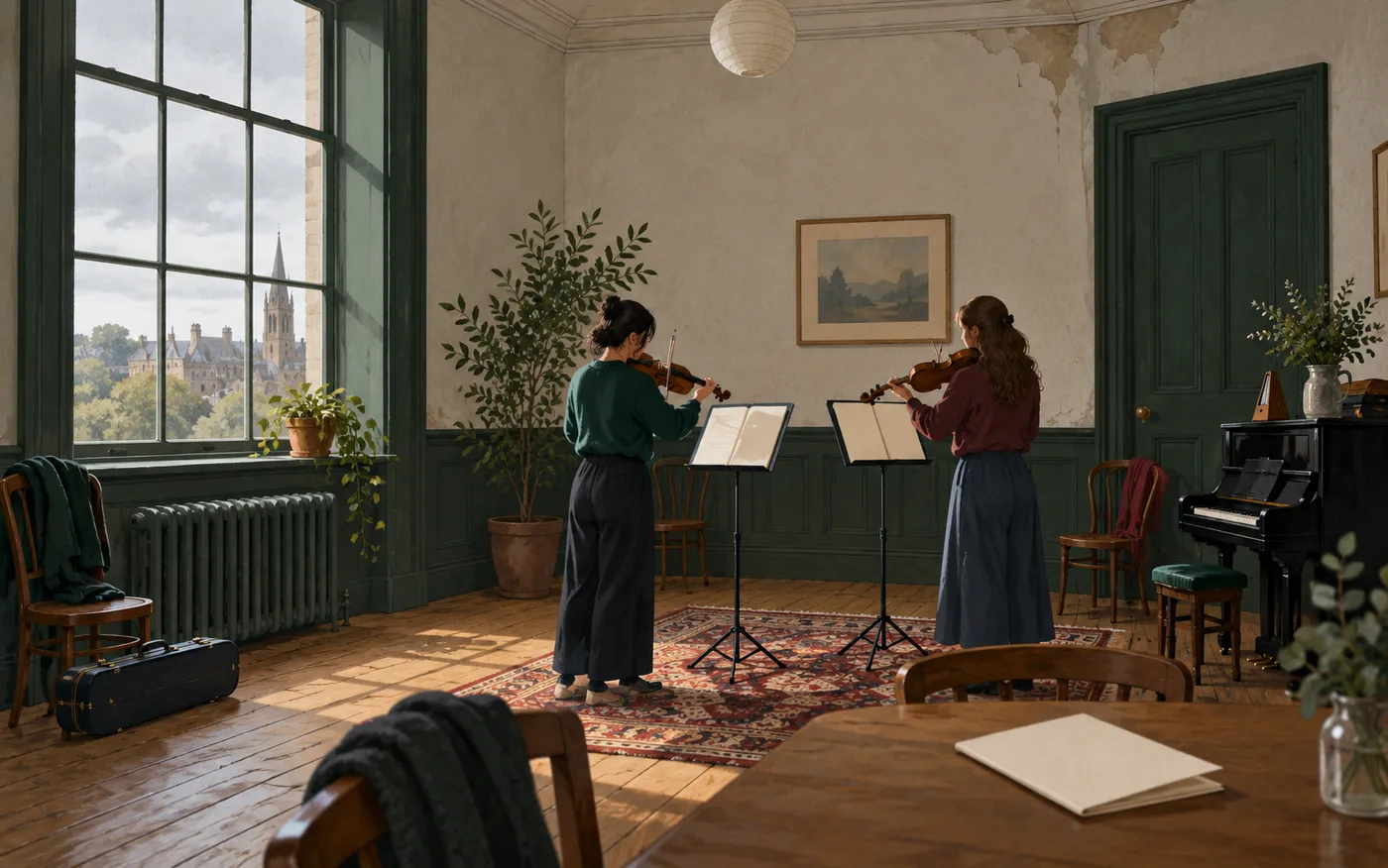
Dos hermanas ensayan juntas con el violín en una sala de una antigua escuela de música.
Las hermanas vuelven a intentarlo, dispuesta cada una a asumir por un momento un papel secundario: play second fiddle. Ilustración: Atelier

Dos hermanas, un ensayo

Second fiddle

At the rehearsal room, Nora found her sister turning the music stands towards the window. Celia had arrived early, as she always did when she wished to make her arrival seem incidental. On the table lay two programmes. Nora's name was above Celia's. Both played the violin; only Nora's photograph had been requested.

'You've had your hair cut,' Celia said. Nora had expected something about the tour, or the twelve years since their last concert together. 'You haven't,' she replied. Celia touched the knot at the back of her head, then returned to the stands.

The room belonged to the music school where their mother had taught. Tomorrow's concert would pay for a new roof. Nora had offered a recital; Celia had suggested a duet. The billing1, their mother used to say, was for people who couldn't hear.

Nora opened her case. Inside, the velvet was threadbare2 where her thumb always rested. Celia's case still had the small dent Nora had made at fourteen, dropping it on the stairs. For years Nora had remembered the dent as evidence of Celia's pettiness3: she had never let Nora forget it. Today she wondered whether the case had simply been too expensive to replace.

'The opening, shall we?' Celia asked. They played. Nora held back4 where she would usually press ahead. Celia, who had learnt to follow her sister before she had learnt to read, waited too. The phrase collapsed into a politeness neither of them could sustain.

'You can take your time,' Celia said. 'I was.' 'So was I.' From the street came the thin complaint of a reversing van. Nora tightened her bow, though it needed no tightening.

The difficult passage they played twice. The easy one they could not get through. It was their mother's arrangement: a tune passed from one violin to the other, with neither allowed to keep it for long. Celia set down her bow. 'She never wrote the dynamics5 in.' 'She expected us to listen.' 'Yes,' Celia said. 'She did.'

Nora looked at the programmes. Across the top of Celia's copy, a pencil line ran beneath the word 'duet'. 'I didn't ask them to put me first.' 'I didn't say you had.' Nora folded her programme, carefully matching the corners. The gesture felt rehearsed6, although she had never made it before.

'Do you want me to ring the printer?' she asked. Celia looked towards the ceiling, where a damp patch had spread beyond the edge of an old repair. 'I want the roof to stop leaking.' Nora laughed, too quickly. Celia did not.

Then Celia moved her stand. A few inches only, but enough for Nora to see her face above the music. 'Again?' Nora loosened her grip7. This time, when the tune reached her, she gave it back before it was quite finished.

Outside, the van had gone. Celia turned the page for them both. Nora caught the corner before it fell back. They had always been good at that: the small, practical accommodations8 by which two people could continue, even when neither knew what to call the arrangement.

Con palabras más sencillas

Nora arrives for a rehearsal with her sister Celia. Nora is the better-known violinist, and the publicity gives her more attention.

Celia mentions Nora's haircut rather than their long separation as performers. Nora gives a short reply about Celia's hair.

They are raising money for the music school's roof. Nora offered to perform alone, while Celia proposed playing together.

Nora notices the old dent she made in Celia's violin case. She begins to consider the cost of replacing it, rather than seeing it only as a reminder of blame.

Both sisters wait for the other to lead, and the music breaks down.

Each says she was taking her time. Nora adjusts her bow to occupy herself.

They manage the difficult passage but struggle to share the tune in their mother's arrangement. Their mother's expectation that they listen also suggests listening to one another.

Nora says she did not choose the order of their names. Celia says she did not accuse her. Nora carefully folds her programme.

Nora offers to ring the printer. Celia replies that she wants the leaking roof repaired, leaving her feelings about the publicity unstated.

Celia moves her stand so that the sisters can see each other. They try again, and Nora passes the tune back.

They help each other turn a page. The shared action shows a small change, while their larger problems remain open.

¿Qué objetos musicales aparecen en el relato?

Objetos que transmiten la tensión

¿Cómo revelan la tensión la anteposición y la elipsis?

Recupera las palabras antes de interpretar el efecto
Palabras del relatoVersión completa o neutraEfecto en este caso
The difficult passage they played twice.They played the difficult passage twice.El complemento va primero y prepara el contraste con el pasaje fácil.
The easy one they could not get through.They could not get through the easy passage.La anteposición destaca la dificultad inesperada.
You haven't.You haven't had your hair cut.Las palabras omitidas están claras; el motivo de esta respuesta de Nora está menos claro.
So was I.I was taking my time too.Celia repite lo que afirma Nora mediante una respuesta breve y paralela.
She did.She expected us to listen.La idea repetida va más allá de escuchar la música.

La anteposición cambia el foco; no tiene por qué cambiar el orden de sujeto y verbo. En The difficult passage they played twice, they sigue delante de played. La frase musical interrumpida, el arco tensado y el programa doblado aportan el subtexto: las hermanas controlan acciones pequeñas mientras les cuesta hablar con franqueza.

¿Qué puedes inferir sobre las hermanas?

Pregunta 1No necesitas una cuenta
¿Por qué importa la nueva idea sobre el estuche de Celia?

Elige una respuesta.

Respuesta y explicación

Nora considers a practical reason for something she once judged harshly.. Antes, Nora veía el estuche como un recordatorio de los reproches. Ahora considera lo que costaría sustituirlo y revisa su juicio sobre Celia.

Pregunta 2No necesitas una cuenta
¿Qué se omite después de «You haven't»?

Elige una respuesta.

Respuesta y explicación

had your hair cut. Celia acaba de mencionar el corte de pelo de Nora. La respuesta de Nora significa You haven't had your hair cut, es decir, que Celia no se ha cortado el pelo.

Pregunta 3No necesitas una cuenta
¿Cuál es el efecto principal de anteponer «The difficult passage» y «The easy one»?

Elige una respuesta.

Respuesta y explicación

It sets up a contrast between technical skill and the sisters' difficulty working together.. Son capaces de tocar la música exigente, pero les cuesta el sencillo intercambio de una melodía. Los dos inicios paralelos intensifican este contraste.

Pregunta 4No necesitas una cuenta
¿Qué detalle respalda mejor un pequeño avance hacia la cooperación al final?

Elige una respuesta.

Respuesta y explicación

Celia turns the page and Nora holds its corner.. Pasar la página entre las dos es un acto práctico de cooperación. El relato termina con esa acción, en vez de con un acuerdo verbal completo.

Pregunta 5No necesitas una cuenta
¿Qué interpretación del comentario de Celia sobre el tejado encaja mejor con la escena?

Elige una respuesta.

Respuesta y explicación

It avoids Nora's offer and redirects attention to their shared purpose.. Celia responde a una pregunta sobre la presentación de sus nombres con el motivo del concierto. Su respuesta deja sin expresar lo que siente respecto al programa.

¿Cómo puedes escribir una escena con subtexto?

Prueba con 90–120 palabras

  • Escribe una escena en la que dos familiares arreglen o preparen algo juntos.
  • Haz que una persona plantee una pregunta práctica con un significado emocional más amplio.
  • Usa un complemento antepuesto y una respuesta breve cuyas palabras omitidas puedan recuperarse.
  • Termina con una acción compartida. Deja que el lector decida cuánto ha cambiado.

Elaborado a partir de