Relato adaptado al nivel

Relato en inglés C1: marea baja en Holy Island

Lee un relato en inglés C1 junto a la calzada de Holy Island, con ocho glosas, una decisión difícil, imágenes del mar y preguntas sobre la narradora.

En pocas palabras

Este relato C1 sigue a una mujer que llega a la calzada de Holy Island con una tabla de mareas y una carta que ha evitado contestar. Las imágenes del mar te ayudan a interpretar sentimientos que no expresa. Distingue lo que cuenta la narradora de lo que sugieren sus acciones.

Amarillo la idea para recordarAzul inglés para aprenderRojo cuidado con esto

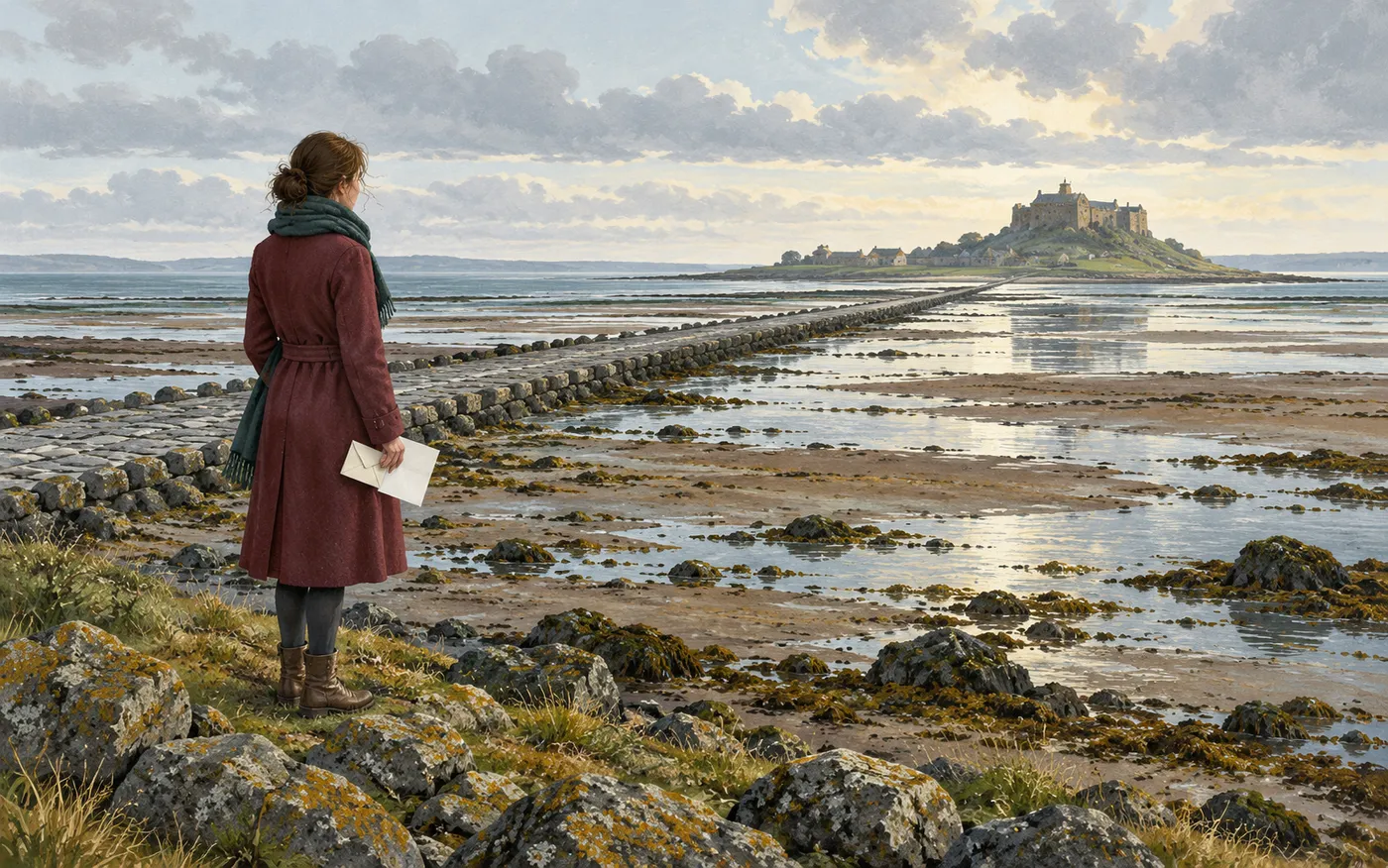
Una mujer con una carta doblada observa la calzada hacia Holy Island durante la marea baja.
La espera tranquila junto a la calzada refleja la decisión de la narradora de esperar: wait. Ilustración: Atelier

Lee para descubrirlo: ¿qué viaje termina haciendo la narradora?

Low tide at Holy Island

The road to Holy Island lay across the sand like a pencil line somebody had begun to rub out. Beyond it, the island was a low, dark shape beneath the cloud. I stopped on the mainland and unfolded the tide table1. The paper had softened along its creases. My sister had circled yesterday's date.

That was my first excuse. The second was the letter in my coat pocket, which I had brought because leaving it at home would have felt like an answer. Ruth had written three weeks earlier. She was spending a few days on the island. Would I come? We could walk, she said. We needn't talk about Dad.

I had read that last sentence so often that it no longer sounded kind. It sounded like a condition I might fail to meet. Since the funeral, our conversations had been practical: a bill, a key, the name of someone who could take the furniture. We were efficient with objects. With each other, we had become less sure-footed2.

From the parking area, I watched a thin ribbon of water3 shine beside the causeway. The wind lifted a corner of the table and snapped it against my thumb. Yesterday's numbers were useless. I rang the guesthouse where Ruth was staying and asked about the current safe crossing times. The owner checked them. The crossing period had ended; the road was closed. I would have to wait until later.

For a moment I felt an almost shameful surge of relief4. The sea had made the decision. I could drive home and tell Ruth I had tried. A tide was an excellent reason: large, impersonal, difficult to argue with.

Then my phone lit up. A message from Ruth: 'Are you still coming?' I began to type: 'Afraid I've missed it.' The sentence looked neat5, almost cheerful. It made my absence sound like a small problem with a train.

I deleted it. Across the sand, the water was gathering into separate silver threads. Soon they would join. I imagined Ruth looking towards the mainland, unable to see me, perhaps not looking at all. That last possibility stung6 more than it should have.

'I'm here,' I wrote. 'On the wrong side. I can wait.'

Her reply came slowly enough for me to regret the message. 'So can I.'

I tucked7 the letter inside the folded table and put both in my pocket. There was a café further inland. I would find it, order something hot, and ring her. I still had no idea what we would say. But the afternoon, which had seemed to be closing around me, now had room in it8.

¿Qué objetos tienen significado en el relato?

Fíjate en los detalles antes de volver a leer

¿Cómo revelan las imágenes los sentimientos de la narradora?

Relaciona una imagen con un detalle del comportamiento de la narradora
Palabras del relatoQué sugieren
a pencil line somebody had begun to rub outLa conexión con la isla parece incierta, como la relación entre las hermanas.
less sure-footedUna imagen del caminar describe la dificultad para hablar entre ellas.
separate silver threads. Soon they would join.El agua ofrece una imagen de conexión justo antes de que envíe un mensaje sincero.
now had room in itEl tiempo parece abrirse porque ha elegido quedarse.

La narradora describe a Ruth a través de su carta y sus mensajes. Solo conocemos los pensamientos de la narradora. Perhaps not looking at all muestra un temor suyo; no indica qué está haciendo Ruth. Una interpretación sólida relaciona un significado posible con palabras concretas.

¿Qué cambia cuando la narradora decide esperar?

Pregunta 1No necesitas una cuenta
¿Por qué se describe el alivio de la narradora como almost shameful?

Elige una respuesta.

Respuesta y explicación

She welcomes a reason to avoid meeting Ruth.. Enseguida imagina usar la marea como razón para volver a casa. El alivio revela su deseo de evitar el encuentro.

Pregunta 2No necesitas una cuenta
¿Qué oculta el mensaje tan pulcro Afraid I've missed it?

Elige una respuesta.

Respuesta y explicación

Her difficulty facing a conversation with her sister. Compara la formulación con un pequeño problema de trenes. Oculta la razón emocional por la que siente la tentación de irse.

Pregunta 3No necesitas una cuenta
¿Qué detalle respalda mejor una interpretación de apertura renovada?

Elige una respuesta.

Respuesta y explicación

She writes "I can wait", and Ruth answers "So can I".. Ambas hermanas expresan disposición a esperar. Su intercambio sugiere apertura, aunque la conversación difícil sigue pendiente.

Pregunta 4No necesitas una cuenta
¿Qué establece el final?

Elige una respuesta.

Respuesta y explicación

The narrator plans to stay and ring Ruth.. La narradora elige una cafetería y planea llamar. El relato termina antes de esa llamada, así que el resultado queda abierto.

¿Cómo puedes escribir un final con una pregunta abierta?

Escribe entre 90 y 120 palabras desde la perspectiva de Ruth mientras lee I can wait. Dale una pequeña acción y un detalle que pueda ver u oír. Deja que esos detalles muestren sus sentimientos antes de responder.

Vuelve a leer tu final

Una ayuda para revisarte, sin nota. Las casillas marcadas no se guardan.

Elaborado a partir de