Lecture

Lecture en anglais B1 sur le fish and chips : quiz sur la nourriture

Lisez un article en anglais B1 sur le fish and chips, l’histoire des boutiques et l’évolution des habitudes, avec huit définitions, des cartes de vocabulaire, des propositions relatives et quatre questions.

L’essentiel

Un chippy est, en anglais britannique familier, une boutique de fish and chips. Cet article B1 présente ce plat, son histoire et l’évolution des habitudes ; en anglais britannique, chips désigne des morceaux épais de pomme de terre frits, tandis que crisps désigne de fines tranches croustillantes vendues en sachets.

Jaune l’idée à retenirBleu l’anglais à retenirRouge point de vigilance

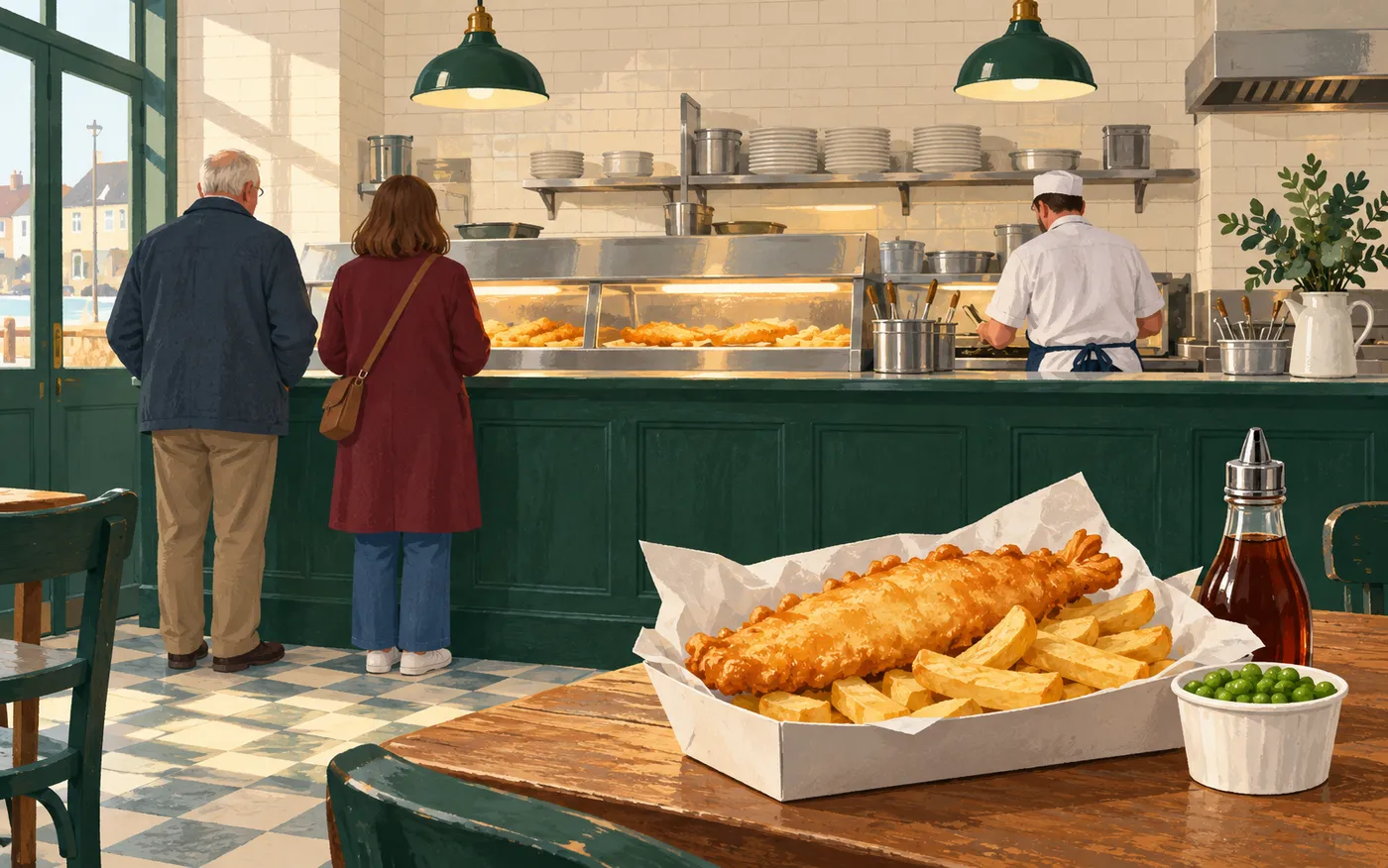
Un plat de poisson-frites est posé sur le comptoir d’une boutique britannique de plats à emporter.
A chippy sert du poisson enrobé de pâte à frire avec des frites épaisses. Illustration : Atelier

Lisez pour découvrir comment un repas du quotidien relie le passé au présent.

The great British chippy

What do you order at a chippy?

Push open the door of a chippy1 and the first question is often simple: which fish would you like? Cod is a familiar choice, but haddock2 is another. The fish is covered in batter3 and fried, then served with thick chips. You can order a large portion4 to share or choose a smaller meal. The person who serves you may ask, 'Salt and vinegar?'

How did fish and chips become popular?

The meal brings together several histories. Fried fish was already popular in nineteenth-century London, where Jewish cooks and sellers helped shape the trade. In 1860, Joseph Malin, a Jewish migrant, opened a fish and chip shop in Bethnal Green. His shop is part of the story of how the two foods became a meal.

Changes in fishing and cold storage also helped. More fish reached the market, and it stayed fresh for longer. The shops that sold these meals became familiar places to buy hot food. A customer could leave work, stop at the counter5 and carry dinner home.

What changes, and what stays familiar?

The wrapping has a history too. Shops once used old newspapers to wrap portions. A paper packet or box is still part of the takeaway6 experience: you carry it carefully and hope the chips stay hot until you get home.

Running a chippy means balancing price and quality. Fish, cooking oil and energy all cost money. An owner whose bills rise has to think carefully about prices while keeping meals affordable7. Customers have choices too: extra peas or curry sauce, a meal to share, or a smaller portion. Each person in the queue8 is deciding what to have for dinner. The meal connects a long history with a very ordinary evening.

En termes plus simples

At a fish and chip shop, you choose your fish and the size of your meal. The fish is crisp on the outside, and the chips are thick. You can add salt and vinegar.

Fried fish was popular in London in the nineteenth century. Jewish cooks and sellers were part of this history. Joseph Malin opened a shop selling fish and chips in 1860.

Better ways of catching and storing fish helped shops get enough fresh fish. People could buy a hot meal to take home.

Shops used newspapers to wrap food in the past. Customers still carry their meals home in packets or boxes.

Shop owners need to cover their costs and keep prices low enough for customers. People choose their food and how much to buy.

Que voit-on dans un repas de fish and chips ?

Six choses que vous pourriez commander ou utiliser

Comment les propositions relatives décrivent-elles la boutique et les personnes ?

Une proposition apporte des précisions sur un nom
ExempleQuel mot la proposition décrit-elle ?
The person who serves you may ask, 'Salt and vinegar?'Person : who serves you indique de quelle personne il s’agit.
The shops that sold these meals became familiar places to buy hot food.Shops : that sold these meals indique de quelles boutiques il s’agit.
An owner whose bills rise has to think carefully about prices.Owner : whose bills rise rattache les factures à ce propriétaire.
This is the shop where we buy our chips.Shop : where we buy our chips indique de quel lieu il s’agit.
  • This is the fish that I ordered it.This is the fish that I ordered.

    That renvoie déjà au poisson. Supprimez le it superflu. Vous pouvez aussi dire This is the fish I ordered.

  • The owner who's bills rise has to think carefully.The owner whose bills rise has to think carefully.

    Utilisez whose pour relier le propriétaire aux factures. Who's signifie who is ou who has.

Comment décririez-vous votre commerce alimentaire préféré ?

Écrivez 60 à 80 mots

  • Nommez le plat et décrivez comment on le commande.
  • Incluez une phrase avec who pour une personne et une autre avec that ou which pour une chose.
  • Expliquez un changement, par exemple dans le menu, les prix ou les emballages.
Question 1Aucun compte nécessaire
Que signifie le mot chippy dans cet article ?

Choisissez une seule réponse.

Réponse et explication

A fish and chip shop.. Chippy est un mot britannique familier qui désigne une boutique de fish and chips.

Question 2Aucun compte nécessaire
Quelle affirmation correspond à l’histoire présentée dans le texte ?

Choisissez une seule réponse.

Réponse et explication

Joseph Malin opened a shop in Bethnal Green in 1860.. L’article cite la boutique ouverte par Malin en 1860 comme un élément de l’histoire plus large de ce plat.

Question 3Aucun compte nécessaire
En quoi l’amélioration de la conservation au froid a-t-elle aidé ce commerce ?

Choisissez une seule réponse.

Réponse et explication

It kept fish fresh for longer.. Conserver le poisson frais plus longtemps a facilité l’approvisionnement des boutiques.

Question 4Aucun compte nécessaire
Pourquoi la hausse des factures compte-t-elle pour le propriétaire d’un chippy ?

Choisissez une seule réponse.

Réponse et explication

They can make it harder to keep meals affordable.. Le propriétaire doit couvrir ses frais tout en gardant des prix que les clients peuvent payer.

Établi à partir de