읽기

Underground에 관한 B2 영어 독해: 퀴즈

1863년부터 전시 대피소까지 Underground의 역사를 읽고 연표, 수동태, 분사구문, 독해 문제로 B2 영어 읽기를 연습하세요.

핵심 요약

London의 첫 지하철은 1863년 1월 10일에 개통했고 깊은 터널과 명확한 지도는 나중에 등장했습니다. 역사를 읽으며 were dug와 passengers studying it을 살펴보세요. -ing형만으로 지금 일어나는 사건이라고 알 수는 없습니다.

노랑 기억할 핵심 내용파랑 익힐 영어 표현빨강 주의할 점

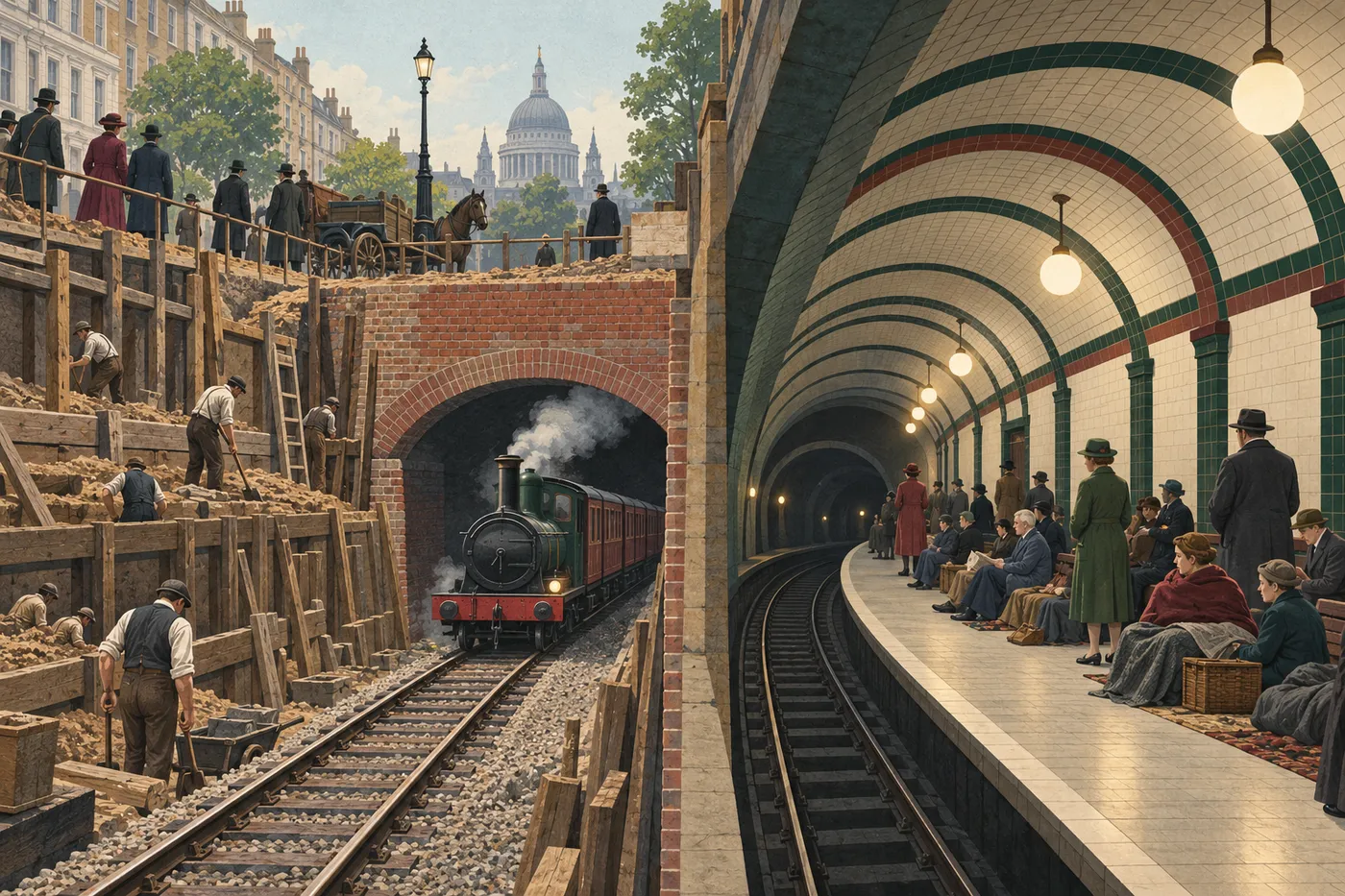
초기의 증기 기관차가 얕은 터널을 달리고 사람들이 역 승강장에서 대피합니다.
The railway was built near the surface, and people later sheltered on its platforms. 삽화: Atelier

거리 아래의 철도에서 연결을 보여 주는 지도까지

How London learnt to travel underground

On 10 January 1863, the Metropolitan Railway opened to passengers between Paddington and Farringdon. Connecting major railway stations, it offered a new route through London. It was the world's first underground passenger railway. The trains were pulled by steam locomotives1, so an underground journey began with technology already familiar from railways above ground.

The early lines were built using a method called cut and cover2. Long trenches3 were dug from the street, tracks were laid, and a roof was built over them. Built close to the surface, these lines were different from the deep tunnels many people now picture. Work could change the streets above: buildings sometimes had to be removed. In 1868, the first section of the District Railway opened between South Kensington and Westminster.

A further change came in 1890, when the City & South London Railway opened. Its trains ran through deep tunnels, and the railway used electric power. Those narrow, round tunnels help explain the name the Tube4. Sections of that railway later became part of the Northern line.

As the network grew, understanding it became a design problem as well as an engineering one. In 1931, Harry Beck produced a diagrammatic map5. First issued in 1933, it used horizontal, vertical and diagonal lines, with evenly spaced stations. Designed to show connections rather than exact distances, the map helped passengers plan journeys. Passengers studying it could see where to change trains, although the space between two stations on the page did not show their true distance apart.

During the Second World War, Underground stations were used as air-raid shelters6. People sheltering7 on platforms gave places built for travel another purpose. The history of the Underground therefore includes much more than trains. It is also a story of construction, public safety and wayfinding8: helping people understand where they are and where to go next.

초기 철도에는 무엇이 필요했나요?

역사 속 물건 네 가지

Underground의 어떤 변화가 먼저였나요?

여섯 시점 순서 맞추기

  1. 1863
    The Metropolitan Railway opens.승객이 Paddington과 Farringdon 사이를 지하로 이동할 수 있습니다.
  2. 1868
    The first part of the District Railway opens.새 구간이 South Kensington과 Westminster를 연결합니다.
  3. 1890
    The City & South London Railway opens.전기 철도가 깊은 터널을 달립니다.
  4. 1931
    Harry Beck designs a new map.단순하고 규칙적인 선으로 철도망을 보여 주는 설계입니다.
  5. 1933
    Beck's map is first issued.승객에게 새 도식 지도가 제공됩니다.
  6. 1939-1945
    Stations are used as shelters during the Second World War.공습을 피해 사람들이 지하로 갑니다.

역사 글은 왜 수동태와 분사구문을 쓰나요?

주어를 찾아 짧아진 표현을 읽으세요.
글의 표현관계
Long trenches were dug.구덩이가 동작을 받았습니다. Workers dug them.
Built close to the surface, these lines were different.The lines were built close to the surface.
First issued in 1933, it used horizontal, vertical and diagonal lines.The map was first issued in 1933. 두 부분 모두 지도가 주어입니다.
Passengers studying it could see where to change trains.The passengers were studying the map. -ing 구는 승객을 설명합니다.
People sheltering on platforms gave places built for travel another purpose.People were sheltering there. The places had been built for travel.

수동태는 동작을 받는 대상을 앞에 놓습니다. tracks were laid에서는 선로에 초점을 둡니다. 분사구문은 설명을 줄일 수 있습니다. 여기서 people sheltering은 people who were sheltering을 뜻합니다. 주변 문장에서 시간을 찾으세요.

  • The trenches were dig from the street.The trenches were dug from the street.

    were + dug를 쓰세요. Dug는 dig의 과거분사입니다.

  • Designed to show connections, passengers found the map useful.Designed to show connections, the map helped passengers plan journeys.

    설계된 것은 승객이 아니라 지도입니다. 도입 설명 뒤에 the map을 놓으세요.

날짜, 설계 선택, 문법을 연결할 수 있나요?

문제 1계정 없이 이용 가능
초기의 개착식 노선은 어떻게 건설했나요?

답을 하나 고르세요.

정답과 해설

Trenches were dug, tracks were laid, and a roof was added.. 글은 구덩이 파기, 선로 놓기, 지붕 만들기의 세 단계를 제시합니다.

문제 2계정 없이 이용 가능
1890년에 개통한 철도에서는 무엇이 달라졌나요?

답을 하나 고르세요.

정답과 해설

It used deep tunnels and electric trains.. City & South London Railway는 깊은 터널과 전력을 사용했습니다. 그보다 앞선 Metropolitan Railway는 1863년에 개통했습니다.

문제 3계정 없이 이용 가능
거리가 달라졌어도 Beck의 지도는 왜 유용할 수 있었나요?

답을 하나 고르세요.

정답과 해설

It made connections between lines easier to see.. 지도는 연결에 초점을 맞췄습니다. 승객은 정확한 거리 없이도 어디서 갈아탈지 알 수 있었습니다.

문제 4계정 없이 이용 가능
이 글에서 People sheltering on platforms는 무슨 뜻인가요?

답을 하나 고르세요.

정답과 해설

People who were sheltering there during the war. Sheltering은 사람들을 설명합니다. 제2차 세계대전이 과거의 시점을 알려 줍니다.

문제 5계정 없이 이용 가능
Underground stations were used as air-raid shelters의 중심 초점은 무엇인가요?

답을 하나 고르세요.

정답과 해설

The stations and their wartime use. 수동태는 Underground stations를 주어로 삼고 전쟁 중 용도가 어떻게 달라졌는지 알려 줍니다.

바탕 과정