Reading

B2 English reading about the Underground: a quiz

Try B2 English reading about the Underground from 1863 to wartime shelters, with a timeline, passive forms, participle clauses and reading questions.

In short

London's first underground railway opened on 10 January 1863; deeper tunnels and clearer maps came later. Read the history and notice were dug and passengers studying it. An -ing form alone does not tell you that an event is happening now.

Yellow the idea to rememberBlue English to learnRed watch out

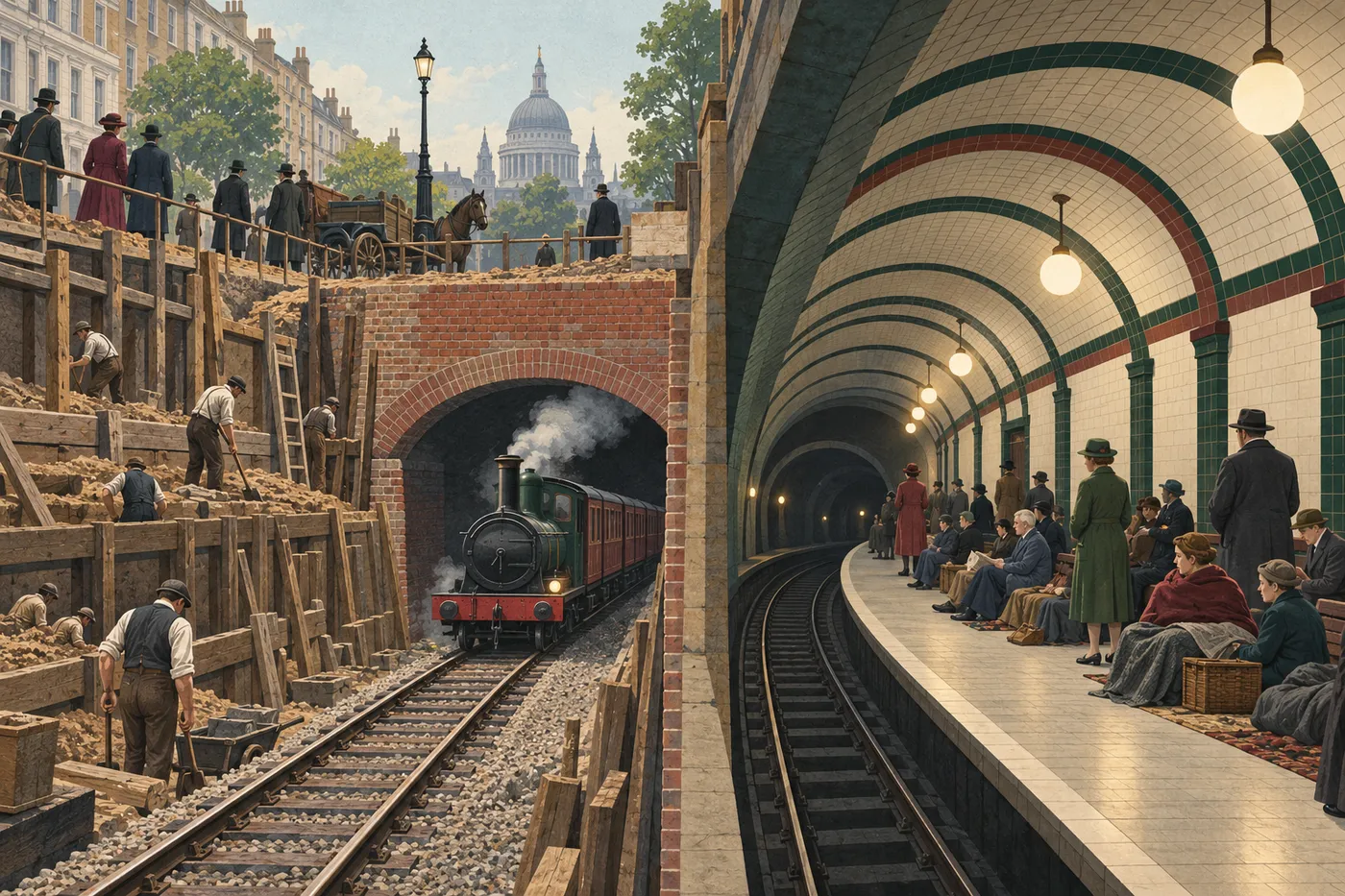
An early steam train runs through a shallow tunnel as people shelter on a station platform.
The railway was built near the surface, and people later sheltered on its platforms. Illustration: Atelier

From a railway beneath the streets to a map of connections

How London learnt to travel underground

On 10 January 1863, the Metropolitan Railway opened to passengers between Paddington and Farringdon. Connecting major railway stations, it offered a new route through London. It was the world's first underground passenger railway. The trains were pulled by steam locomotives1, so an underground journey began with technology already familiar from railways above ground.

The early lines were built using a method called cut and cover2. Long trenches3 were dug from the street, tracks were laid, and a roof was built over them. Built close to the surface, these lines were different from the deep tunnels many people now picture. Work could change the streets above: buildings sometimes had to be removed. In 1868, the first section of the District Railway opened between South Kensington and Westminster.

A further change came in 1890, when the City & South London Railway opened. Its trains ran through deep tunnels, and the railway used electric power. Those narrow, round tunnels help explain the name the Tube4. Sections of that railway later became part of the Northern line.

As the network grew, understanding it became a design problem as well as an engineering one. In 1931, Harry Beck produced a diagrammatic map5. First issued in 1933, it used horizontal, vertical and diagonal lines, with evenly spaced stations. Designed to show connections rather than exact distances, the map helped passengers plan journeys. Passengers studying it could see where to change trains, although the space between two stations on the page did not show their true distance apart.

During the Second World War, Underground stations were used as air-raid shelters6. People sheltering7 on platforms gave places built for travel another purpose. The history of the Underground therefore includes much more than trains. It is also a story of construction, public safety and wayfinding8: helping people understand where they are and where to go next.

What did the early railway need?

Four things from the history

Which Underground development came first?

Put six moments in order

  1. 1863
    The Metropolitan Railway opens.Passengers can travel underground between Paddington and Farringdon.
  2. 1868
    The first part of the District Railway opens.The new section links South Kensington and Westminster.
  3. 1890
    The City & South London Railway opens.An electric railway runs through deep tunnels.
  4. 1931
    Harry Beck designs a new map.The design shows the network with simple, regular lines.
  5. 1933
    Beck's map is first issued.Passengers receive the new diagrammatic map.
  6. 1939-1945
    Stations are used as shelters during the Second World War.People go underground for protection from air raids.

Why does a history text use passive forms and participle clauses?

Read the shorter form by finding its subject
Words from the textThe relationship
Long trenches were dug.The trenches received the action. Workers dug them.
Built close to the surface, these lines were different.The lines were built close to the surface.
First issued in 1933, it used horizontal, vertical and diagonal lines.The map was first issued in 1933. The map is the subject of both parts.
Passengers studying it could see where to change trains.The passengers were studying the map. The -ing phrase describes them.
People sheltering on platforms gave places built for travel another purpose.People were sheltering there. The places had been built for travel.

A passive puts the thing receiving the action first. In tracks were laid, the text focuses on the tracks. A participle clause can make a description shorter: people sheltering means people who were sheltering here. Use the surrounding sentence to find the time.

  • The trenches were dig from the street.The trenches were dug from the street.

    Use were + dug. Dug is the past participle of dig.

  • Designed to show connections, passengers found the map useful.Designed to show connections, the map helped passengers plan journeys.

    The map was designed, not the passengers. Put the map after the opening description.

Can you connect the dates, design choices and grammar?

Question 1No account needed
How were the early cut-and-cover lines built?

Choose one answer.

Answer and explanation

Trenches were dug, tracks were laid, and a roof was added.. The text gives three stages: digging trenches, laying tracks and building a roof.

Question 2No account needed
What changed with the railway that opened in 1890?

Choose one answer.

Answer and explanation

It used deep tunnels and electric trains.. The City & South London Railway used deep tunnels and electric power. The earlier Metropolitan Railway opened in 1863.

Question 3No account needed
Why could Beck's map be useful even though distances were changed?

Choose one answer.

Answer and explanation

It made connections between lines easier to see.. The map focused on connections. Passengers could see where to change trains without needing exact distances.

Question 4No account needed
What does 'People sheltering on platforms' mean in this text?

Choose one answer.

Answer and explanation

People who were sheltering there during the war. Sheltering describes the people. The Second World War gives the past time.

Question 5No account needed
What is the main focus of 'Underground stations were used as air-raid shelters'?

Choose one answer.

Answer and explanation

The stations and their wartime use. The passive makes Underground stations the subject and tells us how their use changed during the war.

Built from