阅读

Underground 的故事:B2 英语阅读与测验

通过一篇 B2 英语文章,了解 Underground 从 1863 年通车到战时用作避难所的历史,学习时间线、被动语态和分词从句,并回答阅读问题。

要点

London 的第一条地下铁路于 1863 年 1 月 10 日通车;更深的隧道和更清晰的地图则是后来的发展。阅读这段历史,留意 were dug 和 passengers studying it。单凭 -ing 形式,不能判断事情正在此刻发生。

黄色 核心要点蓝色 重点英语表达红色 注意陷阱

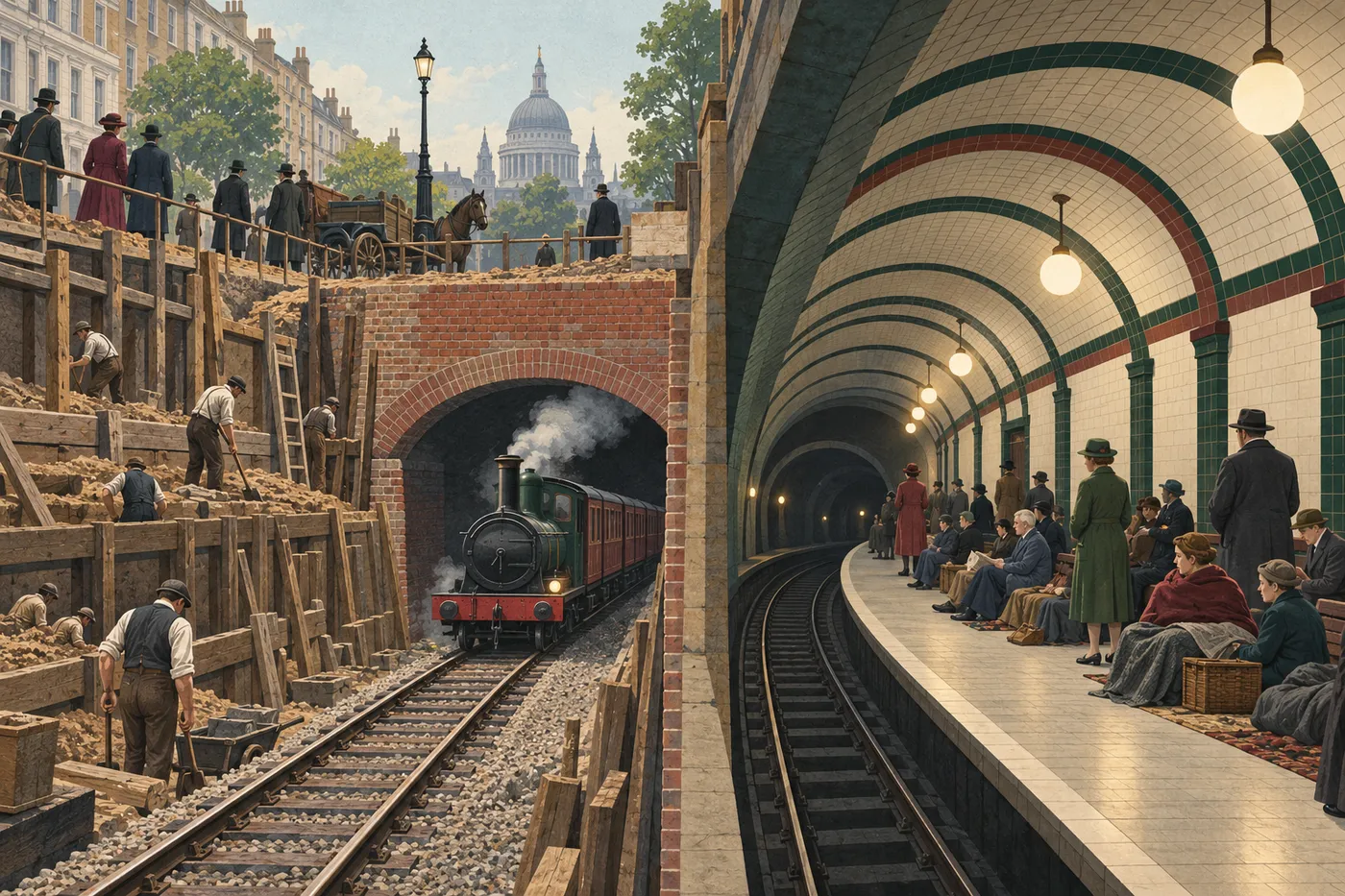
一列早期蒸汽火车驶过浅层隧道,人们在车站站台上避难。
The railway was built near the surface, and people later sheltered on its platforms. 插图:Atelier

从街道下的铁路,到呈现换乘关系的地图

How London learnt to travel underground

On 10 January 1863, the Metropolitan Railway opened to passengers between Paddington and Farringdon. Connecting major railway stations, it offered a new route through London. It was the world's first underground passenger railway. The trains were pulled by steam locomotives1, so an underground journey began with technology already familiar from railways above ground.

The early lines were built using a method called cut and cover2. Long trenches3 were dug from the street, tracks were laid, and a roof was built over them. Built close to the surface, these lines were different from the deep tunnels many people now picture. Work could change the streets above: buildings sometimes had to be removed. In 1868, the first section of the District Railway opened between South Kensington and Westminster.

A further change came in 1890, when the City & South London Railway opened. Its trains ran through deep tunnels, and the railway used electric power. Those narrow, round tunnels help explain the name the Tube4. Sections of that railway later became part of the Northern line.

As the network grew, understanding it became a design problem as well as an engineering one. In 1931, Harry Beck produced a diagrammatic map5. First issued in 1933, it used horizontal, vertical and diagonal lines, with evenly spaced stations. Designed to show connections rather than exact distances, the map helped passengers plan journeys. Passengers studying it could see where to change trains, although the space between two stations on the page did not show their true distance apart.

During the Second World War, Underground stations were used as air-raid shelters6. People sheltering7 on platforms gave places built for travel another purpose. The history of the Underground therefore includes much more than trains. It is also a story of construction, public safety and wayfinding8: helping people understand where they are and where to go next.

早期铁路需要什么?

历史中的四样事物

Underground 的哪项发展最早出现?

将六个历史时刻按先后排序

  1. 1863
    The Metropolitan Railway opens.乘客可以乘坐地下铁路往返 Paddington 和 Farringdon。
  2. 1868
    The first part of the District Railway opens.新路段连接 South Kensington 和 Westminster。
  3. 1890
    The City & South London Railway opens.一条电气化铁路在深层隧道中运行。
  4. 1931
    Harry Beck designs a new map.这份设计用简明、规整的线条表示铁路网络。
  5. 1933
    Beck's map is first issued.乘客拿到了新的线路示意图。
  6. 1939-1945
    Stations are used as shelters during the Second World War.人们到地下躲避空袭。

历史文章为什么使用被动语态和分词从句?

找出主语,读懂缩短后的表达
文中的表达两部分之间的关系
Long trenches were dug.沟槽是动作的承受者。工人挖出了沟槽,即 Workers dug them.
Built close to the surface, these lines were different.The lines were built close to the surface.
First issued in 1933, it used horizontal, vertical and diagonal lines.地图于 1933 年首次发行,即 The map was first issued in 1933. 两部分的主语都是地图。
Passengers studying it could see where to change trains.乘客正在研究地图,即 The passengers were studying the map. 这个 -ing 短语描述的是乘客。
People sheltering on platforms gave places built for travel another purpose.People were sheltering there. The places had been built for travel.

被动语态将动作的承受者放在前面。 在 tracks were laid 中,文章关注的是铁轨。分词从句可以让描述更简洁:这里的 people sheltering 就是 people who were sheltering 的意思。要结合上下文判断时间。

  • The trenches were dig from the street.The trenches were dug from the street.

    使用 were + dug。Dug 是 dig 的过去分词。

  • Designed to show connections, passengers found the map useful.Designed to show connections, the map helped passengers plan journeys.

    被设计的是地图,而不是乘客。 开头的描述之后,应接 the map。

你能把日期、设计取舍和语法联系起来吗?

第 1 题无需账户
早期明挖回填式线路是怎样修建的?

选择一个答案。

答案与解释

Trenches were dug, tracks were laid, and a roof was added.. 文章列出了三个步骤:挖沟槽、铺设铁轨,再加上顶盖。

第 2 题无需账户
1890 年通车的铁路带来了什么变化?

选择一个答案。

答案与解释

It used deep tunnels and electric trains.. City & South London Railway 使用深层隧道和电力。更早的 Metropolitan Railway 于 1863 年通车。

第 3 题无需账户
Beck 的地图改变了距离比例,为什么仍然实用?

选择一个答案。

答案与解释

It made connections between lines easier to see.. 地图着重呈现线路的连接关系。乘客无需知道准确距离,也能看出在哪里换乘。

第 4 题无需账户
文中的「People sheltering on platforms」是什么意思?

选择一个答案。

答案与解释

People who were sheltering there during the war. Sheltering 描述的是人们。提到第二次世界大战,就明确了这里是在说过去。

第 5 题无需账户
「Underground stations were used as air-raid shelters」主要关注什么?

选择一个答案。

答案与解释

The stations and their wartime use. 被动语态将 Underground stations 作为主语,说明这些车站在战争期间的用途发生了怎样的变化。

编写依据