Lecture

Lecture en anglais B2 sur l’Underground : un quiz

Lisez en anglais B2 l’histoire de l’Underground, de 1863 aux abris de guerre, avec une chronologie, des formes passives, des propositions participiales et des questions de lecture.

L’essentiel

Le premier chemin de fer souterrain de London a ouvert le 10 janvier 1863 ; les tunnels plus profonds et les plans plus clairs sont venus ensuite. Lisez l’histoire et observez were dug et passengers studying it. Une forme en -ing ne suffit pas à indiquer qu’un événement se déroule maintenant.

Jaune l’idée à retenirBleu l’anglais à retenirRouge point de vigilance

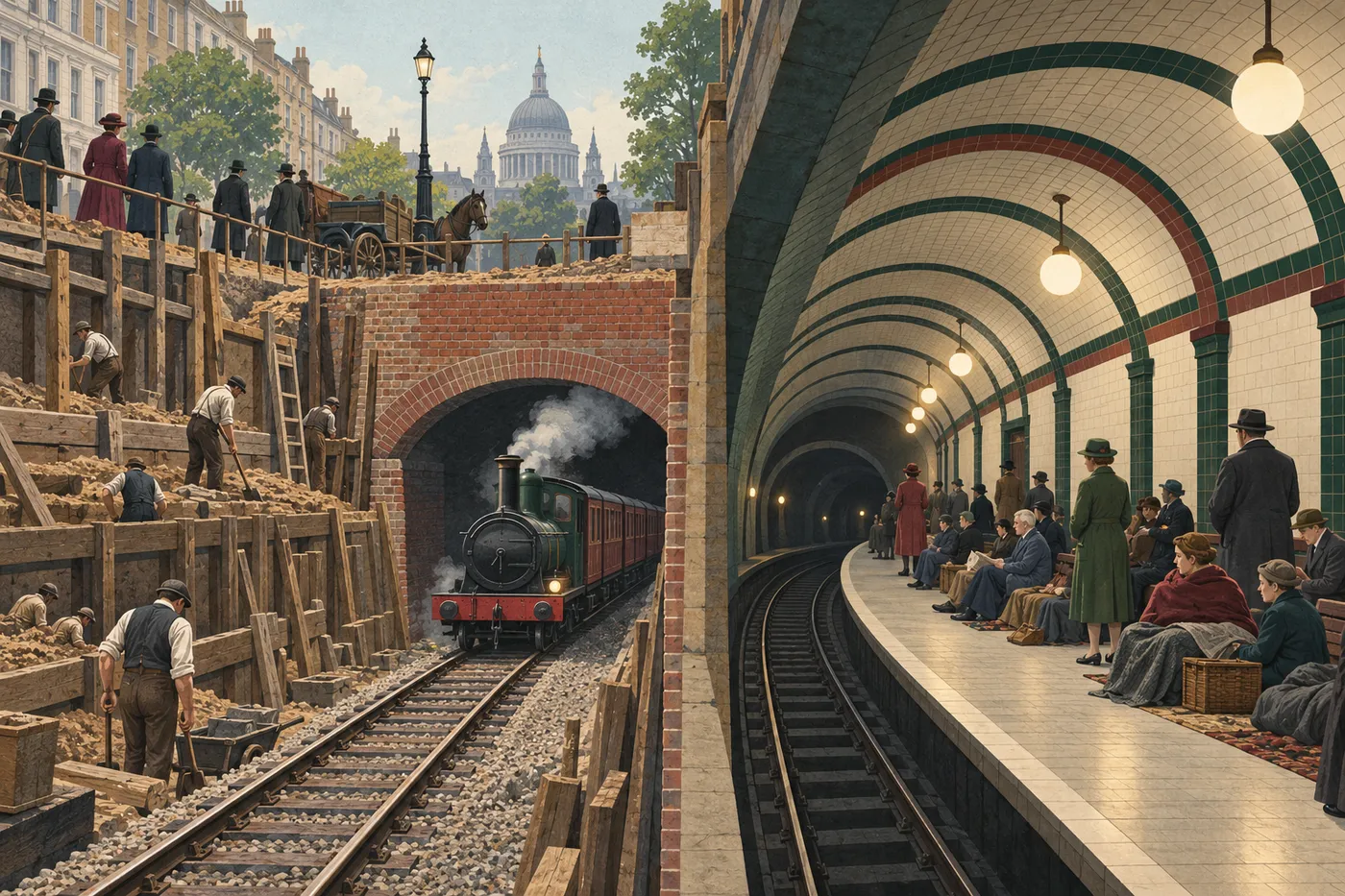
Un ancien train à vapeur traverse un tunnel peu profond tandis que des personnes s’abritent sur un quai de gare.
The railway was built near the surface, and people later sheltered on its platforms. Illustration : Atelier

D’un chemin de fer sous les rues à un plan des correspondances

How London learnt to travel underground

On 10 January 1863, the Metropolitan Railway opened to passengers between Paddington and Farringdon. Connecting major railway stations, it offered a new route through London. It was the world's first underground passenger railway. The trains were pulled by steam locomotives1, so an underground journey began with technology already familiar from railways above ground.

The early lines were built using a method called cut and cover2. Long trenches3 were dug from the street, tracks were laid, and a roof was built over them. Built close to the surface, these lines were different from the deep tunnels many people now picture. Work could change the streets above: buildings sometimes had to be removed. In 1868, the first section of the District Railway opened between South Kensington and Westminster.

A further change came in 1890, when the City & South London Railway opened. Its trains ran through deep tunnels, and the railway used electric power. Those narrow, round tunnels help explain the name the Tube4. Sections of that railway later became part of the Northern line.

As the network grew, understanding it became a design problem as well as an engineering one. In 1931, Harry Beck produced a diagrammatic map5. First issued in 1933, it used horizontal, vertical and diagonal lines, with evenly spaced stations. Designed to show connections rather than exact distances, the map helped passengers plan journeys. Passengers studying it could see where to change trains, although the space between two stations on the page did not show their true distance apart.

During the Second World War, Underground stations were used as air-raid shelters6. People sheltering7 on platforms gave places built for travel another purpose. The history of the Underground therefore includes much more than trains. It is also a story of construction, public safety and wayfinding8: helping people understand where they are and where to go next.

De quoi le premier chemin de fer avait-il besoin ?

Quatre éléments de l’histoire

Quelle évolution de l’Underground est venue en premier ?

Remettez six moments dans l’ordre

  1. 1863
    The Metropolitan Railway opens.Les voyageurs peuvent circuler sous terre entre Paddington et Farringdon.
  2. 1868
    The first part of the District Railway opens.La nouvelle section relie South Kensington et Westminster.
  3. 1890
    The City & South London Railway opens.Un chemin de fer électrique circule dans des tunnels profonds.
  4. 1931
    Harry Beck designs a new map.Le dessin représente le réseau avec des lignes simples et régulières.
  5. 1933
    Beck's map is first issued.Les voyageurs reçoivent le nouveau plan schématique.
  6. 1939-1945
    Stations are used as shelters during the Second World War.Les gens descendent sous terre pour se protéger des raids aériens.

Pourquoi un texte historique utilise-t-il le passif et les propositions participiales ?

Comprenez la forme raccourcie en trouvant son sujet
Mots du texteLe lien
Long trenches were dug.Les tranchées subissaient l’action. Workers dug them.
Built close to the surface, these lines were different.The lines were built close to the surface.
First issued in 1933, it used horizontal, vertical and diagonal lines.The map was first issued in 1933. Le plan est le sujet des deux parties.
Passengers studying it could see where to change trains.The passengers were studying the map. L’expression en -ing les décrit.
People sheltering on platforms gave places built for travel another purpose.People were sheltering there. The places had been built for travel.

Le passif place en premier ce qui subit l’action. Dans tracks were laid, le texte met l’accent sur les rails. Une proposition participiale permet de raccourcir une description : people sheltering signifie ici people who were sheltering. Appuyez-vous sur le reste de la phrase pour situer le moment.

  • The trenches were dig from the street.The trenches were dug from the street.

    Employez were + dug. Dug est le participe passé de dig.

  • Designed to show connections, passengers found the map useful.Designed to show connections, the map helped passengers plan journeys.

    C’est le plan qui a été conçu, pas les voyageurs. Placez the map après la description initiale.

Savez-vous relier les dates, les choix de conception et la grammaire ?

Question 1Aucun compte nécessaire
Comment les premières lignes construites en tranchée couverte ont-elles été réalisées ?

Choisissez une seule réponse.

Réponse et explication

Trenches were dug, tracks were laid, and a roof was added.. Le texte donne trois étapes : creuser des tranchées, poser les rails et construire un toit.

Question 2Aucun compte nécessaire
Qu’est-ce qui a changé avec le chemin de fer ouvert en 1890 ?

Choisissez une seule réponse.

Réponse et explication

It used deep tunnels and electric trains.. Le City & South London Railway utilisait des tunnels profonds et l’électricité. Le Metropolitan Railway, antérieur, avait ouvert en 1863.

Question 3Aucun compte nécessaire
Pourquoi le plan de Beck pouvait-il être utile malgré la modification des distances ?

Choisissez une seule réponse.

Réponse et explication

It made connections between lines easier to see.. Le plan mettait l’accent sur les correspondances. Les voyageurs pouvaient voir où changer de train sans connaître les distances exactes.

Question 4Aucun compte nécessaire
Que signifie « People sheltering on platforms » dans ce texte ?

Choisissez une seule réponse.

Réponse et explication

People who were sheltering there during the war. Sheltering décrit les personnes. La Seconde Guerre mondiale situe le moment dans le passé.

Question 5Aucun compte nécessaire
Sur quoi la phrase « Underground stations were used as air-raid shelters » met-elle l’accent ?

Choisissez une seule réponse.

Réponse et explication

The stations and their wartime use. Le passif fait de Underground stations le sujet et indique comment leur usage a changé pendant la guerre.

Établi à partir de