Lectura

Lectura en inglés B2 sobre el Underground: un cuestionario

Lee en inglés de nivel B2 sobre el Underground, desde 1863 hasta los refugios de guerra, con una cronología, formas pasivas, cláusulas de participio y preguntas de comprensión.

En pocas palabras

El primer ferrocarril subterráneo de London se inauguró el 10 de enero de 1863; los túneles más profundos y los planos más claros llegaron después. Lee su historia y fíjate en were dug y passengers studying it. Una forma en -ing por sí sola no indica que algo esté ocurriendo ahora.

Amarillo la idea para recordarAzul inglés para aprenderRojo cuidado con esto

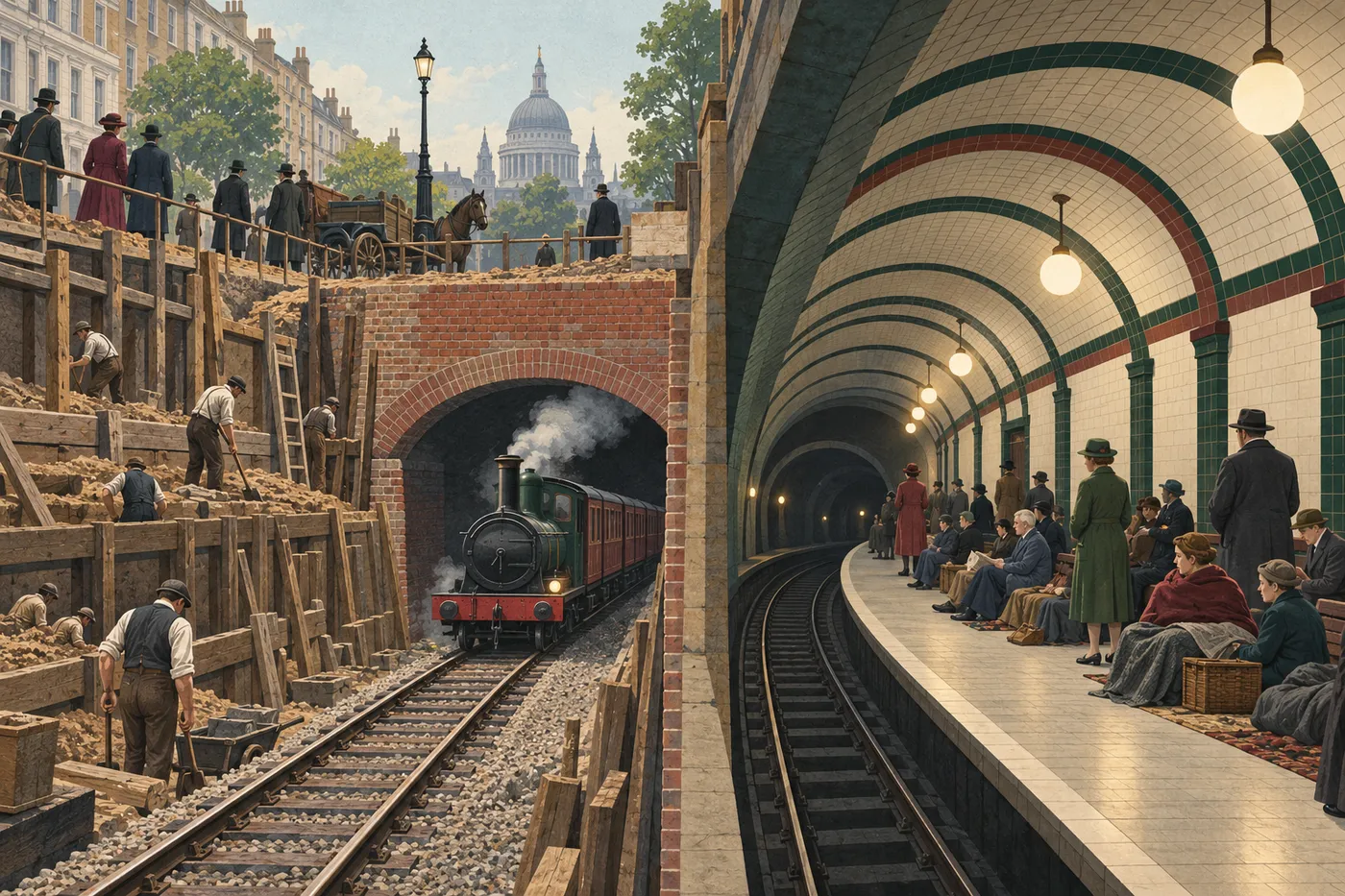
Un antiguo tren de vapor atraviesa un túnel poco profundo mientras varias personas se refugian en el andén de una estación.
The railway was built near the surface, and people later sheltered on its platforms. Ilustración: Atelier

De un ferrocarril bajo las calles a un plano de conexiones

How London learnt to travel underground

On 10 January 1863, the Metropolitan Railway opened to passengers between Paddington and Farringdon. Connecting major railway stations, it offered a new route through London. It was the world's first underground passenger railway. The trains were pulled by steam locomotives1, so an underground journey began with technology already familiar from railways above ground.

The early lines were built using a method called cut and cover2. Long trenches3 were dug from the street, tracks were laid, and a roof was built over them. Built close to the surface, these lines were different from the deep tunnels many people now picture. Work could change the streets above: buildings sometimes had to be removed. In 1868, the first section of the District Railway opened between South Kensington and Westminster.

A further change came in 1890, when the City & South London Railway opened. Its trains ran through deep tunnels, and the railway used electric power. Those narrow, round tunnels help explain the name the Tube4. Sections of that railway later became part of the Northern line.

As the network grew, understanding it became a design problem as well as an engineering one. In 1931, Harry Beck produced a diagrammatic map5. First issued in 1933, it used horizontal, vertical and diagonal lines, with evenly spaced stations. Designed to show connections rather than exact distances, the map helped passengers plan journeys. Passengers studying it could see where to change trains, although the space between two stations on the page did not show their true distance apart.

During the Second World War, Underground stations were used as air-raid shelters6. People sheltering7 on platforms gave places built for travel another purpose. The history of the Underground therefore includes much more than trains. It is also a story of construction, public safety and wayfinding8: helping people understand where they are and where to go next.

¿Qué necesitaba el primer ferrocarril?

Cuatro elementos de esta historia

¿Qué novedad del Underground llegó primero?

Ordena seis momentos

  1. 1863
    The Metropolitan Railway opens.Los pasajeros pueden viajar bajo tierra entre Paddington y Farringdon.
  2. 1868
    The first part of the District Railway opens.El nuevo tramo une South Kensington y Westminster.
  3. 1890
    The City & South London Railway opens.Un ferrocarril eléctrico circula por túneles profundos.
  4. 1931
    Harry Beck designs a new map.El diseño muestra la red con líneas sencillas y regulares.
  5. 1933
    Beck's map is first issued.Los pasajeros reciben el nuevo plano esquemático.
  6. 1939-1945
    Stations are used as shelters during the Second World War.La gente baja al subsuelo para protegerse de los bombardeos.

¿Por qué usa un texto histórico formas pasivas y cláusulas de participio?

Comprende la forma abreviada identificando su sujeto
Palabras del textoLa relación
Long trenches were dug.Las zanjas recibieron la acción. Workers dug them.
Built close to the surface, these lines were different.The lines were built close to the surface.
First issued in 1933, it used horizontal, vertical and diagonal lines.The map was first issued in 1933. El plano es el sujeto de ambas partes.
Passengers studying it could see where to change trains.The passengers were studying the map. La expresión en -ing describe a los pasajeros.
People sheltering on platforms gave places built for travel another purpose.People were sheltering there. The places had been built for travel.

La pasiva coloca primero aquello que recibe la acción. En tracks were laid, el texto se centra en las vías. Una cláusula de participio puede abreviar una descripción: aquí people sheltering significa people who were sheltering. Usa el resto de la oración para identificar el momento.

  • The trenches were dig from the street.The trenches were dug from the street.

    Usa were + dug. Dug es el participio pasado de dig.

  • Designed to show connections, passengers found the map useful.Designed to show connections, the map helped passengers plan journeys.

    Se diseñó el plano, no a los pasajeros. Coloca the map después de la descripción inicial.

¿Puedes relacionar las fechas, las decisiones de diseño y la gramática?

Pregunta 1No necesitas una cuenta
¿Cómo se construyeron las primeras líneas mediante excavación y cubrimiento?

Elige una respuesta.

Respuesta y explicación

Trenches were dug, tracks were laid, and a roof was added.. El texto indica tres fases: excavar zanjas, colocar vías y construir un techo.

Pregunta 2No necesitas una cuenta
¿Qué cambió con el ferrocarril que se inauguró en 1890?

Elige una respuesta.

Respuesta y explicación

It used deep tunnels and electric trains.. El City & South London Railway utilizaba túneles profundos y energía eléctrica. El anterior Metropolitan Railway se inauguró en 1863.

Pregunta 3No necesitas una cuenta
¿Por qué podía ser útil el plano de Beck aunque las distancias estuvieran modificadas?

Elige una respuesta.

Respuesta y explicación

It made connections between lines easier to see.. El plano se centraba en las conexiones. Los pasajeros podían ver dónde cambiar de tren sin necesitar las distancias exactas.

Pregunta 4No necesitas una cuenta
¿Qué significa People sheltering on platforms en este texto?

Elige una respuesta.

Respuesta y explicación

People who were sheltering there during the war. Sheltering describe a las personas. La Segunda Guerra Mundial sitúa la acción en el pasado.

Pregunta 5No necesitas una cuenta
¿En qué se centra principalmente Underground stations were used as air-raid shelters?

Elige una respuesta.

Respuesta y explicación

The stations and their wartime use. La pasiva convierte Underground stations en el sujeto y nos cuenta cómo cambió su uso durante la guerra.

Elaborado a partir de