Phrasal verbs: what they are and how to learn them
Phrasal verbs explained with 40 useful verbs, object patterns, action pictures and ten questions. Learn meanings and use them in everyday English.
In short
Phrasal verbs combine a verb with a small word such as up, off or out: get up, turn off, find out. The small word is called a particle, and it helps make the meaning. Use these verbs in everyday conversations, messages and work: Please turn it off. We need to find out. Learn the meaning and the whole sentence pattern together.
Yellow the idea to rememberBlue English to learnRed watch out
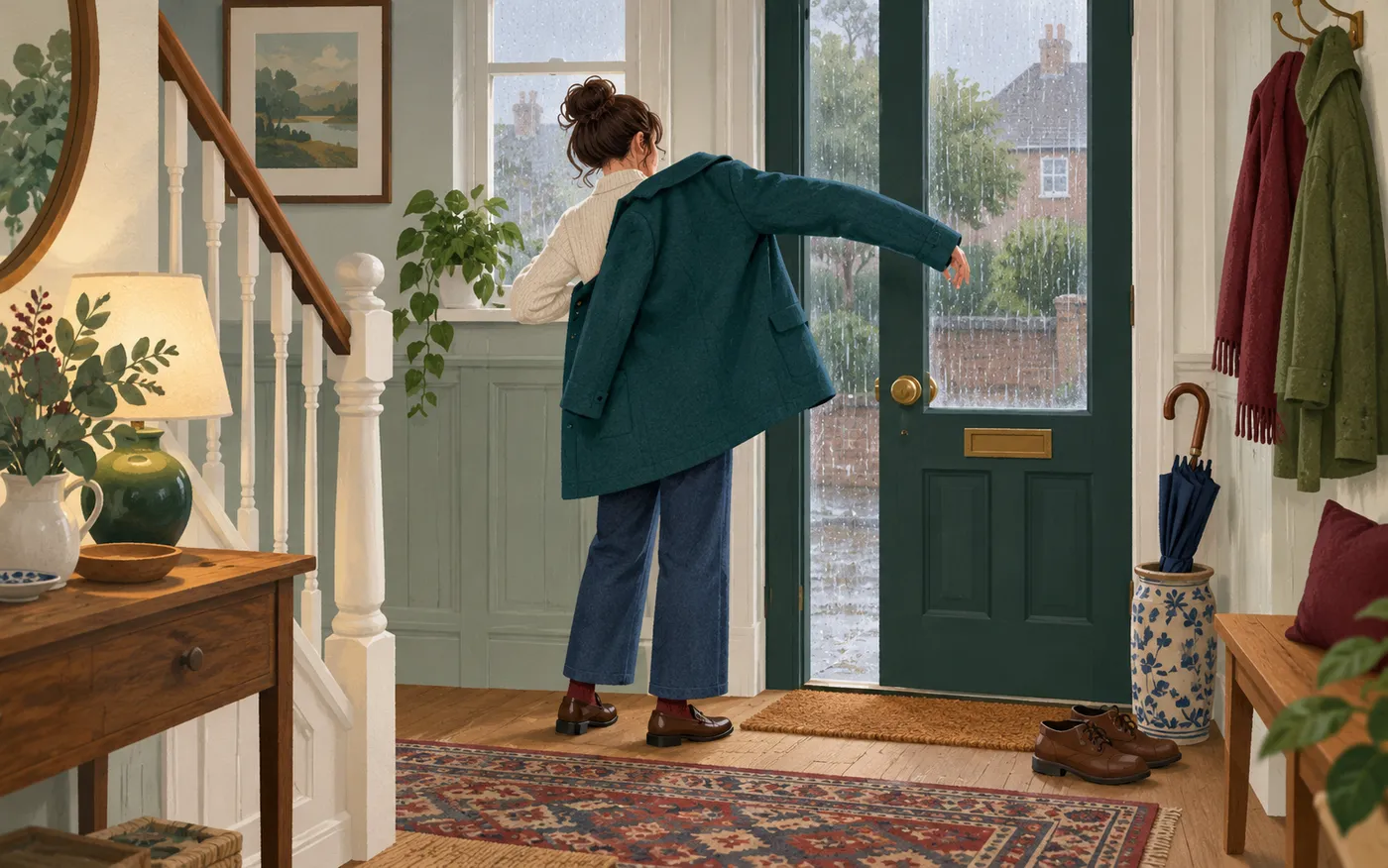
What is a phrasal verb and what does the particle do?
The verb and particle work together to give a meaning, even when they are apart. Sit down describes movement; give up means stop trying. A particle has no single meaning everywhere.
| Verb | Meaning | Example |
|---|---|---|
| take off | remove clothing | Take your coat off. |
| take up | start an activity | I've taken up swimming. |
| take after | be like a family member | She takes after her dad. |
| take off | leave the ground | The plane took off on time. |
Learner books often group look after and put up with with phrasal verbs. Ask what each expression means and where its object goes.
The plane took off at six.
The plane left the ground at six.
Compare Take your coat off: the same verb has another meaning.
Where does the object go in a phrasal verb?
Depending on the verb and meaning, the object goes in the middle or after the expression. The object is the person or thing the action is about: the lamp in turn off the lamp.
| Pattern | With a noun | With a pronoun |
|---|---|---|
| Separable: object can go in the middle | Turn off the lamp. / Turn the lamp off. | Turn it off. |
| Inseparable: words stay together | Look after the children. | Look after them. |
| No object | The plane took off. | It took off. |
Please turn the lamp off. Please turn it off.
Both sentences ask someone to stop the lamp working.
With a separable verb, put it, them, him or her in the middle.
Can you look after them on Friday?
Can you take care of them on Friday?
Learn dictionary patterns such as turn something off and look after somebody. Longer objects often follow the particle: Turn off the lamp next to the window.
How do you use three-part verbs such as look forward to?
Keep all three parts together and put the object after them: I'm looking forward to the weekend. Learn the final word too; leaving it out can break the pattern.
| Expression | Meaning | Example |
|---|---|---|
| put up with something | accept something unpleasant | I can't put up with this noise. |
| look forward to something | feel happy about a future event | I'm looking forward to the holiday. |
| run out of something | use all of something | We've run out of paper. |
| get on with somebody | have a good relationship | I get on with my neighbours. |
I'm looking forward to seeing you.
I feel happy about our future meeting.
After look forward to, use a noun or -ing form.
What are 40 useful phrasal verbs for everyday English?
These 40 verbs cover everyday situations. Each row gives one meaning. Middle means a separable object; after means it follows the expression; none means no object. Other meanings may use different patterns.
| Verb | Meaning | Object | Example |
|---|---|---|---|
| wake up | stop sleeping | none | I woke up at seven. |
| get up | leave your bed | none | We get up early on Mondays. |
| put on | dress in something | middle | Put your coat on. |
| take off | remove clothing | middle | Take your shoes off. |
| turn on | start a device | middle | Turn the light on. |
| turn off | stop a device | middle | Please turn your phone off. |
| tidy up | make a place tidy | middle | We tidied the kitchen up. |
| throw away | put in the bin | middle | Don't throw that receipt away. |
| Verb | Meaning | Object | Example |
|---|---|---|---|
| set off | start a journey | none | We set off before breakfast. |
| get on | board a bus or train | after | Get on the bus here. |
| get off | leave a bus or train | after | Get off the train at York. |
| get in | enter a car or taxi | after | Get in the taxi. |
| get out of | leave a car or taxi | after | She got out of the car. |
| pick up | collect a person or thing | middle | I'll pick you up at six. |
| drop off | take someone to a place and leave them there | middle | Can you drop me off at the station? |
| come back | return | none | What time did you come back? |
| Verb | Meaning | Object | Example |
|---|---|---|---|
| look after | take care of | after | I'm looking after my sister's cat. |
| get on with | have a good relationship | after | I get on with my flatmates. |
| fall out with | stop being friendly after an argument | after | He fell out with his brother. |
| meet up | meet by arrangement | none | Let's meet up after work. |
| go out | leave home for a social activity | none | We're going out this evening. |
| take up | start a hobby or activity | middle | She's taken up cycling. |
| give up | stop doing something | middle | I've given up sugar. |
| look forward to | feel happy about a future event | after | I'm looking forward to the weekend. |
| Verb | Meaning | Object | Example |
|---|---|---|---|
| put away | put in the usual place | middle | Put the plates away, please. |
| try on | put on clothes to check the fit | middle | Can I try this jacket on? |
| run out of | use all of something | after | We've run out of milk. |
| break down | stop working | none | The car broke down yesterday. |
| look for | try to find | after | I'm looking for my keys. |
| look up | find information in a book or online | middle | Look the word up in a dictionary. |
| fill in | complete a form | middle | Please fill this form in. |
| put up with | accept something unpleasant | after | I can't put up with the noise. |
| Verb | Meaning | Object | Example |
|---|---|---|---|
| find out | discover information | middle | I need to find out the price. |
| work out | find an answer by thinking | middle | Can you work this out? |
| sort out | solve or organise | middle | Let's sort the problem out. |
| put off | move to a later time | middle | We've put the meeting off until Tuesday. |
| call off | cancel | middle | They called the match off. |
| bring up | mention a subject | middle | She brought the issue up at lunch. |
| carry on | continue | none | Please carry on while I answer the phone. |
| hand in | give completed work to someone | middle | I handed my report in yesterday. |
We put the meeting off until Tuesday.
We moved the meeting to Tuesday.
Put off delays a plan. Call off cancels it.
Which phrasal verbs can you picture?
You can picture actions such as put on a coat and turn off a lamp. Say what is happening, then try replacing the object with it.
Four actions to picture
Find:
How do you learn phrasal verbs so you can use them?
Learn a few verbs in a familiar situation, with one meaning and sentence each. Try the course's printer problem: it has run out of paper, so you turn it off and sort out the problem.
| Step | Try this |
|---|---|
| Choose a situation | Use three verbs for your journey. |
| Record the pattern | Write 'pick someone up'. |
| Change the object | Change 'Sam' to 'him'. |
| Change the time | Change 'pick' to 'picked'. |
| Recall later | Cover it; try again tomorrow. |
I picked her up at the station yesterday.
I collected her from the station.
Change pick to picked; keep up.
Check meanings, patterns and forms in a dictionary. Past forms include got, took and brought. Then use a verb in a message about your plans.
Can you use phrasal verbs at work and in formal writing?
Yes, many phrasal verbs are natural at work. Choose words for your reader. Find out and carry out are common in professional English; a single verb can sometimes make a report clearer.
| Everyday wording | More formal wording |
|---|---|
| put off the meeting | postpone the meeting |
| call off the event | cancel the event |
| look into the problem | investigate the problem |
| carry out the checks | perform the checks |
We need to sort out the room change before we contact everyone.
We need to solve the problem with the room first.
For a formal report, try resolve the room issue.
What are the most common phrasal verb mistakes?
Common mistakes involve object position, missing particles or verb forms. Check the whole expression.
- Please turn off it.Please turn it off.
A pronoun goes in the middle with a separable verb. Use turn it off.
- I'll look the children after.I'll look after the children.
Keep look after together. Put the children after the whole expression.
- I'm looking forward to see you.I'm looking forward to seeing you.
The to in look forward to is followed by a noun or an -ing form.
- We've run out paper.We've run out of paper.
Learn all three parts of run out of. The thing you have used comes after of.
- She taked her coat off.She took her coat off.
The past simple of take is took. Only the main verb changes; off stays the same.
What should you record for each new phrasal verb?
Record a meaning, a pattern and an example you can use.
Can you choose the meaning and the right word order?
Choose one answer each time. Use the situation and the sentence pattern.