Updated
Timeline
A short history of the English language
Follow the history of the English language through ten moments, from Old English to online use, with word examples and a timeline to put in order.
- B2
- 10 moments
- Put-in-order game
- Learn this in the B2 notebook →
In short
English grew from Germanic languages brought to Britain from about the fifth century, then changed through contact with other languages and communities. Old English, Middle English and Modern English are stages of the same language; Shakespeare's English is Early Modern English, not Old English.
Yellow the idea to rememberBlue English to learnRed watch out
How did English change from Old English to today?
The dates below are useful starting points. A battle or a new printing press has a date; a change in everyday speech takes much longer. Britain already had Celtic languages before English developed, and Latin had been used under Roman rule.
- About 450Old English begins to developGermanic-speaking settlers arrive in Britain. Their speech develops into Old English. Many basic words in today's English have Old English roots.
- From the late 800sNorse-speaking settlers add everyday wordsContact with Scandinavian settlers brings Old Norse words into English over time. Familiar examples include sky and they.
- 1066The Norman Conquest changes the languages of powerWilliam of Normandy conquers England. French becomes important at court and in government; Latin remains important in writing. People continue speaking English.
- About 1100-1500Middle English developsMany word endings disappear or become simpler. French adds vocabulary, including beef and mutton. This is the period of Chaucer's Canterbury Tales.
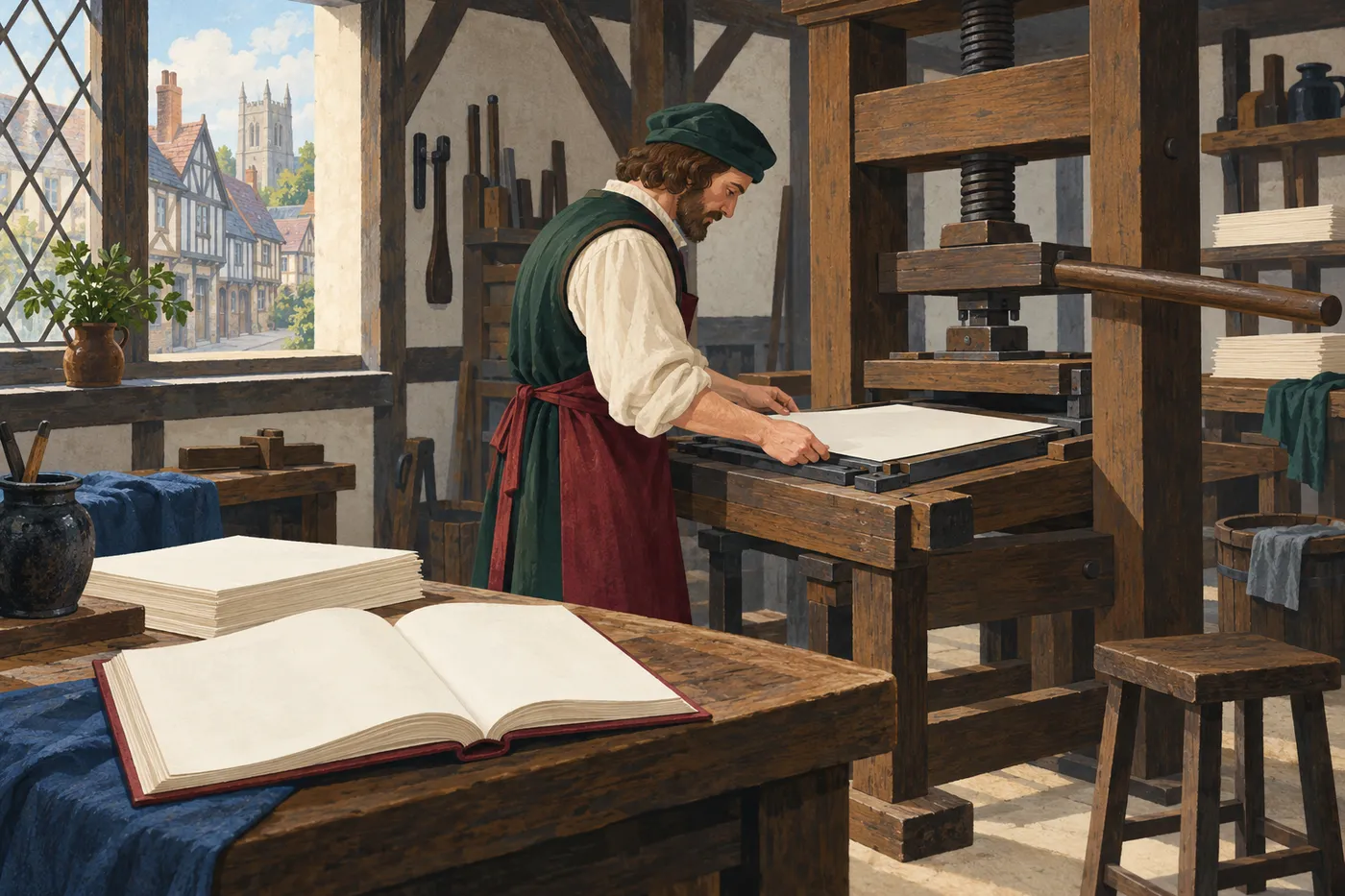
- 1476Caxton establishes a printing press in EnglandPrinted books reach more readers. Printers' choices help spread written conventions, although spelling continues to vary.
- Around 1600Shakespeare writes in Early Modern EnglishEnglish is recognisably closer to today's language. Writers use a growing vocabulary, while pronunciation and grammar continue to change.
- 1755Samuel Johnson publishes his dictionaryThe dictionary explains words and illustrates their use. It becomes influential, but English already has a long history of dictionaries and writing conventions.
- 1800sEmpire, industry and migration expand EnglishBritish colonial rule spreads English, often through unequal power. Trade and migration also increase contact. Scientific and industrial work needs more specialist vocabulary.
- 1900sBroadcasting and international media widen its reachRadio, cinema and television carry English to large audiences. American cultural and economic influence helps spread it, alongside the continued growth of many English varieties.
- 1990s to todayOnline communities create and share new usesPeople use English across borders in work, education and online life. New expressions spread quickly, and speakers adapt English to their own communities.
Is Shakespeare's English Old English?
| Stage | Useful guide | What to expect |
|---|---|---|
| Old English | About 450-1100 | Very different words, endings and spelling; most learners need a translation. |
| Middle English | About 1100-1500 | More familiar vocabulary, but spelling and grammar still look different. |
| Early Modern English | From about 1500 | The language of Shakespeare, with older forms such as thou. |
| English today | Many present-day varieties | Shared forms alongside differences in accent, vocabulary and use. |
Why do we say cow but beef?
The animal names cow and sheep have Old English roots. The meat words beef and mutton came through French. A language can keep an older word and add a borrowed one. Today these pairs name different things.
Can you match each animal with its meat?
Find:
Why is English spelling different from pronunciation?
Speech and writing change at different speeds. During the Great Vowel Shift, roughly between the fifteenth and seventeenth centuries, many long vowel sounds changed. Spellings often kept older patterns. Borrowed words brought other spelling patterns too, so one event cannot explain every difficult spelling.
Please write your name here.
A modern sentence with a familiar spelling.
The long vowel in name has changed since Middle English; the written form has kept a much older pattern.
Did English become better as it changed?
A standard form makes shared writing easier, but a regional variety has patterns too. The course makes this distinction in module 82. A standard spelling is not a measure of a speaker's intelligence. History explains how conventions developed; it also shows that language keeps changing.