Relato adaptado al nivel

Relato en inglés de B1: la carta del desván

Lee un relato en inglés de B1 sobre un misterio familiar en Yorkshire, una carta antigua y un secreto, con ocho glosas, pasado perfecto y preguntas de comprensión.

¿Qué vas a practicar?

Una carta antigua cambia lo que Ella sabe de su abuela. Sigue lo que ocurrió primero: had hidden señala un momento anterior al hallazgo de la carta. No uses el pasado perfecto para todos los acontecimientos; usa el pasado simple para que avance la historia.

Amarillo la idea para recordarAzul inglés para aprenderRojo cuidado con esto

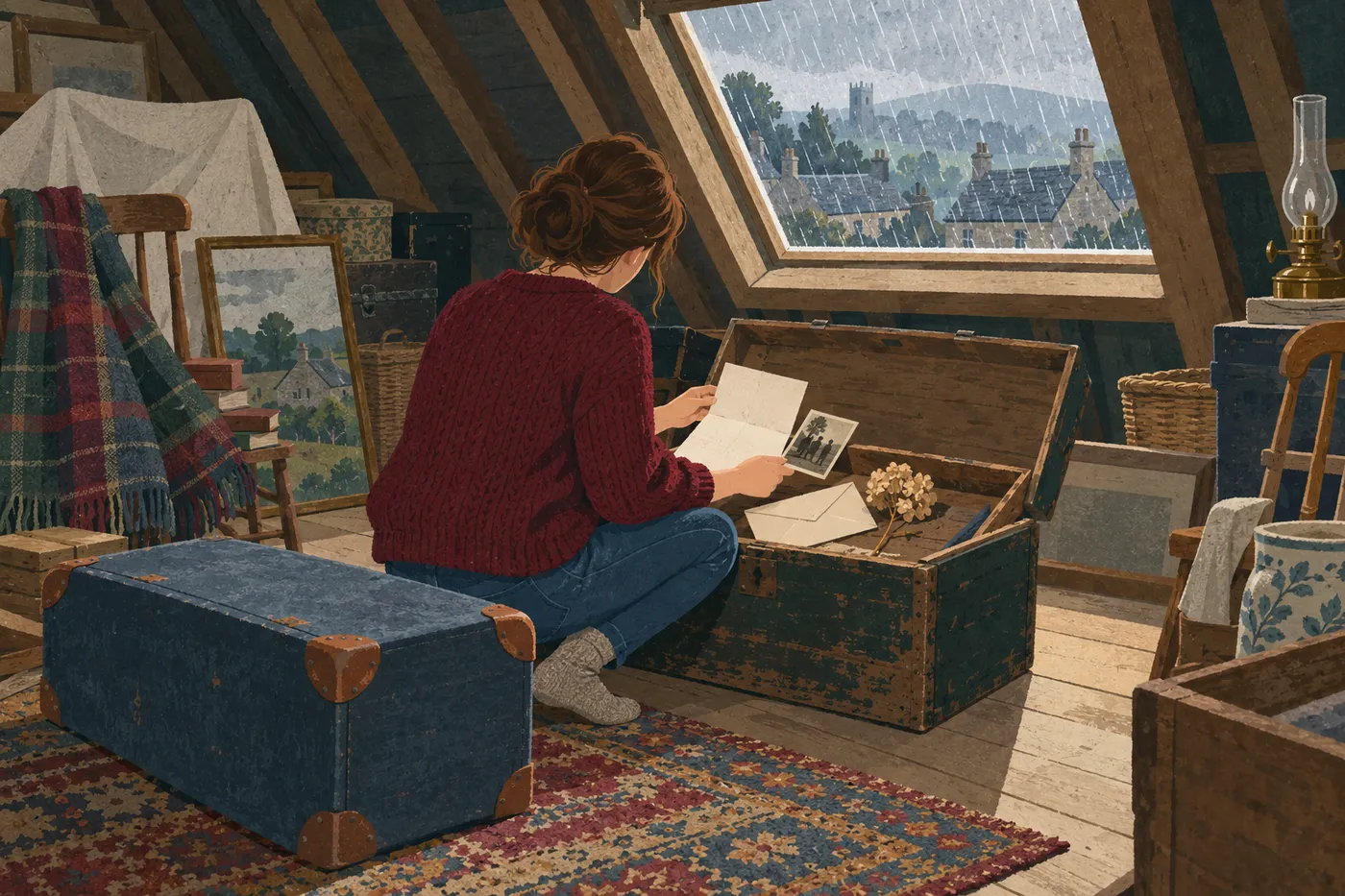
Una mujer encuentra una carta y una fotografía en una caja de madera, en un desván mientras llueve.
La carta antigua revela lo que Alice había escondido años antes: had hidden. Ilustración: Atelier

Una casa en Yorkshire

The letter in the attic

Rain was beating against the windows of her grandmother's house in Yorkshire. Ella was helping to clear the attic1 when she found a small wooden box behind a suitcase. Inside lay a photograph, a dried flower and an envelope2 addressed to Alice, her grandmother.

Someone had opened the letter before. Ella carefully unfolded3 the paper. It was dated 1962.

"Dear Alice, I arrived in London yesterday. The room is tiny, but I can practise my violin here. Your money paid for the train ticket. Please keep this letter somewhere safe. Dad mustn't find out you've helped me. Your loving sister, Rose."

Ella read the last line twice. Her grandmother had always said she was an only child4. Yet the girl in the photograph had Alice's eyes. On the back, someone had written two names: Alice and Rose.

Downstairs, Alice was making tea. When Ella put the photograph on the table, her grandmother stopped pouring.

"Where did you find that?"

"In the attic. Who's Rose?"

For a moment, Alice watched the rain. Then she sat down.

"My younger sister. Our father wanted her to stay and work in his shop. She wanted to play music. I had saved a little money, so I sent it to her."

"Why didn't you tell us?"

"At first, I was afraid of upsetting5 Dad. Later, I didn't know how to begin. Rose and I lost touch6 after she moved again. I had hidden the letter so well that I forgot where it was."

Ella looked at the photograph. All those years, the answer had been upstairs.

"We could try to find her," she said.

Alice nodded7. "There's one thing I remember. She played in a little orchestra in Leeds."

Ella reached for her phone. The tea had gone cold8, but neither of them noticed.

Con palabras más sencillas

It is raining. Ella finds a box in her grandmother's attic. There is a letter to her grandmother, Alice, inside.

The letter is already open. Ella opens out the paper and sees the date: 1962.

Rose writes that she has arrived in London. Alice sent her money for the train. Rose asks Alice to keep their secret.

Ella is surprised. Alice said she had no brothers or sisters. The photograph shows Alice and Rose together.

Alice is making tea. She stops when she sees the photograph.

Alice asks where Ella found the photograph.

Ella says it was in the attic and asks about Rose.

Alice is quiet, then sits down.

Alice says Rose is her younger sister. Rose wanted to be a musician, but their father wanted her to work in his shop. Alice helped Rose with money.

Ella asks why Alice kept this secret.

Alice was worried about her father's feelings. Later, it became hard to talk about Rose. The sisters stopped speaking, and Alice forgot where she had put the letter.

The letter was in the attic for many years.

Ella suggests looking for Rose.

Alice agrees. She remembers that Rose played music in Leeds.

Ella gets her phone to start looking. They are too interested to notice their cold tea.

¿Qué objetos te ayudan a seguir el misterio?

Encuentra los objetos del relato

¿Cómo muestra el pasado perfecto lo que ocurrió primero?

Acontecimiento anterior y posterior
Oración del relatoPrimeroDespués
Someone had opened the letter before Ella found it.Alguien abrió la carta.Ella la encontró.
Alice had saved some money before she sent it to Rose.Alice ahorró dinero.Alice envió el dinero.
Alice had hidden the letter before Ella discovered it.Alice escondió la carta.Ella la descubrió.

Forma el pasado perfecto con had + participio pasado: had saved, had hidden, had gone. La forma es la misma con I, she y they. Cuando el orden ya está claro, el pasado simple permite contar los acontecimientos siguientes: Ella read the letter. She went downstairs.

  • Alice had hide the letter.Alice had hidden the letter.

    Usa el participio pasado hidden después de had. Las tres formas son hide - hid - hidden.

  • Ella didn't knew about Rose.Ella didn't know about Rose.

    Usa la forma base después de didn't. Didn't ya indica pasado, así que escribe know, no knew.

¿Has entendido la carta y el secreto?

Pregunta 1No necesitas una cuenta
¿Por qué le sorprenden a Ella las palabras «Your loving sister»?

Elige una respuesta.

Respuesta y explicación

Alice had told her she had no brothers or sisters.. Alice había dicho que era hija única, only child. La carta y los dos nombres de la fotografía cuentan otra historia.

Pregunta 2No necesitas una cuenta
¿Qué había hecho Alice antes de que Rose viajara a Londres?

Elige una respuesta.

Respuesta y explicación

She had sent Rose some money.. Rose usó el dinero de Alice para comprar el billete de tren. La carta dice que llegó a Londres el día anterior a escribirla.

Pregunta 3No necesitas una cuenta
¿Qué les ocurrió a las hermanas después de que Rose volviera a mudarse?

Elige una respuesta.

Respuesta y explicación

They stopped keeping in touch.. Alice usa lost touch para decir que perdieron el contacto. Esto significa que dejaron de escribirse, llamarse o verse.

Pregunta 4No necesitas una cuenta
¿Qué ocurrió primero en «Alice had hidden the letter before Ella discovered it»?

Elige una respuesta.

Respuesta y explicación

Alice hid the letter.. Had hidden sitúa la acción de Alice antes del descubrimiento de Ella. El pasado perfecto señala el acontecimiento anterior.

¿Cómo podrías continuar el relato?

Escribe entre 60 y 80 palabras sobre la primera llamada de Ella a la orquesta. ¿Quién responde? ¿Qué recuerdan de Rose? Incluye un acontecimiento anterior con had + participio pasado y usa después el pasado simple para los acontecimientos siguientes.

Elaborado a partir de