Histoire adaptée au niveau

Histoire courte en anglais B1 : la lettre du grenier

Lisez une histoire courte en anglais B1 sur un mystère familial du Yorkshire, une vieille lettre et un secret, avec huit glosses, le past perfect et des questions de compréhension.

Qu’allez-vous pratiquer ?

Une vieille lettre change ce qu’Ella sait de sa grand-mère. Suivez ce qui s’est passé en premier : had hidden renvoie à un moment antérieur à la découverte de la lettre. N’utilisez pas le past perfect pour chaque événement ; utilisez le prétérit pour faire avancer le récit.

Jaune l’idée à retenirBleu l’anglais à retenirRouge point de vigilance

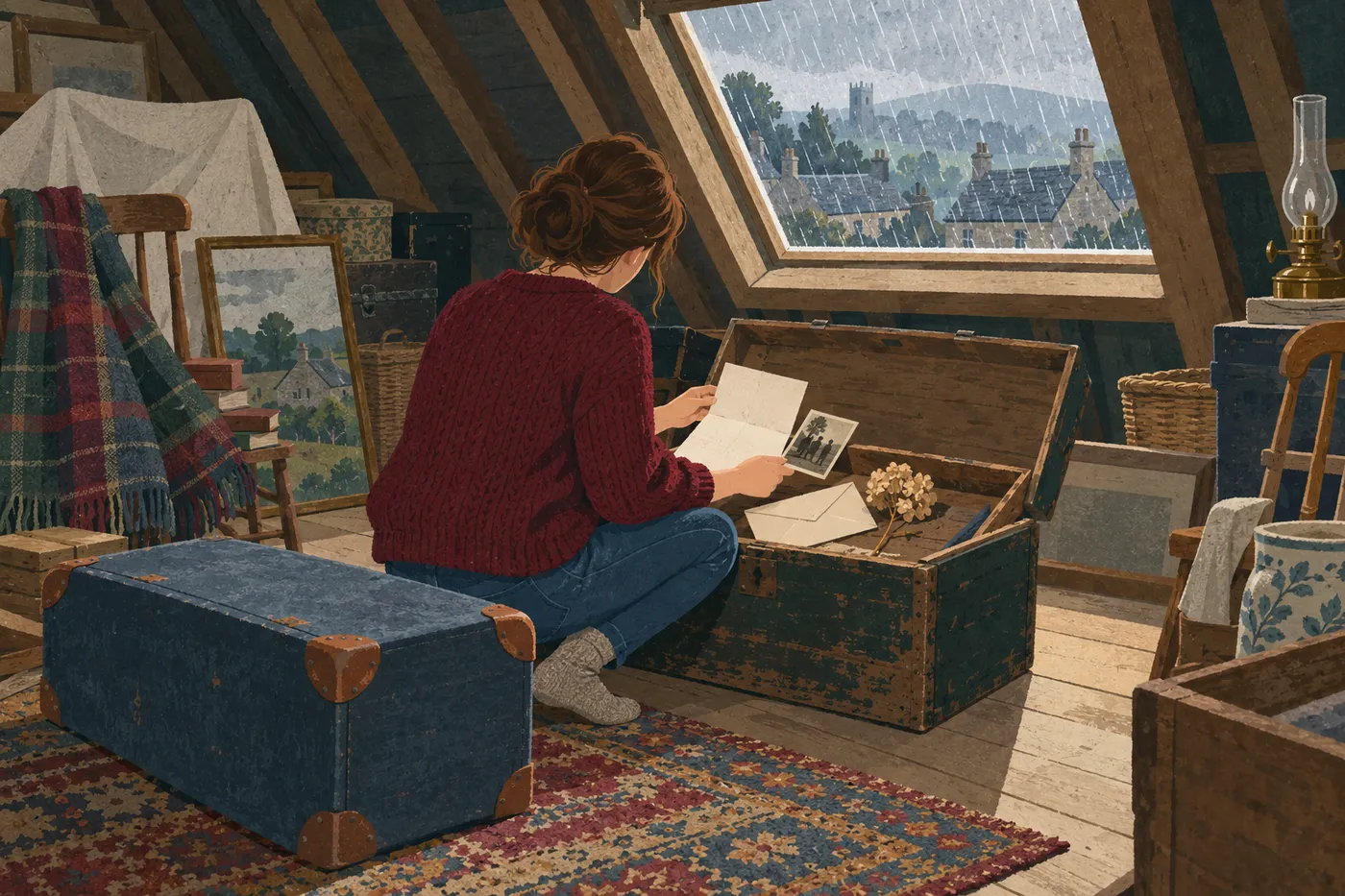
Une femme trouve une lettre et une photographie dans une boîte en bois, dans un grenier par temps de pluie.
La vieille lettre révèle ce qu’Alice avait caché des années auparavant : had hidden. Illustration : Atelier

Une maison dans le Yorkshire

The letter in the attic

Rain was beating against the windows of her grandmother's house in Yorkshire. Ella was helping to clear the attic1 when she found a small wooden box behind a suitcase. Inside lay a photograph, a dried flower and an envelope2 addressed to Alice, her grandmother.

Someone had opened the letter before. Ella carefully unfolded3 the paper. It was dated 1962.

"Dear Alice, I arrived in London yesterday. The room is tiny, but I can practise my violin here. Your money paid for the train ticket. Please keep this letter somewhere safe. Dad mustn't find out you've helped me. Your loving sister, Rose."

Ella read the last line twice. Her grandmother had always said she was an only child4. Yet the girl in the photograph had Alice's eyes. On the back, someone had written two names: Alice and Rose.

Downstairs, Alice was making tea. When Ella put the photograph on the table, her grandmother stopped pouring.

"Where did you find that?"

"In the attic. Who's Rose?"

For a moment, Alice watched the rain. Then she sat down.

"My younger sister. Our father wanted her to stay and work in his shop. She wanted to play music. I had saved a little money, so I sent it to her."

"Why didn't you tell us?"

"At first, I was afraid of upsetting5 Dad. Later, I didn't know how to begin. Rose and I lost touch6 after she moved again. I had hidden the letter so well that I forgot where it was."

Ella looked at the photograph. All those years, the answer had been upstairs.

"We could try to find her," she said.

Alice nodded7. "There's one thing I remember. She played in a little orchestra in Leeds."

Ella reached for her phone. The tea had gone cold8, but neither of them noticed.

En termes plus simples

It is raining. Ella finds a box in her grandmother's attic. There is a letter to her grandmother, Alice, inside.

The letter is already open. Ella opens out the paper and sees the date: 1962.

Rose writes that she has arrived in London. Alice sent her money for the train. Rose asks Alice to keep their secret.

Ella is surprised. Alice said she had no brothers or sisters. The photograph shows Alice and Rose together.

Alice is making tea. She stops when she sees the photograph.

Alice asks where Ella found the photograph.

Ella says it was in the attic and asks about Rose.

Alice is quiet, then sits down.

Alice says Rose is her younger sister. Rose wanted to be a musician, but their father wanted her to work in his shop. Alice helped Rose with money.

Ella asks why Alice kept this secret.

Alice was worried about her father's feelings. Later, it became hard to talk about Rose. The sisters stopped speaking, and Alice forgot where she had put the letter.

The letter was in the attic for many years.

Ella suggests looking for Rose.

Alice agrees. She remembers that Rose played music in Leeds.

Ella gets her phone to start looking. They are too interested to notice their cold tea.

Quels objets vous aident à suivre le mystère ?

Retrouvez les objets de l’histoire

Comment le past perfect indique-t-il ce qui s’est passé en premier ?

Événement antérieur et événement suivant
Phrase de l’histoireD’abordEnsuite
Someone had opened the letter before Ella found it.Quelqu’un a ouvert la lettre.Ella l’a trouvée.
Alice had saved some money before she sent it to Rose.Alice a économisé de l’argent.Alice a envoyé l’argent.
Alice had hidden the letter before Ella discovered it.Alice a caché la lettre.Ella l’a découverte.

Formez le past perfect avec had + participe passé : had saved, had hidden, had gone. La forme est identique avec I, she et they. Une fois l’ordre établi, le prétérit peut raconter la suite : Ella read the letter. She went downstairs.

  • Alice had hide the letter.Alice had hidden the letter.

    Utilisez le participe passé hidden après had. Les trois formes sont hide - hid - hidden.

  • Ella didn't knew about Rose.Ella didn't know about Rose.

    Utilisez la forme de base après didn't. Didn't indique déjà le passé ; écrivez donc know, pas knew.

Avez-vous compris la lettre et le secret ?

Question 1Aucun compte nécessaire
Pourquoi les mots « Your loving sister » surprennent-ils Ella ?

Choisissez une seule réponse.

Réponse et explication

Alice had told her she had no brothers or sisters.. Alice avait dit qu’elle était enfant unique : only child. La lettre et les deux noms sur la photographie racontent autre chose.

Question 2Aucun compte nécessaire
Qu’avait fait Alice avant le départ de Rose pour Londres ?

Choisissez une seule réponse.

Réponse et explication

She had sent Rose some money.. Rose a utilisé l’argent d’Alice pour acheter le billet de train. La lettre indique qu’elle est arrivée à Londres la veille de sa rédaction.

Question 3Aucun compte nécessaire
Qu’est-il arrivé aux sœurs après le nouveau déménagement de Rose ?

Choisissez une seule réponse.

Réponse et explication

They stopped keeping in touch.. Alice dit qu’elles ont perdu contact : lost touch. Cela signifie qu’elles ont cessé de s’écrire, de s’appeler ou de se voir.

Question 4Aucun compte nécessaire
Quel événement est arrivé en premier dans « Alice had hidden the letter before Ella discovered it » ?

Choisissez une seule réponse.

Réponse et explication

Alice hid the letter.. Had hidden place l’action d’Alice avant la découverte d’Ella. Le past perfect indique l’événement antérieur.

Comment pourriez-vous continuer l’histoire ?

Rédigez 60 à 80 mots sur le premier appel d’Ella à l’orchestre. Qui répond ? Que se rappelle cette personne de Rose ? Incluez un événement antérieur avec had + participe passé, puis utilisez le prétérit pour les événements suivants.

Établi à partir de