British and American English differences: examples
Learn British and American English differences in vocabulary, spelling and everyday usage, with clear examples and practice questions on common contrasts.
In short
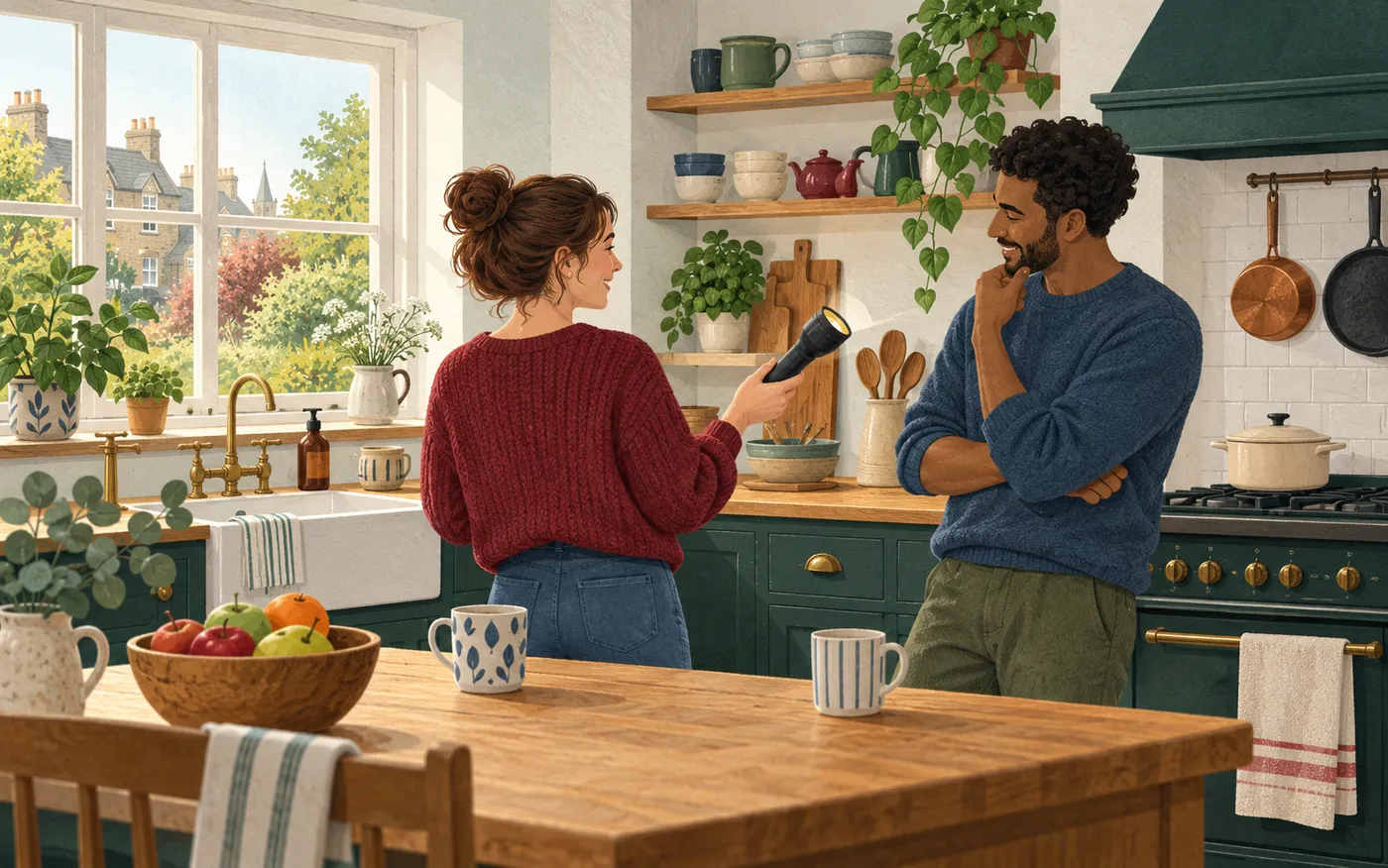
British and American English share most of their grammar. The useful differences are everyday words, spelling choices and a few grammar patterns: British a torch is American a flashlight. Learn to recognise both, and use a consistent style in your writing. A common American form is not an English mistake.
Yellow the idea to rememberBlue English to learnRed watch out
Which spellings are different in British and American English?
| British English | American English | What to notice |
|---|---|---|
| colour, favourite | color, favorite | Many British -our words have American -or forms. |
| centre, theatre | center, theater | These British -re endings become -er. |
| travelled, travelling | traveled, traveling | British usage usually doubles the l here. |
| organise, recognise | organize, recognize | Atelier uses -ise for these verbs. |
| a licence / to license | a license / to license | British licence is the noun; license is the verb. |
| practice / to practise | practice / to practice | British practice is the noun; practise is the verb. |
| a television programme | a television program | For software, both use computer program. |
Some British publishers use organize and recognize. Those spellings are also British; -ise is a style choice used here. Learn whole words rather than replacing every s with z: advertise is written with s in both varieties.
I need more practice, so I'll practise after work.
The noun names the activity; the verb says what I will do.
This is the British distinction. American English uses practice for both.
Which everyday words should you recognise?
The cards give British words first and the common American word in the meaning. Most speakers understand many of these pairs. If a word is unclear, name or describe the object: the small light in my bag.
Eight objects and places: British words first
Find:
Which words can cause a misunderstanding?
| Word | Common British meaning | Common American meaning |
|---|---|---|
| pants | underwear | trousers |
| chips | fried potato pieces, often fairly thick | thin, crunchy potato slices |
| first floor | the floor above the ground floor | the floor at street level |
| football | the sport played mainly by kicking a round ball | American football; the round-ball sport is usually soccer |
For directions, check the floor number in the building. A British second-floor flat is normally two floors above street level. In American English it would usually be a third-floor apartment. Labels in a particular building may vary, so the lift buttons can help.
Which grammar differences will you hear?
| Situation | British English | Common American English |
|---|---|---|
| Recent action with a result now | I've just eaten. | I just ate. |
| A change up to now | The weather has got colder. | The weather has gotten colder. |
| A group seen as its members | The team are wearing their new shirts. | The team is wearing its new shirts. |
| A patient receiving care | She's in hospital. | She's in the hospital. |
| A weekend plan | We're meeting at the weekend. | We're meeting on the weekend. |
These are common preferences. American speakers also use the present perfect. British English allows The team is when the group is seen as one unit. Both varieties use have got for possession: I've got a car. American I've gotten a car means that I have obtained one.
She's in hospital. I'm waiting outside the hospital.
She is a patient; I am outside a particular building.
The first phrase follows the British course pattern. The article in the second phrase identifies the building.
How do you keep your English consistent?
- Editor
You've written "colour" and "center". Which spelling style are you using?
The message mixes two spelling styles.
- You
British English. I'll change "center" to "centre".
You choose the British form.
- Editor
And this is a computer program, so keep "program".
The software word has the same spelling in both varieties.
Keep the same spelling style through a piece of writing. When you quote a person's exact words, keep their wording. You can still use an American word when the setting needs it: asking for the subway in New York is clear and natural.