Common English idioms and what they really mean
Learn common English idioms with clear meanings, natural examples and context clues, then check which expressions fit in short practice questions.
In short
An idiom has a meaning you learn as a whole phrase: a piece of cake can mean an easy task. Reading each word separately can give you the wrong meaning, so learn the phrase with its situation and tone.
Yellow the idea to rememberBlue English to learnRed watch out
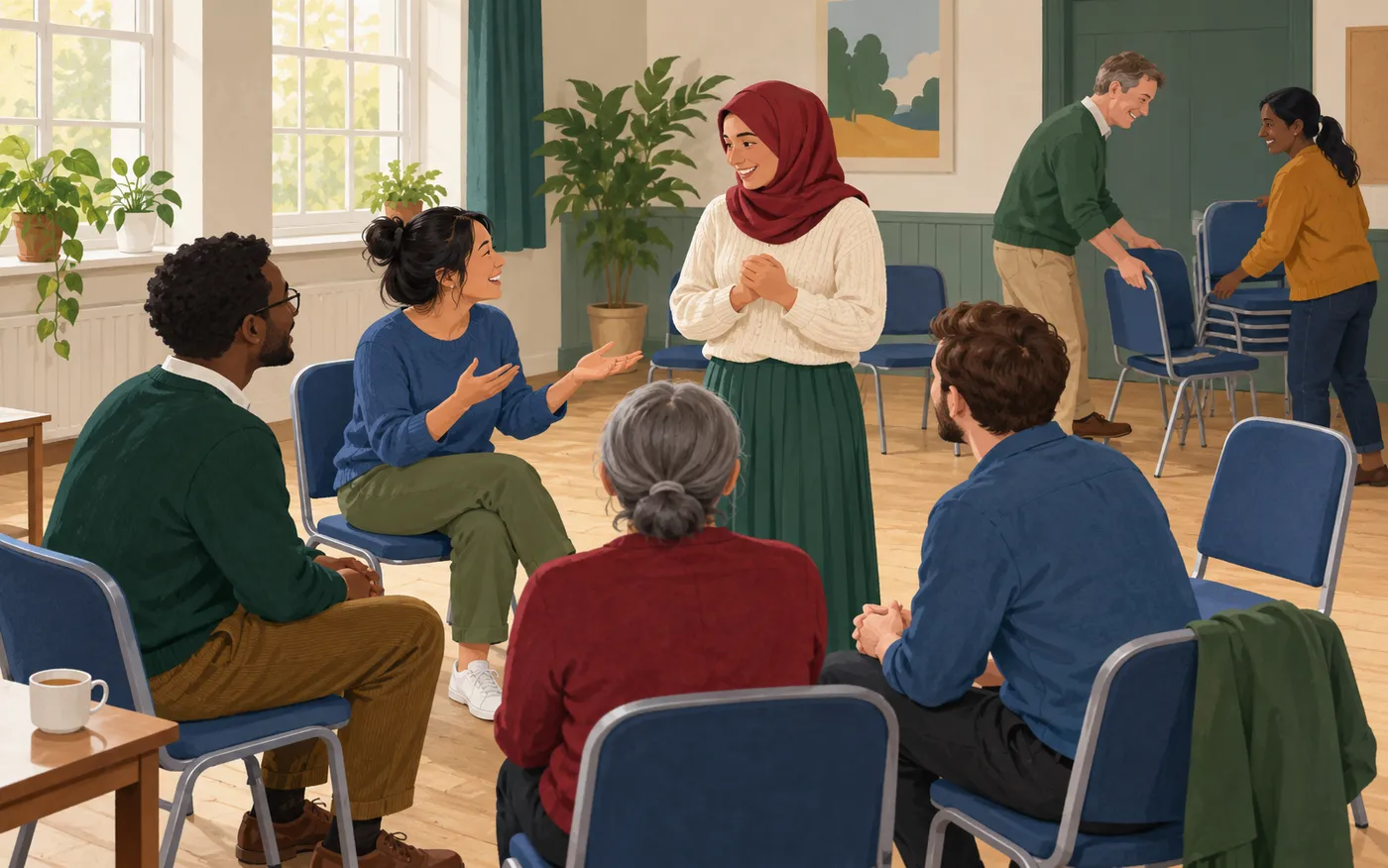
Which idioms help you talk about people and conversations?
| Idiom | Meaning | Example | Use note |
|---|---|---|---|
| break the ice | help people feel comfortable when they first meet | A quick game helped break the ice at the workshop. | Friendly and informal. Use break the ice, with the. |
| be on the same page | understand or agree about the same thing | Before we send the invitation, let's check we're on the same page. | Common in work conversations. Say what you agree about. |
| give someone a hand | help someone | Could you give me a hand with these chairs? | Friendly request. A hand means help here, rather than a body part. |
| take the floor | start speaking to a group | After the chair's introduction, Niamh took the floor. | Useful for meetings and discussions. The past form is took. |
| keep an eye on | watch or check something to make sure it is all right | Could you keep an eye on my bag while I get a coffee? | An informal request to watch something; it does not mean stare at it. |
Which idioms describe memory, surprises and feelings?
| Idiom | Meaning | Example | Use note |
|---|---|---|---|
| ring a bell | seem familiar | Her name rings a bell, but I can't remember where we met. | Often used about a name, place or detail. You recognise it but cannot remember it clearly. |
| slip someone's mind | be forgotten by someone | I'm sorry I didn't call. It completely slipped my mind. | Informal explanation for forgetting. Add an apology when someone was waiting. |
| out of the blue | unexpectedly | An old school friend rang me out of the blue. | Used for a surprise. Keep out of the blue together. |
| once in a blue moon | very rarely | We eat at that expensive restaurant once in a blue moon. | Informal. It gives a general idea of frequency, rather than an exact number. |
| feel under the weather | feel slightly ill | I'm feeling under the weather, so I'll stay at home tonight. | Informal. Usually describes a mild illness or a general feeling of being unwell. |
Which idioms describe tasks, costs and plans?
| Idiom | Meaning | Example | Use note |
|---|---|---|---|
| be a piece of cake | be very easy | With the new app, booking a seat was a piece of cake. | Informal. It can sound unkind if someone else found the same task difficult. |
| cost an arm and a leg | be very expensive | The repairs cost an arm and a leg. | Informal and strong. Use cost for the past too: It cost a lot. |
| be under pressure | feel that you must do something difficult or urgent | We were under pressure to finish the packs by Friday. | Used in everyday and work conversations. Under pressure to do names the demand. |
| be on track | be making the progress needed to achieve a plan | We're on track to finish the captions by Thursday. | Useful in progress updates. It describes progress, rather than completed work. |
| be up in the air | be uncertain or undecided | Our moving date is still up in the air. | Informal. Useful when a plan or decision is not settled. |
Which idioms help you talk about choices and results?
| Idiom | Meaning | Example | Use note |
|---|---|---|---|
| be in the same boat | have the same difficult situation as someone else | Neither of us has found a flat yet. We're in the same boat. | Informal and often sympathetic. Usually used for a shared problem. |
| be on the fence | be unable or unwilling to choose between options | I'm still on the fence about joining the evening class. | Informal. About introduces the choice you have not made. |
| get the ball rolling | start an activity or process | I'll send the first email to get the ball rolling. | Common in group work. Follow it with a specific first action. |
| call it a day | stop working or doing an activity for now | We've checked all the labels. Let's call it a day. | Informal. Often a suggestion to stop after doing enough work. |
| in the long run | over a long period, considering the final result | The stronger shelves cost more now, but they'll save us money in the long run. | Useful in discussion. Compare a present cost with a later benefit. |
How do you know whether a phrase has its ordinary meaning?
a piece of cakefood on a plate
Focus: The situation is about eating.
Would you like a piece of cake with your tea?
Someone offers you some cake.
a piece of cakea very easy task
Focus: The situation is about difficulty.
The first exercise was a piece of cake.
The speaker found it very easy.
The situation helps you choose the meaning. In a short formal message, plain words can be clearer: The date is undecided is more direct than The date is up in the air. In a friendly conversation, either can fit.
Can you match eight idioms to their meanings?
Tap one on the left, then its partner on the right.